
美国成年人中心血管代谢指数与骨密度的非线性关系:体脂百分比的中介作用。
Nonlinear relationship between cardiometabolic index and bone mineral density in U.S. adults: the mediating role of percent body fat.
机构信息
Department of Urology, Renmin Hospital, Hubei University of Medicine, Shiyan, 442000, Hubei, People's Republic of China.
School of Public Health, Ningxia Medical University, Yinchuan, 750004, Ningxia, China.
出版信息
Sci Rep. 2024 Sep 28;14(1):22449. doi: 10.1038/s41598-024-73427-3.
BACKGROUND
Both lipid metabolism and obesity are crucial factors in osteoporosis, influencing the relevance of the cardiometabolic index (CMI), a new body fat index incorporating obesity and lipid metrics. Our study aims to explore the relationship between CMI and lumbar spine bone mineral density (BMD) and the mediating role of body fat percentage.
METHODS
Utilizing the National Health and Nutrition Examination Survey (NHANES) data from 2011 to 2018, we conducted a cross-sectional analysis. We employed multiple linear regression models, subgroup analyses, generalized additive models (GAM), smooth curve fitting, and mediation analysis to evaluate the linear and nonlinear relationships between CMI and lumbar spine BMD.
RESULTS
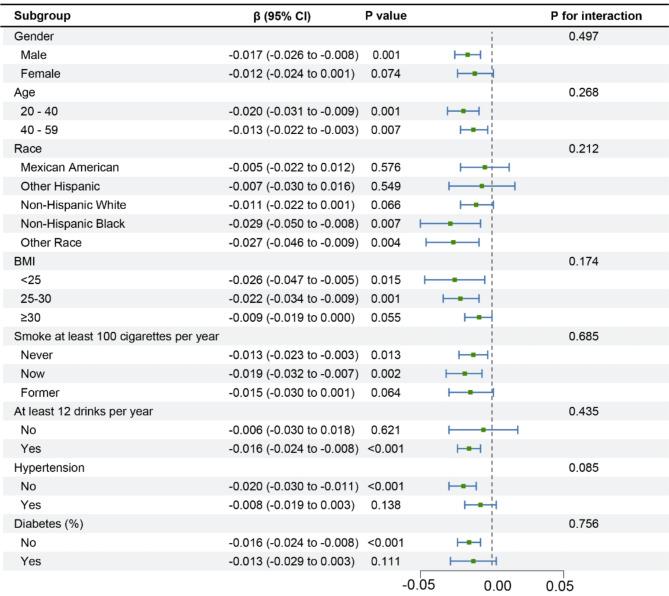
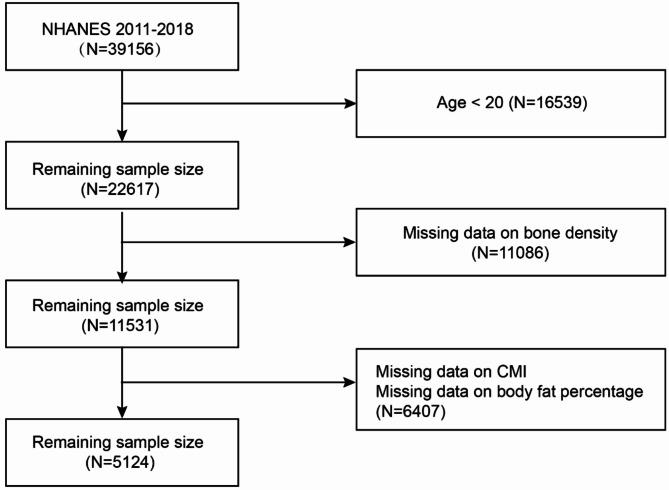
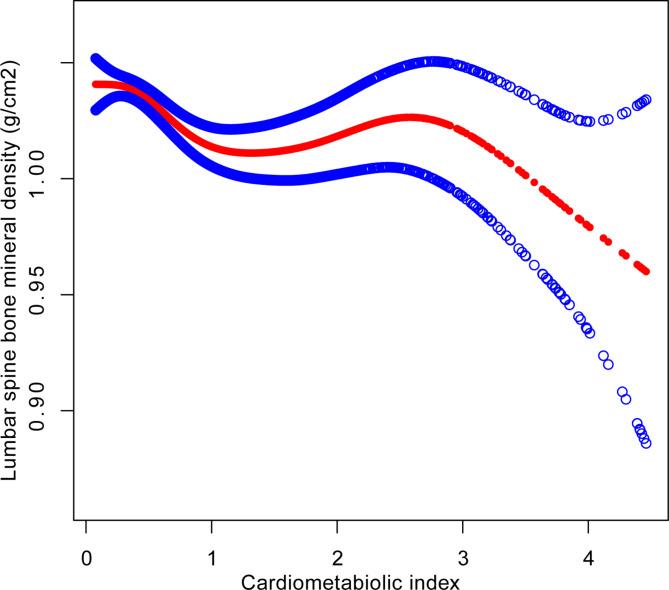
The study involved 5,124 participants with an average lumbar spine BMD of 1.03 ± 0.15 g/cm. We identified a negative correlation between CMI and lumbar spine BMD (β = -0.015; 95% CI: -0.023, -0.008). Nonlinear associations were evident, with inflection points at CMI values of 1.12 and 2.86. Subgroup analyses showed consistent negative correlations across all categories without significant differences (p for interaction > 0.05). Moreover, body fat percentage negatively correlated with BMD (β = -0.005; 95% CI: -0.006, -0.004) and mediated 9.41% of the relationship between CMI and BMD.
CONCLUSION
Increased CMI levels are associated with lower lumbar spine BMD, with body fat percentage significantly mediating this relationship. This underscores the importance of managing body composition in the context of bone health, highlighting CMI's potential utility in osteoporosis risk assessment.
背景
脂质代谢和肥胖都是骨质疏松症的关键因素,影响了包含肥胖和脂质指标的新体脂指数——心脏代谢指数(CMI)的相关性。我们的研究旨在探讨 CMI 与腰椎骨密度(BMD)的关系,以及体脂百分比的中介作用。
方法
利用 2011 年至 2018 年的国家健康和营养调查(NHANES)数据,我们进行了一项横断面分析。我们采用了多元线性回归模型、亚组分析、广义加性模型(GAM)、平滑曲线拟合和中介分析来评估 CMI 和腰椎 BMD 之间的线性和非线性关系。
结果
该研究共纳入了 5124 名参与者,平均腰椎 BMD 为 1.03±0.15 g/cm。我们发现 CMI 与腰椎 BMD 呈负相关(β=-0.015;95%CI:-0.023,-0.008)。存在非线性关系,在 CMI 值为 1.12 和 2.86 时出现拐点。亚组分析显示,在所有类别中都存在一致的负相关关系,且交互作用的 p 值均大于 0.05。此外,体脂百分比与 BMD 呈负相关(β=-0.005;95%CI:-0.006,-0.004),并介导了 CMI 与 BMD 之间 9.41%的关系。
结论
CMI 水平升高与腰椎 BMD 降低相关,体脂百分比显著介导了这种关系。这突显了在骨骼健康背景下管理身体成分的重要性,同时强调了 CMI 在骨质疏松症风险评估中的潜在效用。
 Zotero 插件