
直接口服抗凝剂时代基于简化的肺栓塞严重程度指数评分对肺栓塞患者进行家庭治疗选择和低危患者识别。
Selection of Home Treatment and Identification of Low-Risk Patients With Pulmonary Embolism Based on Simplified Pulmonary Embolism Severity Index Score in the Era of Direct Oral Anticoagulants.
机构信息
Department of Cardiovascular Medicine, Graduate School of Medicine Kyoto University Kyoto Japan.
Department of Clinical Epidemiology Hyogo College of Medicine Nishinomiya Japan.
出版信息
J Am Heart Assoc. 2024 Oct;13(19):e034953. doi: 10.1161/JAHA.124.034953. Epub 2024 Sep 30.
BACKGROUND
The simplified Pulmonary Embolism Severity Index (sPESI) score could help identify low-risk patients with pulmonary embolism for home treatment. However, the application of the sPESI score and selection for home treatment have not been fully evaluated in the direct oral anticoagulants era.
METHODS AND RESULTS
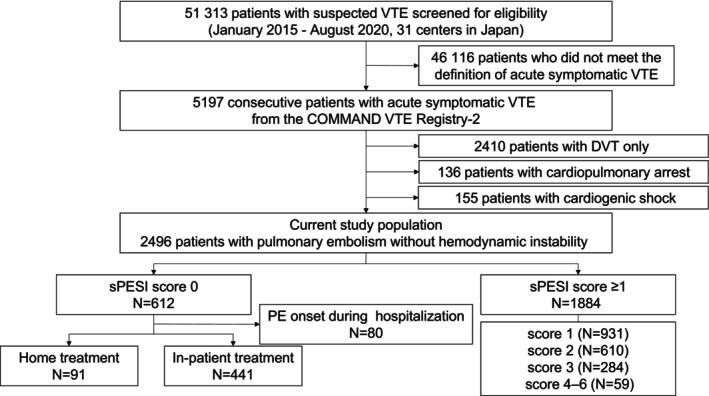
The COMMAND VTE (Contemporary Management and Outcomes in Patients With Venous Thromboembolism) Registry-2 is a multicenter registry enrolling consecutive patients with acute symptomatic venous thromboembolism. The current study population consists of 2496 patients with hemodynamically stable pulmonary embolism (2100 patients [84%] treated with direct oral anticoagulants), who were divided into 2 groups: sPESI scores of 0 and ≥1. We investigated the 30-day mortality, home treatment prevalence, and factors predisposing to home treatment using the Kaplan-Meier method and logistic regression model. Patients with an sPESI score of 0 accounted for 612 (25%) patients, and only 17% among 532 patients with out-of-hospital pulmonary embolism were treated at home. The cumulative 30-day mortality was lower in patients with an sPESI score of 0 than the score of ≥1 (0% and 4.8%, log-rank <0.001). There was no patient with 30-day mortality with an sPESI score of 0. Independent factors for home treatment among out-of-hospital pulmonary embolism patients with an sPESI score of 0 were no transient risk factors for venous thromboembolism, no cardiac biomarker elevation, and direct oral anticoagulants use in the acute phase.
CONCLUSIONS
The 30-day mortality rate was notably low in an sPESI score of 0. Nevertheless, only a minority of patients with an sPESI score of 0 were treated at home between 2015 and 2020 after the introduction of direct oral anticoagulants for venous thromboembolismin Japan.
背景
简化的肺栓塞严重程度指数(sPESI)评分有助于识别低危肺栓塞患者,以便进行家庭治疗。然而,在直接口服抗凝剂时代,sPESI 评分的应用和家庭治疗的选择尚未得到充分评估。
方法和结果
COMMAND VTE(静脉血栓栓塞症患者的当代管理和结局)登记-2 是一项多中心登记研究,纳入了连续的急性有症状静脉血栓栓塞症患者。本研究人群包括 2496 例血流动力学稳定的肺栓塞患者(2100 例[84%]接受直接口服抗凝剂治疗),分为 sPESI 评分为 0 和≥1 两组。我们使用 Kaplan-Meier 法和 logistic 回归模型调查了 30 天死亡率、家庭治疗的流行率以及家庭治疗的倾向因素。sPESI 评分为 0 的患者占 612 例(25%),仅有 532 例院外肺栓塞患者中的 17%在家中接受治疗。sPESI 评分为 0 的患者的 30 天累积死亡率低于评分≥1 的患者(0%和 4.8%,对数秩检验<0.001)。sPESI 评分为 0 的患者无一例在 30 天内死亡。sPESI 评分为 0 且院外肺栓塞患者的家庭治疗的独立因素是没有短暂的静脉血栓栓塞危险因素、没有心脏生物标志物升高以及在急性期使用直接口服抗凝剂。
结论
sPESI 评分为 0 的患者 30 天死亡率显著降低。然而,在直接口服抗凝剂用于日本静脉血栓栓塞症后,2015 年至 2020 年间,sPESI 评分为 0 的患者中仅有少数人在家中接受治疗。


 Zotero 插件