
175 例中国胃癌患者的突变特征。
Mutational signatures in 175 Chinese gastric cancer patients.
机构信息
Shanghai Key Laboratory of Biliary Tract Disease Research, Shanghai, 200092, P. R. China.
Department of General Surgery, Xinhua Hospital, Shanghai JiaoTong University School of Medicine, Shanghai, 200092, P. R. China.
出版信息
BMC Cancer. 2024 Sep 30;24(1):1208. doi: 10.1186/s12885-024-12968-2.
BACKGROUND
Gastric cancer (GC), a molecularly heterogeneous disease, is the third leading cause of cancer death worldwide. The majority of GC cases worldwide occur in East Asia, predominantly China. Mutational Signature Framework offers an elegant approach to identify mutational processes present in tumors.
METHODS
To identify mutational signature patterns, we conducted whole exome sequencing (WES) analysis in Chinese patients with GC. Mutect2 and MutsigCV were used to identify significantly mutated genes in 175 Chinese GC cases using paired tumor-normal tissues. We investigated mutational signatures using Catalogue of Somatic Mutations in Cancer (COSMIC) Version 2 (V2) and Version 3 (V3).
RESULTS
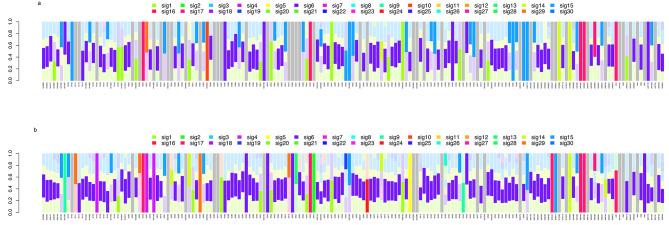
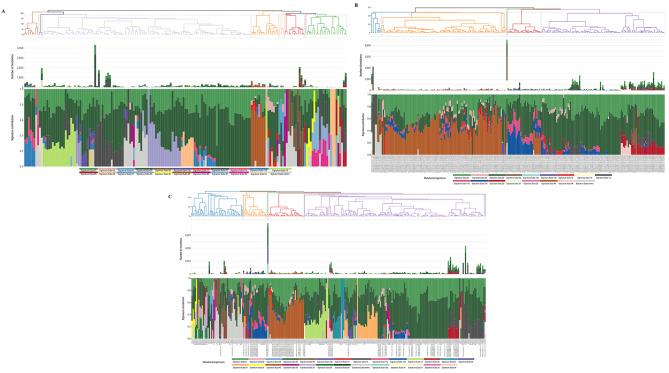
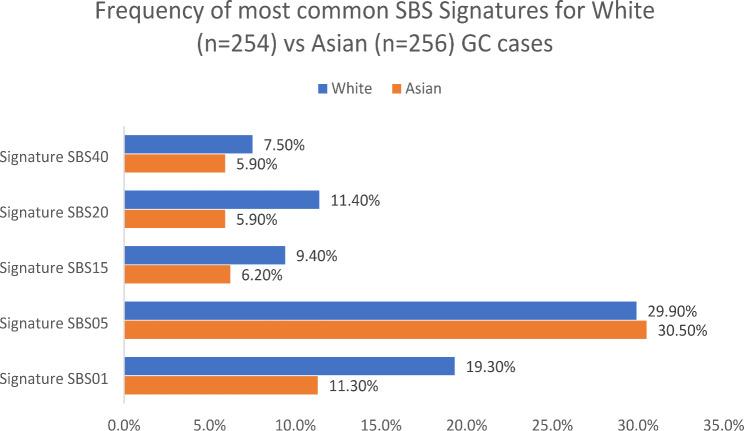
We identified 104 mutated genes with P < 0.01. Seven genes (OR6B1, B2M, ELF3, RHOA, RPL22, TP53, ARIDIA) had q < 0.0001, including six previously associated with GC. Mutational signatures (COSMIC-V3) observed include 14 single base substitutions (SBS), one doublet base substitution (DBS) Signature A, and one InDel (ID2). The most frequent SBS signatures (SBS05, SBS01, SBS15, SBS20, SBS40) were also observed in 254 White GC cases from The Cancer Genome Atlas (TCGA) Project. However, SBS01 and SBS20 showed significant differences between Whites vs. All Asians (19.3% vs. 11.3% for SBS 1 (P = 0.012) and 11.4% vs. 5.9% for SBS20 (P = 0.025), respectively). Using COSMIC V2, signatures 6, 15, and 1 were the most frequent in Chinese GC cases. Further, most Chinese GC cases carried multiple signatures.
CONCLUSIONS
This effort represents the most detailed mutational signatures analysis of GC cases from China to date. Results hold promise for new insights in understanding risk and prognosis factors in GC.
背景
胃癌(GC)是一种分子异质性疾病,是全球癌症死亡的第三大主要原因。全球大多数 GC 病例发生在东亚,主要在中国。突变特征框架提供了一种优雅的方法来识别肿瘤中存在的突变过程。
方法
为了确定突变特征模式,我们对中国 GC 患者进行了全外显子组测序(WES)分析。使用 Mutect2 和 MutsigCV 在 175 例中国 GC 患者的配对肿瘤-正常组织中鉴定显著突变基因。我们使用癌症体细胞突变目录(COSMIC)版本 2(V2)和版本 3(V3)调查突变特征。
结果
我们鉴定了 104 个具有 P<0.01 的突变基因。七个基因(OR6B1、B2M、ELF3、RHOA、RPL22、TP53、ARIDIA)具有 q<0.0001,其中六个与 GC 有关。观察到的突变特征(COSMIC-V3)包括 14 个单碱基替换(SBS)、一个双碱基替换(DBS)特征 A 和一个插入缺失(ID2)。在来自癌症基因组图谱(TCGA)项目的 254 例白人 GC 病例中也观察到最常见的 SBS 特征(SBS05、SBS01、SBS15、SBS20、SBS40)。然而,SBS01 和 SBS20 在白人与所有亚洲人之间存在显著差异(SBS1 的 19.3%比 11.3%(P=0.012)和 SBS20 的 11.4%比 5.9%(P=0.025))。使用 COSMIC V2,特征 6、15 和 1 是中国 GC 病例中最常见的。此外,大多数中国 GC 病例携带多个特征。
结论
这是迄今为止对中国 GC 病例进行的最详细的突变特征分析。结果有望为理解 GC 的风险和预后因素提供新的见解。
 Zotero 插件