
探究循证医疗实践应用的影响因素。
Investigating the influencing factors of evidence-based healthcare practice adoption.
作者信息
Motsi Lovemore
机构信息
School of Computing, College of Science, Engineering and Technology, University of South Africa, Pretoria.
出版信息
Curationis. 2024 Sep 12;47(1):e1-e8. doi: 10.4102/curationis.v47i1.2586.
BACKGROUND
In healthcare facilities, evidence-based healthcare practice (EBHP) is becoming more widely acknowledged as a critical element of patient care delivery. An increasingly important component of EBHP is the implementation of electronic health records (EHRs).
OBJECTIVES
This study aims to investigate factors that influence EBHP adoption in public healthcare institutions in South Africa.
METHOD
Four hundred and fifty patients were self-administered to healthcare professionals at an academic public hospital in Gauteng and used in this study. A total of 300 responses were available for use in the final analysis following the data cleaning procedure. Utilising structural equation modelling (SEM), the collected data were analysed.
RESULTS
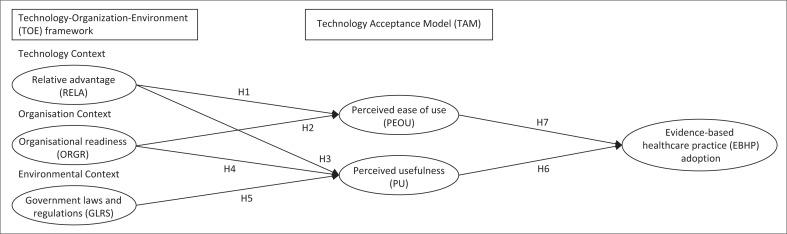
Perceived ease of use (PEOU) and perceived usefulness (PU) were found to be major variables in the adoption of EBHP along with technological, organisational and environmental factors. The technology context relative advantage (RELA) was shown to have a positive significant influence on the adoption of evidence-based healthcare practice by the PEOU and PU, with the environmental context government laws and regulations (GLRS) and organisational context organisational readiness (ORGR) coming in second and third, respectively.
CONCLUSION
Perceived ease of use, PU, ORGR, and GLRS are regarded as a vital variables in the implementation of EBHP in South African public hospitals.Contribution: The study's conclusions would be helpful to policymakers as they redefine nursing practice. Furthermore, the findings heighten the consciousness of healthcare practitioners regarding the significance of employing evidence-based practice while making decisions.
背景
在医疗保健机构中,循证医疗实践(EBHP)作为患者护理服务的关键要素正得到越来越广泛的认可。电子健康记录(EHRs)的实施是循证医疗实践中一个日益重要的组成部分。
目的
本研究旨在调查影响南非公共医疗机构采用循证医疗实践的因素。
方法
在豪登省的一家学术公立医院,450名患者由医护人员自行管理并用于本研究。经过数据清理程序后,共有300份回复可用于最终分析。利用结构方程模型(SEM)对收集的数据进行分析。
结果
感知易用性(PEOU)和感知有用性(PU)以及技术、组织和环境因素被发现是采用循证医疗实践的主要变量。技术背景相对优势(RELA)被证明对循证医疗实践的采用通过PEOU和PU有显著的正向影响,环境背景政府法律法规(GLRS)和组织背景组织准备度(ORGR)分别位列第二和第三。
结论
感知易用性、PU、ORGR和GLRS被视为南非公立医院实施循证医疗实践的重要变量。贡献:该研究的结论将有助于政策制定者重新定义护理实践。此外,研究结果提高了医护人员在决策时采用循证实践重要性的意识。
 Zotero 插件