
纳米银氟化物对乳牙龋坏牙本质上玻璃离子水门汀和树脂改性玻璃离子水门汀微拉伸粘结强度影响的评估:一项研究。
Assessment of Nanosilver Fluoride Application on the Microtensile Bond Strength of Glass Ionomer Cement and Resin-modified Glass Ionomer Cement on Primary Carious Dentin: An Study.
作者信息
Das Anushka, Ramamurthy Neeraja, Srinivasan Ila, Milit Yuthi
机构信息
Department of Pedodontics and Preventive Dentistry, MR Ambedkar Dental College and Hospital (MRADCH), Bengaluru, Karnataka, India.
出版信息
Int J Clin Pediatr Dent. 2024 May;17(5):565-569. doi: 10.5005/jp-journals-10005-2863.
BACKGROUND AND OBJECTIVES
Nanosilver sodium fluoride (NSF) has recently gained popularity in dentistry as an alternative to silver diamine fluoride (SDF) due to its drawbacks of staining the tooth black and possibly causing soft tissue injury, which has been eliminated in NSF due to the nanoparticle size of silver. This study aims to assess the microtensile bond strength of glass ionomer cement (GIC) and resin-modified glass ionomer cement (RMGIC) with pretreatment of NSF on extracted primary carious teeth.
MATERIALS AND METHODS
Teeth were stored in 10% formalin. The roots were severed, and the pulp chambers were cleaned. The occlusal enamel was ground, reducing the dentin thickness by 1 mm. The specimens were covered with nail varnish, leaving only the area of flat dentin exposed. Caries were induced microbiologically by inoculating . Group I-NSF with GIC restoration, group II-NSF with RMGIC restoration, group III-restoration with GIC, and group IV-restoration with RMGIC. After different surface treatments of the carious dentin were performed, each specimen was placed in the testing jig of a universal testing machine and stressed in tension at a crosshead speed of 1 mm/minute until bond failure was observed. They were air-dried and placed under a scanning electron microscope. The failure modes-adhesive, cohesive, and mixed failure were recorded for statistical evaluation.
RESULTS
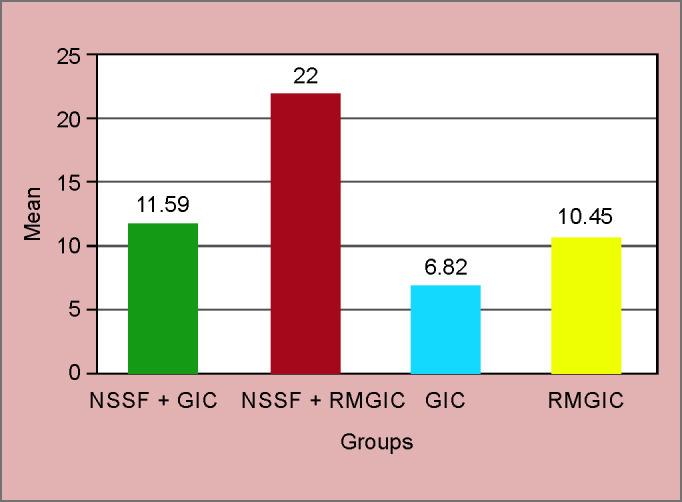
Maximum results of microtensile bond strength were seen in the pretreatment group with NSF sealant, followed by RMGIC restoration, and the least results were observed in the conventional GIC restoration group. Of all the types of failures in our study, adhesive was the maximum type.
INTERPRETATION AND CONCLUSION
The microtensile bond strength of pretreatment with NSF showed higher values when compared to conventional restorations of GIC and RMGIC. The failure modes in each group were not significantly varied. Pretreatment with NSF will prevent secondary caries formation, and the restorations will also be stronger.
HOW TO CITE THIS ARTICLE
Das A, Ramamurthy N, Srinivasan I, Assessment of Nanosilver Fluoride Application on the Microtensile Bond Strength of Glass Ionomer Cement and Resin-modified Glass Ionomer Cement on Primary Carious Dentin: An Study. Int J Clin Pediatr Dent 2024;17(5):565-569.
背景与目的
纳米银氟化钠(NSF)最近在牙科领域受到欢迎,成为二胺银氟化物(SDF)的替代品,因为SDF存在使牙齿变黑以及可能导致软组织损伤的缺点,而NSF由于银的纳米颗粒尺寸消除了这些问题。本研究旨在评估纳米银氟化钠预处理对拔除的乳牙龋坏牙体上玻璃离子水门汀(GIC)和树脂改性玻璃离子水门汀(RMGIC)的微拉伸粘结强度。
材料与方法
牙齿保存在10%的福尔马林中。切断牙根,清理髓腔。磨除咬合面釉质,使牙本质厚度减少1mm。标本用指甲油覆盖,仅暴露平坦的牙本质区域。通过接种在微生物学上诱导龋齿。第一组 - 用GIC修复的NSF组,第二组 - 用RMGIC修复的NSF组,第三组 - 用GIC修复组,第四组 - 用RMGIC修复组。对龋坏牙本质进行不同的表面处理后,将每个标本置于万能试验机的测试夹具中,以1mm/分钟的十字头速度进行拉伸加载,直至观察到粘结失效。将它们风干并置于扫描电子显微镜下。记录粘结、内聚和混合失效等失效模式以进行统计评估。
结果
在使用NSF封闭剂的预处理组中观察到微拉伸粘结强度的最大值,其次是RMGIC修复组,而在传统GIC修复组中观察到的结果最少。在我们的研究中,所有类型的失效中,粘结失效是最主要的类型。
解读与结论
与GIC和RMGIC的传统修复相比,NSF预处理的微拉伸粘结强度显示出更高的值。每组的失效模式没有显著差异。NSF预处理将防止继发龋的形成,并且修复体也会更强。
如何引用本文
Das A, Ramamurthy N, Srinivasan I, 纳米银氟化物对乳牙龋坏牙本质上玻璃离子水门汀和树脂改性玻璃离子水门汀微拉伸粘结强度的应用评估:一项研究。《国际临床儿科牙科学杂志》2024;17(5):565 - 569。
 Zotero 插件