
基于衰弱指数和实验室指标的急性心肌梗死患者短期预后新型量表系统:一项回顾性队列研究
A Novel Scale System Based on the Frailty Index and Laboratory Indicators for the Short-Term Prognosis of Patients with Acute Myocardial Infarction: A Retrospective Cohort Study.
作者信息
Cao Tianqing, Liu Fei, Yao Yan, Sun Danghong, Wang Rong, Cao Junxia, Meng Jie, Zhang Ling, Li Weiming
机构信息
Shanghai Tenth People's Hospital, Clinical Medical College of Nanjing Medical University, Nanjing, People's Republic of China.
Department of Cardiology, Northern Jiangsu People's Hospital, Yangzhou, Jiangsu, People's Republic of China.
出版信息
Clin Interv Aging. 2024 Sep 26;19:1597-1606. doi: 10.2147/CIA.S469480. eCollection 2024.
OBJECTIVE
Current scoring systems for short-term prognosis in patients with acute myocardial infarction (AMI) lack coverage of risk factors and have limitations in risk stratification. The aim of this study was to develop a novel assessment system based on laboratory indicators and frailty quantification to better infer short-term prognosis and risk indication in patients with AMI.
METHODS
A total of 365 patients with MI from January 2022 to June 2023 in Northern Jiangsu Province Hospital were included. The primary endpoint was all-cause mortality and major adverse cardiac events (MACE) during follow-up. A novel scoring model ranging from 0 to 12 was constructed, and the predictive ability of this scoring system was evaluated using the area under the receiver operating characteristic curve (AUC).
RESULTS
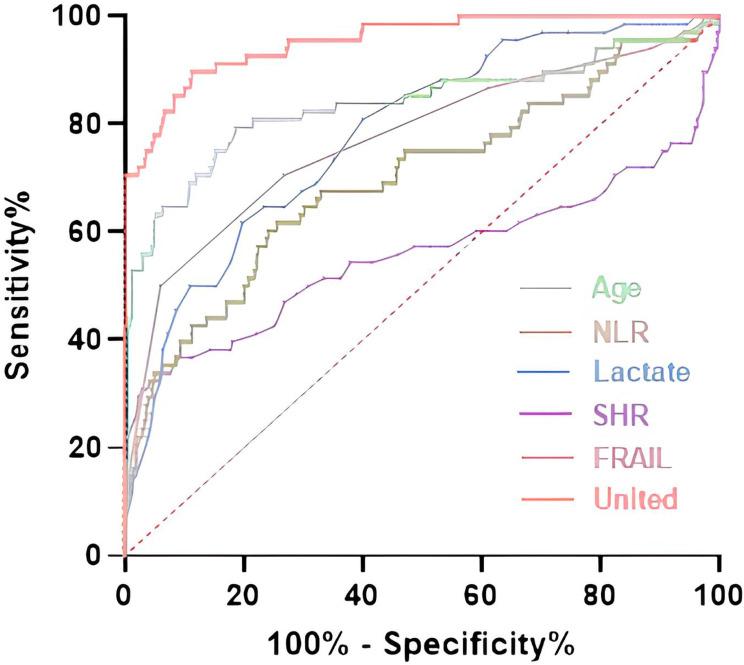
During follow-up, 68 patients experienced MACE. Five scoring indicators were selected through multivariate logistic regression analysis, resulting in a composite score with an AUC of 0.925, demonstrating good prognostic accuracy.
CONCLUSION
The novel prognostic assessment system, which integrates age, Stress Hyperglycemia Ratio (SHR), Neutrophil to Lymphocyte Ratio (NLR), lactate, and frailty score, exhibits good predictive value for short-term MACE in patients with acute myocardial infarction and may enable more accurate risk classification for future use in MI patient risk management.
目的
目前急性心肌梗死(AMI)患者短期预后评分系统缺乏对危险因素的覆盖,且在风险分层方面存在局限性。本研究旨在基于实验室指标和衰弱量化开发一种新型评估系统,以更好地推断AMI患者的短期预后和风险指征。
方法
纳入2022年1月至2023年6月在苏北医院的365例心肌梗死患者。主要终点是随访期间的全因死亡率和主要不良心脏事件(MACE)。构建了一个范围从0到12的新型评分模型,并使用受试者工作特征曲线下面积(AUC)评估该评分系统的预测能力。
结果
随访期间,68例患者发生MACE。通过多因素逻辑回归分析选择了5个评分指标,得出的综合评分AUC为0.925,显示出良好的预后准确性。
结论
该新型预后评估系统整合了年龄、应激血糖比值(SHR)、中性粒细胞与淋巴细胞比值(NLR)、乳酸和衰弱评分,对急性心肌梗死患者的短期MACE具有良好的预测价值,可能有助于更准确地进行风险分类,以供未来用于心肌梗死患者的风险管理。


 Zotero 插件