
甲状腺功能亢进与胃食管反流或食管癌风险之间的因果关联:一项双向孟德尔随机化研究
Causal association between hyperthyroidism and risk of gastroesophageal reflux or esophageal cancer: a bidirectional Mendelian randomization investigation.
作者信息
Zhu Xingyu, Li Ming, Gan Hanghang, Guo Yingqiang
机构信息
Department of Cardiovascular Surgery, West China School of Medicine, West China Hospital, Sichuan University, Chengdu, China.
Cardiovascular Surgery Research Laboratory, West China Hospital, Sichuan University, Chengdu, China.
出版信息
Front Endocrinol (Lausanne). 2024 Sep 17;15:1411629. doi: 10.3389/fendo.2024.1411629. eCollection 2024.
BACKGROUND
Emerging observational studies indicated an association between hyperthyroidism and gastrointestinal disorders. However, it remains unclear whether this association is causal, particularly in the case of gastroesophageal reflux (GERD) and esophageal cancer.
METHODS
To assess the potential causal relationship between hyperthyroidism and GERD or esophageal cancer, we conducted a bidirectional 2-sample Mendelian randomization study. Independent genetic instruments for hyperthyroidism from the UK Biobank (N case=3,545 and N control=459,388) and public genome-wide association study (GWAS) dataset (N case=3,731 and N control=480,867) were used to investigate the association with esophageal cancer in the UK Biobank study (N case=740 and N control=372,016) and GERD in the public GWAS database (N case=20,381 and N control=464,217). Four different approaches (inverse variance weighted (IVW), weighted mode, MR-Egger, and weighted median regression) were used to ensure that our results more reliable. Additional sensitivity analyses were also performed to validate our results.
RESULTS
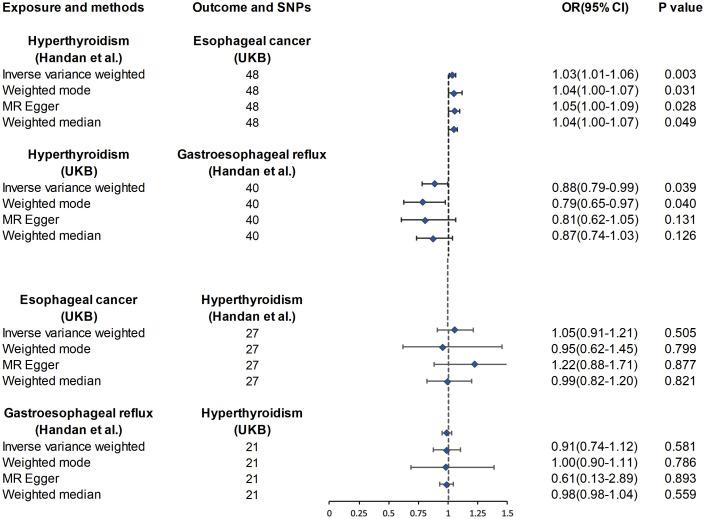
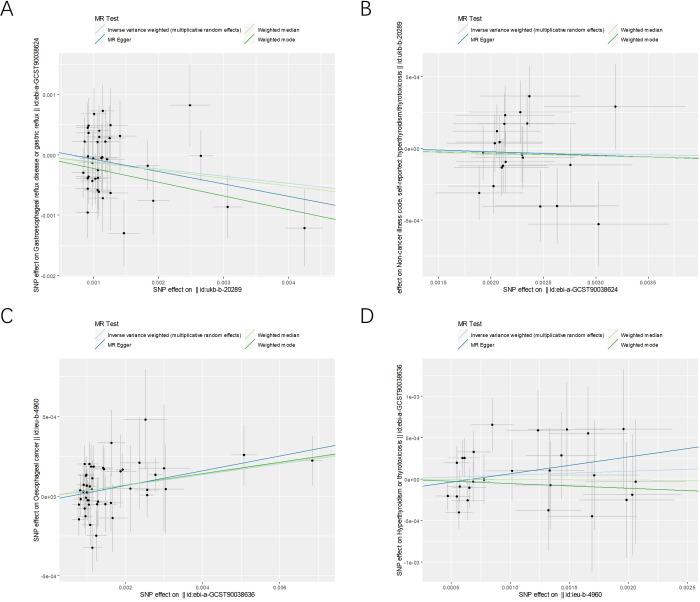
When hyperthyroidism was considered as the exposure factor, it appeared to act as a protective factor for GERD (OR = 0.88, 95% CI, 0.79-0.99, P = 0.039), while as a risk factor for esophageal cancer (OR = 1.03, 95% CI, 1.01-1.06, P = 0.003). However, there is no evidence supporting a reverse causal relationship between genetic susceptibility to hyperthyroidism and GERD or esophageal cancer.
CONCLUSION
Our findings provided genetic evidence supporting bidirectional causal relationships between hyperthyroidism and GERD or esophageal cancer. These results substantiate certain discoveries from previous observational studies on a causal level and provide insight into relevant genetic susceptibility factors.
背景
新兴的观察性研究表明甲状腺功能亢进与胃肠道疾病之间存在关联。然而,这种关联是否为因果关系仍不明确,尤其是在胃食管反流病(GERD)和食管癌的情况下。
方法
为了评估甲状腺功能亢进与GERD或食管癌之间的潜在因果关系,我们进行了一项双向双样本孟德尔随机化研究。使用来自英国生物银行(病例数=3545,对照数=459388)的甲状腺功能亢进独立遗传工具和公共全基因组关联研究(GWAS)数据集(病例数=3731,对照数=480867),在英国生物银行研究(病例数=740,对照数=372016)中研究与食管癌的关联,以及在公共GWAS数据库(病例数=20381,对照数=464217)中研究与GERD的关联。采用四种不同方法(逆方差加权法(IVW)、加权模式法、MR-Egger法和加权中位数回归法)以确保我们的结果更可靠。还进行了额外的敏感性分析以验证我们的结果。
结果
当将甲状腺功能亢进视为暴露因素时,它似乎对GERD起保护作用(比值比=0.88,95%置信区间,0.79 - 0.99,P = 0.039),而对食管癌起危险因素作用(比值比=1.03,95%置信区间,1.01 - 1.06,P = 0.003)。然而,没有证据支持甲状腺功能亢进的遗传易感性与GERD或食管癌之间存在反向因果关系。
结论
我们的研究结果提供了遗传证据,支持甲状腺功能亢进与GERD或食管癌之间的双向因果关系。这些结果在因果层面证实了先前观察性研究的某些发现,并为相关遗传易感性因素提供了见解。

 Zotero 插件