
接受辅助芳香化酶抑制剂治疗激素受体阳性早期乳腺癌的女性监测血清雌二醇的临床意义。
Clinical significance of serum estradiol monitoring in women receiving adjuvant aromatase inhibitor for hormone receptor-positive early breast cancer.
机构信息
Department of Medicine Laboratory, State Key Laboratory of Oncology in South China, Guangdong Provincial Clinical Research Center for Cancer, Sun Yat-Sen University Cancer Center, Guangzhou, 510060, PR China.
Department of Clinic, State Key Laboratory of Oncology in South China, Guangdong Provincial Clinical Research Center for Cancer, Sun Yat-Sen University Cancer Center, Guangzhou, 510060, PR China.
出版信息
Breast. 2024 Dec;78:103818. doi: 10.1016/j.breast.2024.103818. Epub 2024 Sep 29.
PURPOSE
The limited understanding of long-term estradiol (E2) suppression poses challenges to the effectiveness of adjuvant therapy with aromatase inhibitors (AI), necessitating comprehensive serum E2 monitoring to address this issue. Therefore, our objective was to investigate serum E2 levels in women undergoing adjuvant AI treatment and evaluate the significance of such monitoring.
PATIENTS AND METHODS
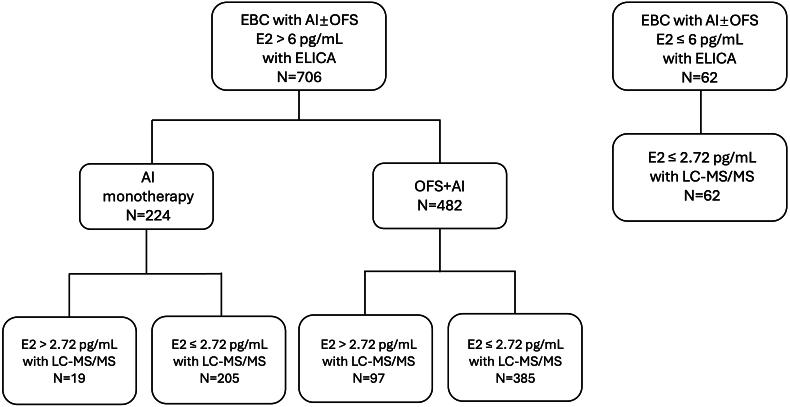
In this prospective cohort study, we recruited women who had received adjuvant AI treatment, including those who underwent ovarian function suppression (OFS). Serum E2 levels were measured using high-performance liquid chromatography-tandem mass spectrometry (LC-MS/MS). The primary endpoint was the proportion of women with E2 levels exceeding 2.72 pg/mL, indicating inadequate suppression achieved with AI therapy.
RESULTS
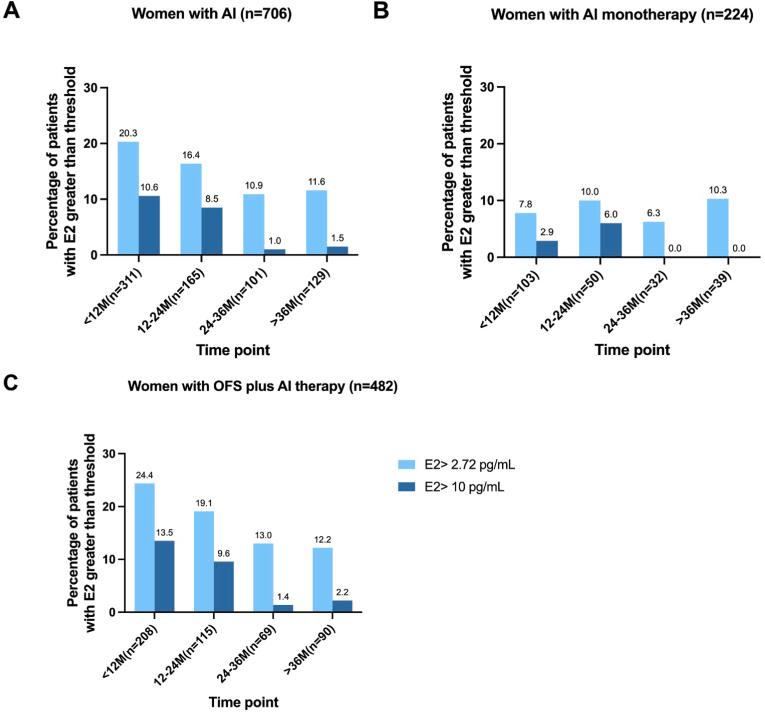
A total of 706 patients were enrolled, including 482 women with OFS in combination with AI. Among them, 116 women (16.4 %) exhibited E2 levels exceeding 2.72 pg/mL. The majority of serum E2 elevations (77.6 %) occurred within the first two years of initiating endocrine therapy. Younger age, no prior chemotherapy, shorter duration of the current treatment regimen, and lower follicle stimulating hormone (FSH) levels were associated with inadequate E2 suppression. Serum E2 concentrations demonstrated dynamic variations and occasional rebound following adjuvant AI therapy.
CONCLUSIONS
Despite receiving adjuvant AI treatment for nearly two years, a certain proportion of patients failed to achieve the adequate threshold of E2 suppression. Our findings emphasize the significance of monitoring serum E2 levels during adjuvant AI therapy, particularly within the first two years. Further research is imperative to facilitate a more comprehensive comprehension of E2 monitoring.
目的
对长期雌二醇(E2)抑制的认识有限,这给芳香化酶抑制剂(AI)辅助治疗的效果带来了挑战,需要进行全面的血清 E2 监测来解决这个问题。因此,我们的目的是研究接受辅助 AI 治疗的女性的血清 E2 水平,并评估这种监测的意义。
患者和方法
在这项前瞻性队列研究中,我们招募了接受辅助 AI 治疗的女性,包括接受卵巢功能抑制(OFS)的女性。使用高效液相色谱-串联质谱(LC-MS/MS)测量血清 E2 水平。主要终点是 E2 水平超过 2.72pg/mL 的女性比例,这表明 AI 治疗的抑制作用不足。
结果
共纳入 706 例患者,其中 482 例接受 OFS 联合 AI 治疗。其中,116 例(16.4%)E2 水平超过 2.72pg/mL。大多数血清 E2 升高(77.6%)发生在开始内分泌治疗的头两年内。年龄较小、无既往化疗、当前治疗方案持续时间较短和卵泡刺激素(FSH)水平较低与 E2 抑制不足有关。血清 E2 浓度在接受辅助 AI 治疗后表现出动态变化,偶尔会出现反弹。
结论
尽管接受辅助 AI 治疗近两年,但仍有一定比例的患者未能达到足够的 E2 抑制阈值。我们的研究结果强调了在辅助 AI 治疗期间监测血清 E2 水平的重要性,尤其是在头两年内。需要进一步研究以促进对 E2 监测的更全面理解。

 Zotero 插件