
重症监护病房护士在警报管理中的应对策略:一项定性研究
Coping strategies of intensive care units nurses in alarm management: a qualitative research study.
作者信息
Lu Shu-Fen, Kuo Yi-Wen, Hung Shih-Hsin, Wu Cheng-Hsueh, Wang Chien-Ying, Chou Shin-Shang, Huang Shu-He
机构信息
Department of Nursing, Taipei Veterans General Hospital, Taipei, Taiwan, ROC.
Department of Nursing, College of Nursing, National Yang Ming Chiao Tung University, No. 12, Ln. 225, Zhixing Rd., Beitou Dist., Taipei City, 112020, Taiwan ROC.
出版信息
BMC Nurs. 2024 Oct 3;23(1):713. doi: 10.1186/s12912-024-02374-1.
BACKGROUND
Intensive care units are critical environments where various alarm systems play a pivotal role in patient monitoring and safety. Alarm fatigue can lead to slower response times and missed alarms, compromising patient safety and increasing stress and burnout among intensive care unit nurses. Understanding how intensive care unit nurses respond to and manage these alarms is crucial in evaluating their impact on patient care and nursing well-being.
METHODS
This descriptive qualitative study explored the experiences of intensive care unit nurses in alarm management. Conducted in the medical and surgical intensive care units of a Northern Taiwan medical center, the study involved 15 nurses. Semi-structured interviews were utilized to investigate the working experiences of ICU nurses in alarm management and to identify their coping strategies for dealing with the constant inundation of medical device alarms. The interviews were transcribed, and content analysis was applied to identify key themes in the responses.
RESULTS
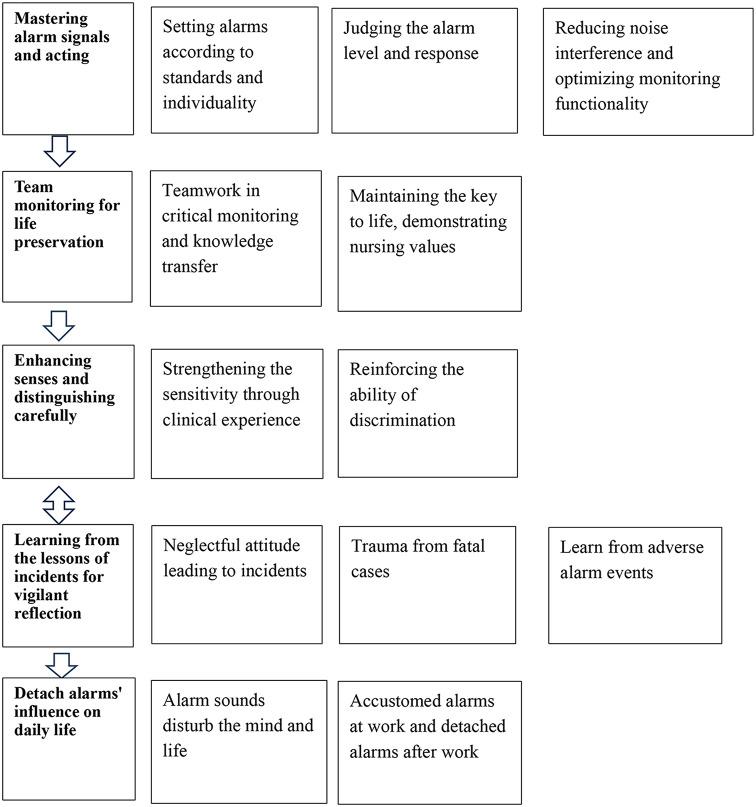
The study revealed five main themes in intensive care unit nurses' strategies for managing alarms: (1) Mastering alarm signals and acting; (2) Team monitoring for life preservation; (3) Enhancing senses and distinguishing carefully; (4) Learning from the lessons of incidents for vigilant reflection; and (5) Detach alarms' influence on daily life. These coping strategies are effective in alarm management, safeguarding patients' lives, enhancing the serenity of the clinical environment, and mitigating the physical and mental exhaustion caused by alarm fatigue.
CONCLUSIONS
Intensive Care Unit nurses develop various coping strategies to manage medical device alarms, based on their experience. These strategies are crucial in maintaining patient safety and reducing nurse alarm fatigue. They can also be used for nursing education and clinical training.
背景
重症监护病房是关键环境,各种警报系统在患者监测和安全方面发挥着关键作用。警报疲劳会导致响应时间延长和警报漏接,危及患者安全,并增加重症监护病房护士的压力和倦怠感。了解重症监护病房护士如何应对和管理这些警报对于评估其对患者护理和护士福祉的影响至关重要。
方法
这项描述性定性研究探讨了重症监护病房护士在警报管理方面的经历。该研究在台湾北部一家医疗中心的内科和外科重症监护病房进行,涉及15名护士。采用半结构化访谈来调查重症监护病房护士在警报管理方面的工作经历,并确定他们应对医疗设备警报不断涌入的应对策略。访谈内容被转录,并应用内容分析法确定回答中的关键主题。
结果
该研究揭示了重症监护病房护士管理警报策略中的五个主要主题:(1)掌握警报信号并采取行动;(2)团队监测以挽救生命;(3)增强感官并仔细辨别;(4)从事件教训中学习以进行警惕反思;(5)消除警报对日常生活的影响。这些应对策略在警报管理、保障患者生命、提高临床环境的宁静度以及减轻警报疲劳引起的身心疲惫方面是有效的。
结论
重症监护病房护士根据自身经验制定了各种应对医疗设备警报的策略。这些策略对于维护患者安全和减轻护士警报疲劳至关重要。它们还可用于护理教育和临床培训。
 Zotero 插件