
慢性抑制性抗生素治疗复发性心室辅助装置感染的临床影响。
Clinical impact of the use of chronic suppressive antibiotics against recurrent ventricular assist device infections.
机构信息
Department of Infectious Diseases, The University of Tokyo Hospital, Tokyo, Japan.
Department of Healthcare Quality Assessment, Graduate School of Medicine, University of Tokyo, Tokyo, Japan.
出版信息
Microbiol Spectr. 2024 Nov 5;12(11):e0039824. doi: 10.1128/spectrum.00398-24. Epub 2024 Oct 4.
UNLABELLED
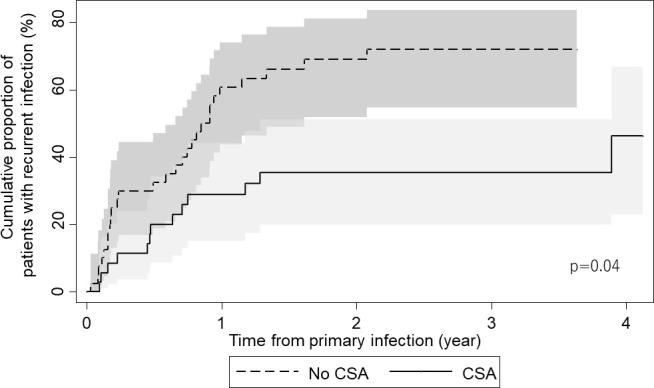
Ventricular assist device (VAD) infections are frequent causes of hospital readmission. The risk factors and optimal preventive strategies for such, including chronic suppressive antibiotics (CSA), remain uncertain. We performed a single-center, retrospective, observational cohort study assessing continuous flow VAD recipients who underwent implantation between 2008 and 2018 in Japan. From primary VAD infection (VADI), we followed the patients for recurrent infection, defined as relapsing VAD-specific (e.g., localized infections) or VAD-related (e.g., bacteremia) infections requiring hospital readmission. CSA was defined as the use of oral antimicrobial agents continued beyond initial antibiotic use until transplantation, VAD withdrawal, VADI recurrence, or death. Survival analysis was performed to identify risk factors for recurrent infection accounting for competing risks (e.g., deaths and transplants). Among 163 eligible patients, 76 patients had VADIs. The main causative organism in primary VADI was (63%, 48/76). Among them, 41 had recurrent infections, whereas 35 had none during the follow-up period (median, 335 days). Thirty-six patients received CSA for a median of 478 days. Although CSA was associated with a decreased risk of recurrent infection [adjusted sub-distribution hazard ratio (SHR), 0.40; 95% confidence interval (CI), 0.18-0.89; 0.03], this protective effect was observed only after primary VAD-specific infection (SHR, 0.28; 95% CI, 0.12-0.64; < 0.01) but not after VAD-related infection. Surgical procedures during primary VADI were associated with an increased risk (SHR, 2.00; 95% CI, 1.10-3.66; = 0.02). One patient had an adverse drug reaction. CSA may be an effective approach to limit relapsing VADIs following a primary VAD-specific infection with minimal adverse events.
IMPORTANCE
Ventricular assist device infections (VADIs) are a significant complication leading to hospital readmissions. However, the risk factors and optimal preventive strategies for VADI remain unclear. This study investigated the effectiveness of chronic suppressive antibiotic therapy in patients with VADI. We found that the use of chronic suppressive antibiotic therapy was associated with a reduction in the risk of VADI recurrence with few adverse reactions. Our findings suggest the potential benefit of chronic suppressive antibiotics in preventing infections in selected cases. Our findings are relevant for the management of patients with ventricular assist devices awaiting heart transplantation, providing valuable insights for clinical practice.
目的
心室辅助装置(VAD)感染是导致医院再入院的常见原因。目前尚不确定此类感染的危险因素和最佳预防策略,包括慢性抑制性抗生素(CSA)。我们进行了一项单中心、回顾性、观察性队列研究,评估了 2008 年至 2018 年间在日本植入的连续流 VAD 接受者。从原发性 VAD 感染(VADI)开始,我们对复发性感染的患者进行了随访,复发性感染定义为 VAD 特异性(例如局部感染)或 VAD 相关性(例如菌血症)感染需要再次入院。CSA 定义为在初始抗生素使用后继续使用口服抗菌药物,直至移植、VAD 退出、VADI 复发或死亡。生存分析用于确定考虑竞争风险(例如死亡和移植)的复发性感染的危险因素。在 163 名合格患者中,76 名患者患有 VADIs。原发性 VADI 的主要病原体是 (63%,48/76)。其中,41 名患者发生了复发性感染,而 35 名患者在随访期间没有感染(中位数为 335 天)。36 名患者接受了 CSA 治疗,中位时间为 478 天。尽管 CSA 与复发性感染风险降低相关[校正的亚分布风险比(SHR),0.40;95%置信区间(CI),0.18-0.89; 0.03],但这种保护作用仅在原发性 VAD 特异性感染后观察到(SHR,0.28;95%CI,0.12-0.64; < 0.01),而不是在 VAD 相关性感染后观察到。原发性 VADI 期间的手术与风险增加相关(SHR,2.00;95%CI,1.10-3.66; = 0.02)。一名患者发生药物不良反应。CSA 可能是一种有效的方法,可以限制原发性 VAD 特异性感染后复发性 VADIs 的发生,且不良反应最小。
意义
心室辅助装置感染(VADIs)是导致医院再入院的严重并发症。然而,VADI 的危险因素和最佳预防策略仍不清楚。本研究调查了慢性抑制性抗生素治疗在 VADI 患者中的效果。我们发现,使用慢性抑制性抗生素治疗与 VADI 复发风险降低相关,且不良反应较少。我们的研究结果表明,在某些情况下,慢性抑制性抗生素可能具有预防感染的潜在益处。我们的研究结果与等待心脏移植的心室辅助装置患者的管理相关,为临床实践提供了有价值的见解。

 Zotero 插件