
通过基因组分析对携带BRCA突变患者的癌前乳腺组织进行癌症风险评估。
Cancer risk assessment of premalignant breast tissues from patients with BRCA mutations by genome profiling.
作者信息
Hirose Takeshi, Ikegami Masachika, Kida Kumiko, Ueno Toshihide, Kitada Rina, Wang Lei, Tanaka Shinya, Endo Makoto, Nakashima Yasuharu, Kanomata Naoki, Mano Hiroyuki, Yamauchi Hideko, Kohsaka Shinji
机构信息
Division of Cellular Signaling, National Cancer Center Research Institute, 5-1-1 Tsukiji, Chuo-ku, Tokyo, 104-0045, Japan.
Department of Orthopaedic Surgery, Graduate School of Medical Sciences, Kyushu University, 3-1-1 Maidashi, Higashi-ku, Fukuoka, 812-8582, Japan.
出版信息
NPJ Breast Cancer. 2024 Oct 4;10(1):87. doi: 10.1038/s41523-024-00693-9.
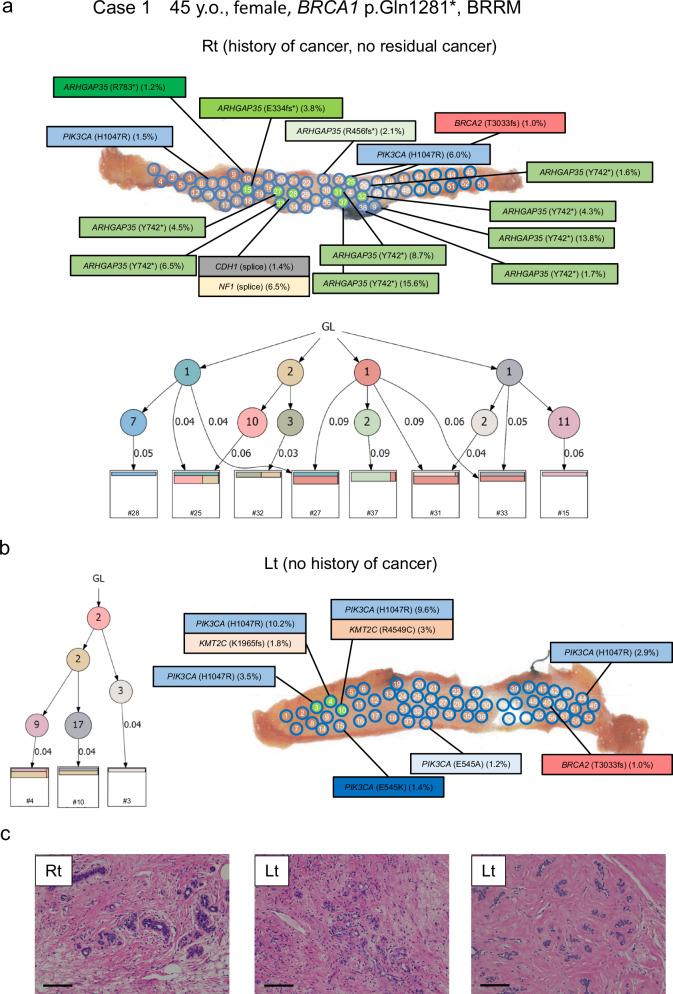
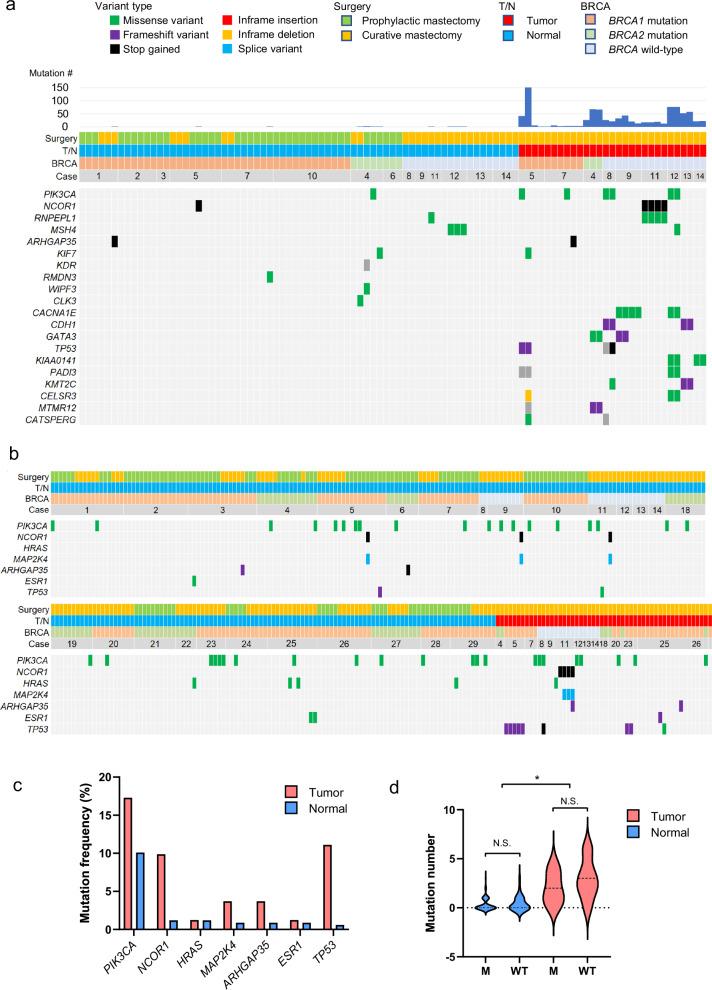
Patients with germline pathogenic variants of BRCA1/2 genes have a particular predisposition to develop breast cancer. No clinical test has been developed to accurately and quantitatively evaluate their risk of developing breast cancer. We hypothesized that aberrant cell clonal expansion may be initiated in normal breast tissues without manifesting pathologic changes. To assess the prevalence of clonal expansion in the normal breast, we collected normal breast tissue from 24 breast cancer patients who had undergone surgical resection and 5 carriers of pathogenic BRCA1/2 variant who had undergone prophylactic mastectomy. Whole-exome sequencing (WES) was conducted in 97 specimens from 14 individuals, and TOP panel, a gene panel targeting 464 genes, was conducted in 321 specimens from 26 individuals, including 8 individuals with germline pathogenic variants of BRCA1/2 genes. Recurrent oncogenic mutations within PIK3CA, ARHGAP35, HRAS, and NF1 were identified in normal breast tissue at considerable variant allelic frequencies (VAF), suggesting clonal expansion. In addition, 937 normal breast tissues were evaluated using the Breast Cancer Panel (BCP) targeting 25 genes to determine the exact prevalence and distribution of clonal expansion. To assess the clonal expansion, we developed the clonality score, which is the mean value of clonal cell fractions for samples obtained from a given breast. The average clonality score in macroscopically normal breast tissue was 0.95 (0-2.46), with a significant difference between cases with and without a history of breast cancer of stage 2 or more advanced stage (p = 0.01). Additional WES on 42 samples with relatively large clone size (VAF > 3%) confirmed that these cell clones harbored multiple mutations (10.7 mutations/sample), and the number of existing mutations was consistent with the clone size (R = 0.50). The results suggest that clonal changes occur in normal breast tissue of women at high risk for breast cancer even before cancer is detected pathologically and/or radiologically, and the clonality score shows the potential to be a valid method of evaluating clonal expansion for cancer-risk assessment that provides appropriate preventive options for patients at high risk for breast cancer.
携带BRCA1/2基因种系致病变异的患者特别容易患乳腺癌。目前尚未开发出能够准确、定量评估其患乳腺癌风险的临床检测方法。我们推测,异常细胞克隆扩增可能在正常乳腺组织中启动,而不表现出病理变化。为了评估正常乳腺中克隆扩增的发生率,我们收集了24例接受手术切除的乳腺癌患者以及5例携带BRCA1/2致病变异并接受预防性乳房切除术患者的正常乳腺组织。对来自14名个体的97个样本进行了全外显子组测序(WES),并对来自26名个体(包括8名携带BRCA1/2基因种系致病变异的个体)的321个样本进行了TOP panel检测,该基因 panel 靶向464个基因。在正常乳腺组织中以相当高的变异等位基因频率(VAF)鉴定出PIK3CA、ARHGAP35、HRAS和NF1内的复发性致癌突变,提示存在克隆扩增。此外,使用靶向25个基因的乳腺癌panel(BCP)对937个正常乳腺组织进行评估,以确定克隆扩增的确切发生率和分布。为了评估克隆扩增,我们开发了克隆性评分,即从给定乳房获取的样本中克隆细胞分数的平均值。宏观正常乳腺组织中的平均克隆性评分为0.95(0 - 2.46),有2期或更晚期乳腺癌病史的病例与无该病史的病例之间存在显著差异(p = 0.01)。对42个克隆大小相对较大(VAF > 3%)的样本进行的额外WES证实,这些细胞克隆携带多个突变(10.7个突变/样本),且现有突变数量与克隆大小一致(R = 0.50)。结果表明,在乳腺癌高危女性的正常乳腺组织中,甚至在病理和/或放射学检测到癌症之前就发生了克隆变化,并且克隆性评分有可能成为评估克隆扩增以进行癌症风险评估的有效方法,为乳腺癌高危患者提供适当的预防选择。


 Zotero 插件