
dynapenic 腹型肥胖与中老年中国人关节炎的相关性:一项纵向研究。
Association between dynapenic abdominal obesity and arthritis among the middle-aged and older Chinese: a longitudinal study.
机构信息
Department of Orthopedic Surgery and Orthopedic Research Institute, West China Hospital, Sichuan University, Chengdu, 610041, China.
出版信息
Aging Clin Exp Res. 2024 Oct 5;36(1):198. doi: 10.1007/s40520-024-02847-y.
BACKGROUND
This study aimed to assess the longitudinal association between dynapenic abdominal obesity and new-onset arthritis among the middle-aged and older Chinese population.
METHODS
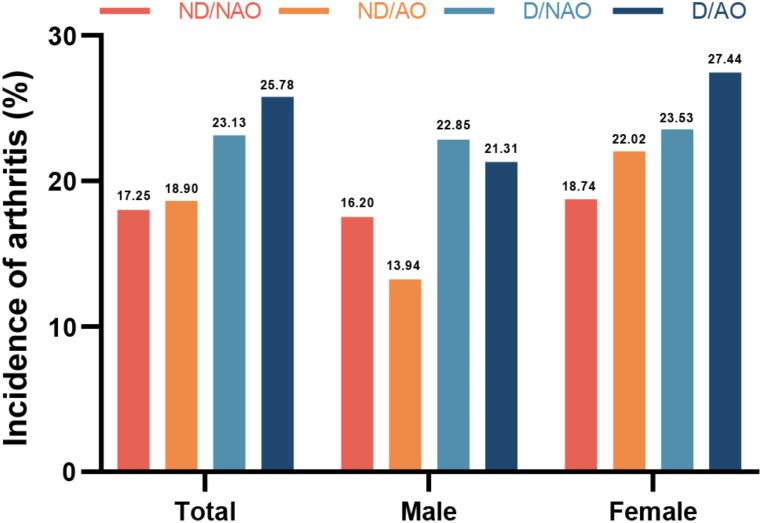
We included 6863 participants from the 2011 and 2015 waves of the China Health and Retirement Longitudinal Study (CHARLS). Dynapenia was defined as handgrip strength < 28 kg for males, and < 18 kg for females. Abdominal obesity was defined as a waist circumference ≥ 90 cm for males and ≥ 85 cm for females. Based on the definitions, all participants were divided into four groups: no dynapenia and no abdominal obesity (ND/NAO), abdominal obesity alone (ND/AO), dynapenia alone (D/NAO), and dynapenia and abdominal obesity (D/AO). The association between dynapenic abdominal obesity and new-onset arthritis was assessed by sex using the Poisson regression models.
RESULTS
After a four-year follow-up, 1272 (18.53%) participants reported new-onset arthritis. Those in the D/AO group had a significantly increased risk of new-onset arthritis compared to those in the ND/NAO group (adjusted relative risk (RR): 1.34, 95% confidence interval (CI): 1.01-1.77). In females, the ND/AO (RR: 1.21, 95% CI: 1.03-1.43) and D/AO (RR: 1.39, 95% CI: 1.01-1.93) groups were associated with a higher risk of arthritis. This significant association was not observed in males.
CONCLUSIONS
Our results indicated that the combined effect of dynapenia and abdominal obesity significantly increased the risk of new-onset arthritis in females, but this association was not observed in males.
背景
本研究旨在评估中年和老年人中dynapenic 腹型肥胖与新发关节炎之间的纵向关联。
方法
我们纳入了中国健康与退休纵向研究(CHARLS)2011 年和 2015 年两个波次的 6863 名参与者。dynapenia 定义为男性握力<28kg,女性握力<18kg。腹型肥胖定义为男性腰围≥90cm,女性腰围≥85cm。根据这些定义,所有参与者被分为四组:无 dynapenia 且无腹型肥胖(ND/NAO)、单纯腹型肥胖(ND/AO)、单纯 dynapenia(D/NAO)和 dynapenia 伴腹型肥胖(D/AO)。使用泊松回归模型按性别评估 dynapenic 腹型肥胖与新发关节炎之间的关系。
结果
在四年的随访后,1272 名(18.53%)参与者报告新发关节炎。与 ND/NAO 组相比,D/AO 组新发关节炎的风险显著增加(调整后的相对风险(RR):1.34,95%置信区间(CI):1.01-1.77)。在女性中,ND/AO 组(RR:1.21,95% CI:1.03-1.43)和 D/AO 组(RR:1.39,95% CI:1.01-1.93)新发关节炎的风险更高。这种显著关联在男性中未观察到。
结论
我们的研究结果表明,dynapenia 和腹型肥胖的联合作用显著增加了女性新发关节炎的风险,但在男性中未观察到这种关联。

 Zotero 插件