
皮下和口服自行给药的高剂量卡洛芬在雄性和雌性C57BL/6J小鼠中显示出良好的药代动力学和耐受性特征。
Subcutaneous and orally self-administered high-dose carprofen shows favorable pharmacokinetic and tolerability profiles in male and female C57BL/6J mice.
作者信息
Glasenapp Aylina, Bankstahl Jens P, Bähre Heike, Glage Silke, Bankstahl Marion
机构信息
Institute for Laboratory Animal Science and Central Animal Facility, Hannover Medical School, Hannover, Germany.
Department of Nuclear Medicine, Hannover Medical School, Hannover, Germany.
出版信息
Front Vet Sci. 2024 Sep 20;11:1430726. doi: 10.3389/fvets.2024.1430726. eCollection 2024.
INTRODUCTION
Surgical interventions in mice require appropriate pain relief to ensure animal welfare and to avoid influence of pain on research findings. Carprofen is a non-steroidal anti-inflammatory drug commonly used as an analgesic for interventions inducing mild to moderate pain in laboratory rodents. Despite its frequent use, species-specific data on pharmacokinetics (PK), side effects, and potential impact on behavioral pain indicators are limited.
METHODS
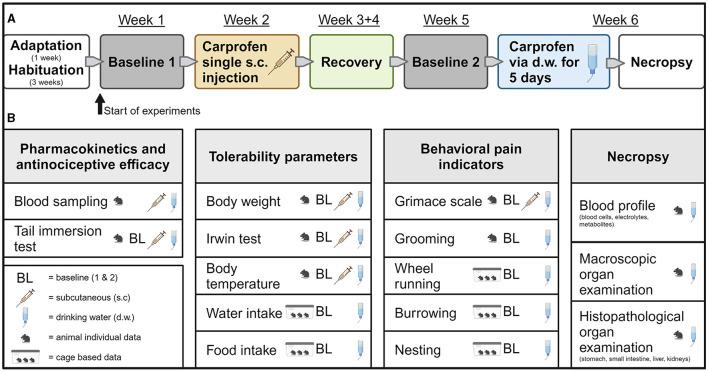
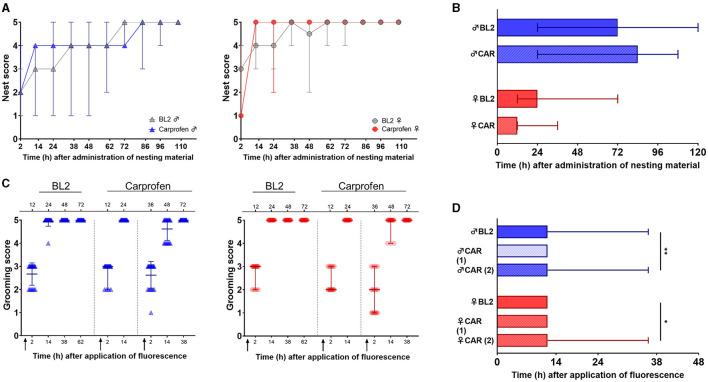
We determined PK and tolerability profiles of carprofen in healthy male and female C57BL/6J mice ( = 42), administered at highest recommended doses via single subcutaneous (s.c.) injection (20 mg/kg) and oral self-administration (25 mg/kg/24 h) per drinking water (d.w.) for 5 days. Plasma concentrations were measured at various time points after the start of the treatment ( = 6 per time point), and side effects were evaluated using a modified Irwin test battery, hematology, and histopathology. Additionally, potential interference with cage-side behaviors commonly used for pain assessment, such as the mouse grimace scale, wheel running, burrowing, nesting, and grooming activity, was investigated.
RESULTS
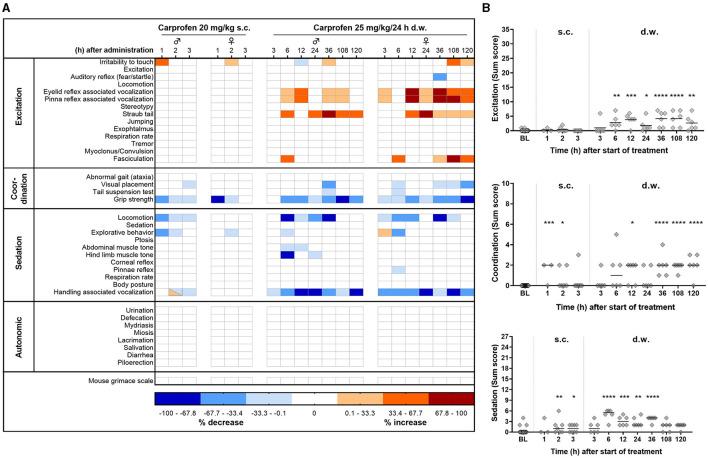
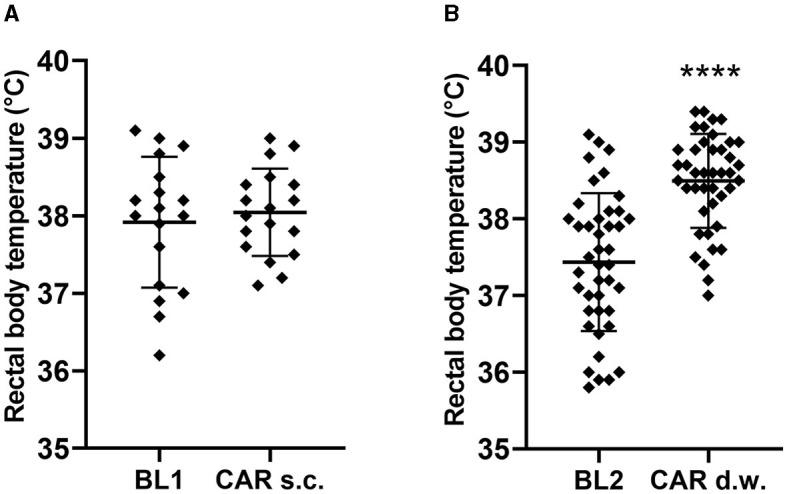
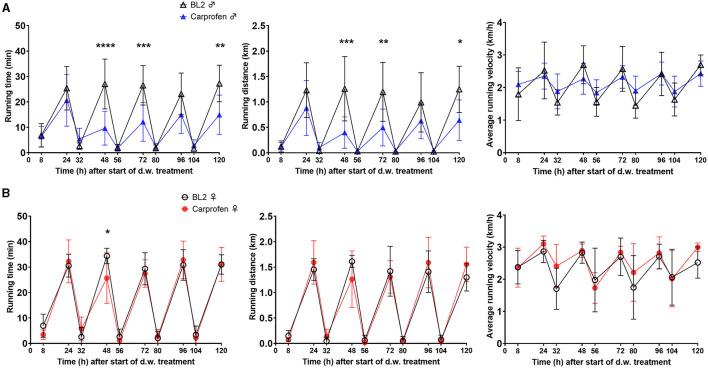
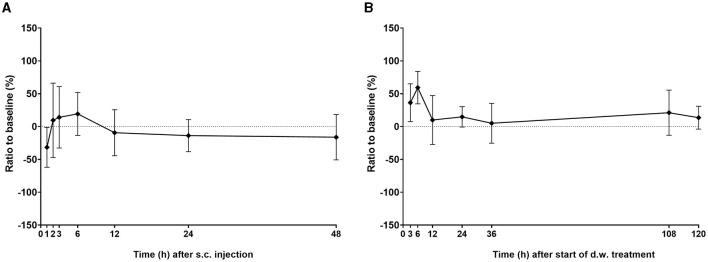
Maximum plasma concentrations of 133.4 ± 11.3 μg/ml were reached 1 h after single s.c. injection with an elimination half-life of 8.52 h. Intake from d.w. resulted in a steady state within 24 h after the start of the treatment with plasma levels of around 60 μg/ml over 5 days in both sexes. The medicated water was well-accepted, and increased d.w. intake was observed in the first 24 h after exposure ( < 0.0001). The Irwin test revealed only minor influence on tested behavior and physiological functions. However, during treatment via d.w., an increase in body temperature ( < 0.0001) was observed, as well as a reduction in voluntary wheel running activity by 49-70% in male mice. Moreover, grooming behavior was slightly affected. Hematology and histopathology were without pathological findings that could be attributed to carprofen treatment. High-dose carprofen can be considered safe and of favorable PK for both administration routes assessed in healthy C57BL/6J mice of both sexes. Further efficacy evaluation of carprofen as monoanalgesic or component of multimodal post-surgical regimens is clearly encouraged; however, the impact on behavioral markers used for pain assessment should be considered in this context.
引言
对小鼠进行手术干预时,需要适当的疼痛缓解措施,以确保动物福利,并避免疼痛对研究结果产生影响。卡洛芬是一种非甾体抗炎药,常用于实验室啮齿动物因轻度至中度疼痛干预而产生的镇痛。尽管其使用频繁,但关于药代动力学(PK)、副作用以及对行为疼痛指标潜在影响的物种特异性数据有限。
方法
我们测定了卡洛芬在健康雄性和雌性C57BL/6J小鼠(n = 42)中的药代动力学和耐受性特征,通过单次皮下(s.c.)注射(20 mg/kg)和经饮用水(d.w.)口服自行给药(25 mg/kg/24 h),持续5天,给予最高推荐剂量。在治疗开始后的不同时间点测量血浆浓度(每个时间点n = 6),并使用改良的欧文测试组、血液学和组织病理学评估副作用。此外,还研究了对常用于疼痛评估的笼边行为的潜在干扰,如小鼠 grimace 量表、转轮跑步、挖掘、筑巢和梳理活动。
结果
单次皮下注射后1小时达到最大血浆浓度133.4 ± 11.3 μg/ml,消除半衰期为8.52小时。经饮用水摄入在治疗开始后24小时内达到稳态,两性在5天内血浆水平约为60 μg/ml。含药饮水被很好地接受,在接触后的最初24小时内观察到饮水摄入量增加(P < 0.0001)。欧文测试显示对测试行为和生理功能仅有轻微影响。然而,在通过饮用水治疗期间,观察到体温升高(P < 0.0001),雄性小鼠的自愿转轮跑步活动减少49 - 70%。此外,梳理行为也受到轻微影响。血液学和组织病理学未发现可归因于卡洛芬治疗的病理结果。对于评估的两种给药途径,高剂量卡洛芬在健康两性C57BL/6J小鼠中可被认为是安全的且具有良好的药代动力学。显然鼓励对卡洛芬作为单一镇痛药或多模式术后方案的组成部分进行进一步的疗效评估;然而,在此背景下应考虑其对用于疼痛评估的行为标志物的影响。




 Zotero 插件