
一种用于双泛素化H1变体的位点特异性点击化学方法揭示了DNA修复蛋白RNF168的位置依赖性刺激。
A Site-Specific Click Chemistry Approach to Di-Ubiquitylate H1 Variants Reveals Position-Dependent Stimulation of the DNA Repair Protein RNF168.
作者信息
Franz Pauline, Delvaux de Fenffe Charlotte M, Fierz Beat
机构信息
Laboratory of Biophysical Chemistry of Macromolecules (LCBM), Institute of Chemical Sciences and Engineering (ISIC), EPFL (Ecole Polytechnique Fédérale de Lausanne), Station 6, 1015, Lausanne, Switzerland.
present address: Hubrecht Institute-KNAW & University Medical Center Utrecht, Uppsalalaan 8, 3584 CT, Utrecht, Nederland.
出版信息
Angew Chem Int Ed Engl. 2024 Dec 20;63(52):e202408435. doi: 10.1002/anie.202408435. Epub 2024 Nov 14.
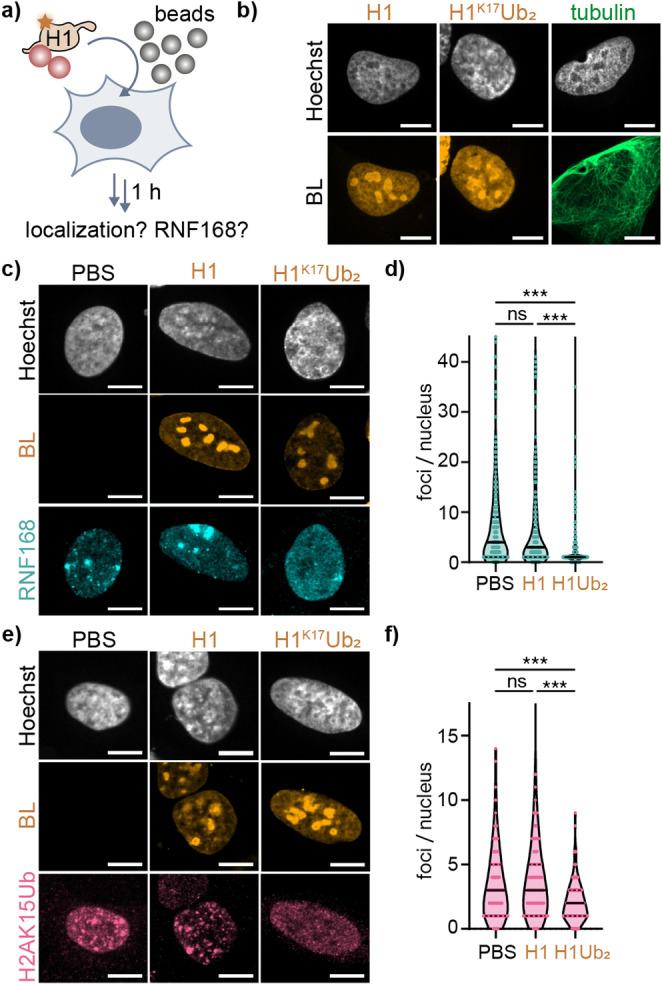
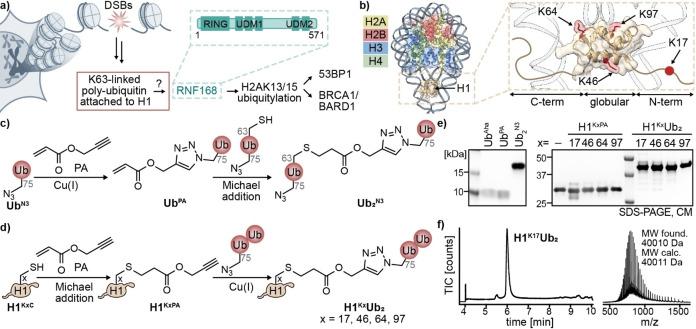
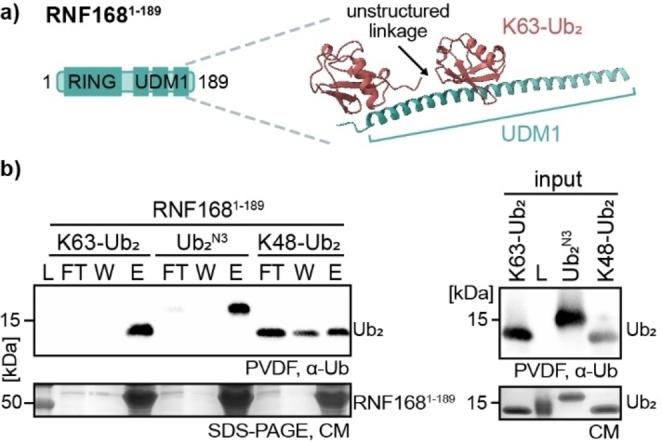
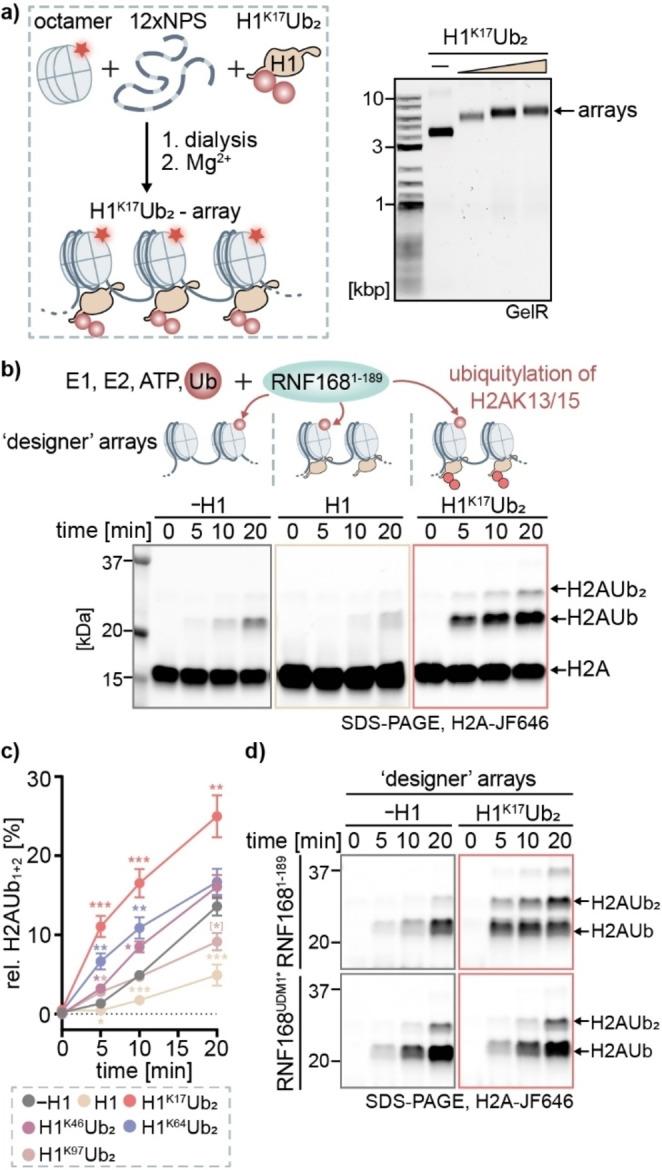
Ubiquitylation of histone H2A at lysines 13 and 15 by the E3 ligase RNF168 plays a key role in orchestrating DNA double-strand break (DSB) repair, which is often deregulated in cancer. RNF168 activity is triggered by DSB signaling cascades, reportedly through K63-linked poly-ubiquitylation of linker histone H1. However, direct experimental evidence of this mechanism has been elusive, primarily due to the lack of methods to specifically poly-ubiquitylate H1. Here, we developed a versatile click chemistry approach to covalently link multiple proteins in a site-specific, controlled, and stepwise manner. Applying this method, we synthesized H1 constructs bearing triazole-linked di-ubiquitin on four DNA repair-associated ubiquitylation hotspots (H1Ub, at K17, 46, 64 and 96). Integrated into nucleosome arrays, the H1Ub variants stimulated H2A ubiquitylation by RNF168 in a position-dependent manner, with H1Ub showing the strongest RNF168 activation effect. Moreover, we show that di-ubiquitin binding is the driving force underlying RNF168 recruitment, introducing H1Ub into living U-2 OS cells. Together, our results support the hypothesis of poly-ubiquitylated H1 guiding RNF168 recruitment to DSB sites. Moreover, we demonstrate how the streamlined synthesis of H1Ub variants enables mechanistic studies into RNF168 regulation, with potential implications for its inhibition in susceptible cancers.
E3 连接酶 RNF168 介导的组蛋白 H2A 赖氨酸 13 和 15 位点的泛素化在协调 DNA 双链断裂(DSB)修复中起关键作用,而这一过程在癌症中常常失调。据报道,RNF168 的活性由 DSB 信号级联触发,可能是通过连接组蛋白 H1 的 K63 连接的多聚泛素化实现的。然而,这一机制的直接实验证据一直难以捉摸,主要是因为缺乏特异性多聚泛素化 H1 的方法。在此,我们开发了一种通用的点击化学方法,以位点特异性、可控且逐步的方式共价连接多种蛋白质。应用该方法,我们在四个与 DNA 修复相关的泛素化热点(K17、46、64 和 96 位点的 H1Ub)上合成了带有三唑连接的二聚泛素的 H1 构建体。将 H1Ub 变体整合到核小体阵列中,其以位置依赖的方式刺激 RNF168 介导的 H2A 泛素化,其中 H1Ub 表现出最强的 RNF168 激活作用。此外我们还发现,引入活的 U-2 OS 细胞中的二聚泛素结合是 RNF168 募集的驱动力。总之,我们的结果支持多聚泛素化的 H1 将 RNF168 募集到 DSB 位点的假说。此外,我们展示了 H1Ub 变体的简化合成如何能够对 RNF168 的调控进行机制研究,这可能对其在易感癌症中的抑制作用具有潜在意义。
 Zotero 插件