
针刺疗法与非手术疗法治疗足底筋膜炎的比较效果:一项网状Meta分析
Comparative Effectiveness of Acupuncture Versus Non-surgical Modalities for Treating Plantar Fasciitis: A Network Meta-Analysis.
作者信息
Asokumaran Indrarajah, Verasamy Bavithaa Sufina, Hasan Mohd Idham B, Wong Danny Kit Chung, Ong Siew Siew, Ng Shih Chau
机构信息
Orthopaedics and Traumatology, Putrajaya Hospital, Putrajaya, MYS.
Integrative and Complementary Medicine, International Medical University, Kuala Lumpur, MYS.
出版信息
Cureus. 2024 Sep 8;16(9):e68959. doi: 10.7759/cureus.68959. eCollection 2024 Sep.
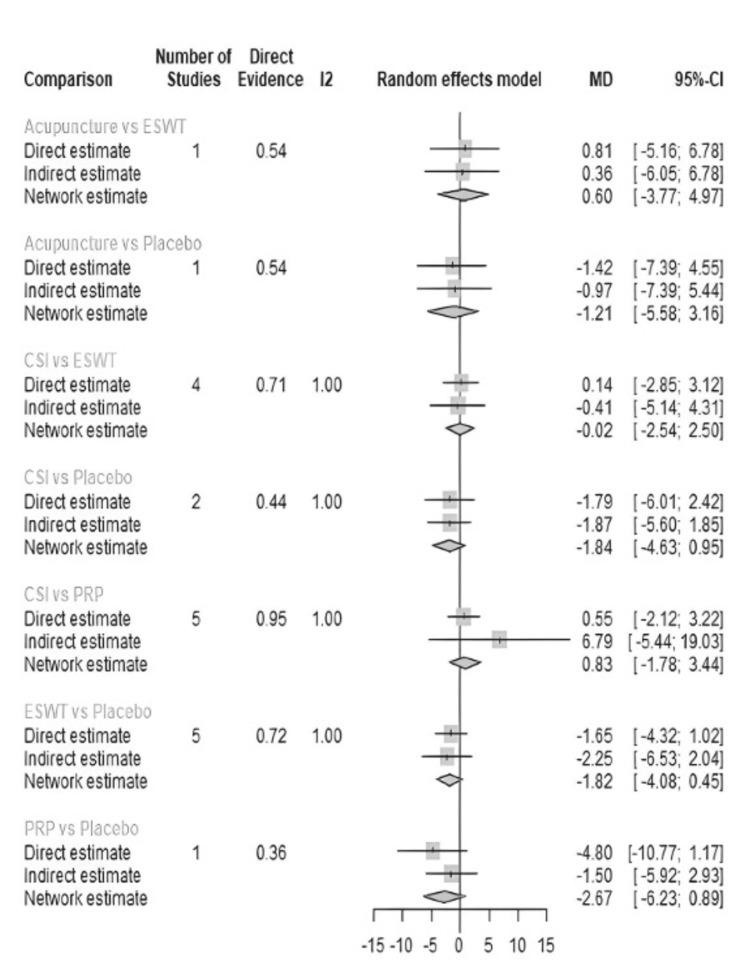
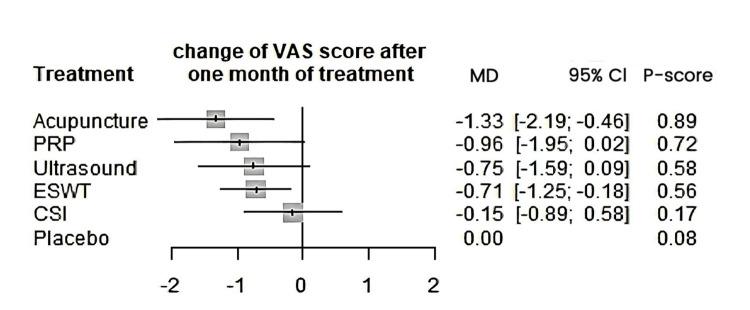
Plantar fasciitis, or plantar heel pain, causes inflammation of the plantar fascia due to various causes, with no clear consensus on the treatment protocol. Standard first-line treatment includes non-steroidal anti-inflammatory drugs and physiotherapy. Second-line treatment prior to surgery includes extracorporeal shockwave therapy (ESWT), ultrasound-guided (USG) therapy, corticosteroid injection (CSI), and platelet-rich plasma (PRP) injection. Recently, the use of acupuncture treatment has been gaining popularity, with increasing published evidence showing its effectiveness in treating plantar fasciitis. The objective of this study was to determine whether acupuncture intervention was a viable alternative treatment method for managing plantar fasciitis when compared to ESWT, USG therapy, CSI, and PRP injection. Data sources from PubMed, Google Scholar, Scopus, Science Direct, and China National Knowledge Infrastructure were reviewed. Clinical trials were searched from their inception over the period of January 2000 to October 2020. A total of 32 relevant papers were included for analysis, totaling 2390 samples. Visual Analog Scale (VAS) scores measuring pain were analyzed in terms of outcome after one and three months of treatment. Each time point was analyzed separately through a network meta-analysis using the frequentist approach. VAS scores for each intervention at baseline and the two-time points (i.e., one and three months) were included in the comprehensive meta-analysis. Then, differences in VAS scores were calculated in R studio (V4.1.2; RStudio: Integrated Development for R, RStudio, Inc., Boston, USA) using the netmeta package. The netmeta package was also used to perform the network meta-analysis and generate corresponding figures. Direct and indirect effects were assessed and visualized through a direct evidence plot and a node-splitting forest plot. Randomized controlled trials (RCTs) and non-RCTs involving treatments of acupuncture, ESWT, USG therapy, CSI, or PRP injection, either in comparison with each other or with a placebo, were included in our review. Our meta-analysis showed that at one month, VAS scores for acupuncture treatment had the highest mean difference (MD) of -1.33 (95% confidence interval (95% CI) = -2.19 to -0.46) compared to placebo, indicating that acupuncture treatment was more effective than other treatment arms when compared to placebo. Analysis at threemonths showed that the highest-ranked treatment was PRP injection, with an MD of -2.67 (95% CI = -6.23 to 0.89). However, the CI for the net effect of all treatments crossed the null effect on the forest plot, indicating no statistically significant difference between the treatment and placebo. Acupuncture treatment should be considered as a second-line treatment for treatment of plantar fasciitis together with other common treatment options such as ESWT, PRP injection, CSI, and USG therapy. Further long-term studies measuring acupuncture treatment outcomes would be beneficial in the future.
足底筋膜炎,又称足跟痛,由多种原因导致足底筋膜发炎,目前对于治疗方案尚无明确共识。标准的一线治疗包括使用非甾体类抗炎药和物理治疗。手术前的二线治疗包括体外冲击波疗法(ESWT)、超声引导(USG)疗法、皮质类固醇注射(CSI)和富血小板血浆(PRP)注射。近来,针灸治疗的应用越来越广泛,越来越多发表的证据表明其对治疗足底筋膜炎有效。本研究的目的是确定与ESWT、USG疗法、CSI和PRP注射相比,针灸干预是否是治疗足底筋膜炎的一种可行替代治疗方法。我们检索了来自PubMed、谷歌学术、Scopus、科学Direct和中国知网的数据来源。检索了2000年1月至2020年10月期间发表的临床试验。总共纳入32篇相关论文进行分析,样本总数为2390例。根据治疗1个月和3个月后的结果,分析了测量疼痛的视觉模拟量表(VAS)评分。每个时间点通过使用频率学派方法的网络荟萃分析进行单独分析。将每种干预措施在基线以及两个时间点(即1个月和3个月)的VAS评分纳入综合荟萃分析。然后,在R studio(V4.1.2;RStudio:R的集成开发环境,RStudio公司,美国波士顿)中使用netmeta软件包计算VAS评分的差异。netmeta软件包还用于进行网络荟萃分析并生成相应的图表。通过直接证据图和节点拆分森林图评估并可视化直接和间接效应。我们的综述纳入了涉及针灸、ESWT、USG疗法、CSI或PRP注射治疗的随机对照试验(RCT)和非RCT,这些试验相互比较或与安慰剂比较。我们的荟萃分析表明,在1个月时,与安慰剂相比,针灸治疗的VAS评分平均差异(MD)最高,为-1.33(95%置信区间(95%CI)=-2.19至-0.46),这表明与安慰剂相比,针灸治疗比其他治疗组更有效。在三个月时的分析表明,排名最高的治疗方法是PRP注射,MD为-2.67(95%CI=-6.23至0.89)。然而,所有治疗的净效应的CI在森林图上穿过无效效应,表明治疗与安慰剂之间无统计学显著差异。针灸治疗应与ESWT、PRP注射、CSI和USG疗法等其他常见治疗方案一起被视为治疗足底筋膜炎的二线治疗方法。未来进行进一步测量针灸治疗结果的长期研究将是有益的。




 Zotero 插件