
卡波西肉瘤相关疱疹病毒的低氧再激活
Hypoxic reactivation of Kaposi's sarcoma associated herpesvirus.
作者信息
Singh Rajnish Kumar, Torne Atharva S, Robertson Erle S
机构信息
Department of Otorhinolaryngology-Head and Neck Surgery, Perelman School of Medicine, University of Pennsylvania, Philadelphia, 19104, USA.
出版信息
Cell Insight. 2024 Sep 7;3(6):100200. doi: 10.1016/j.cellin.2024.100200. eCollection 2024 Dec.
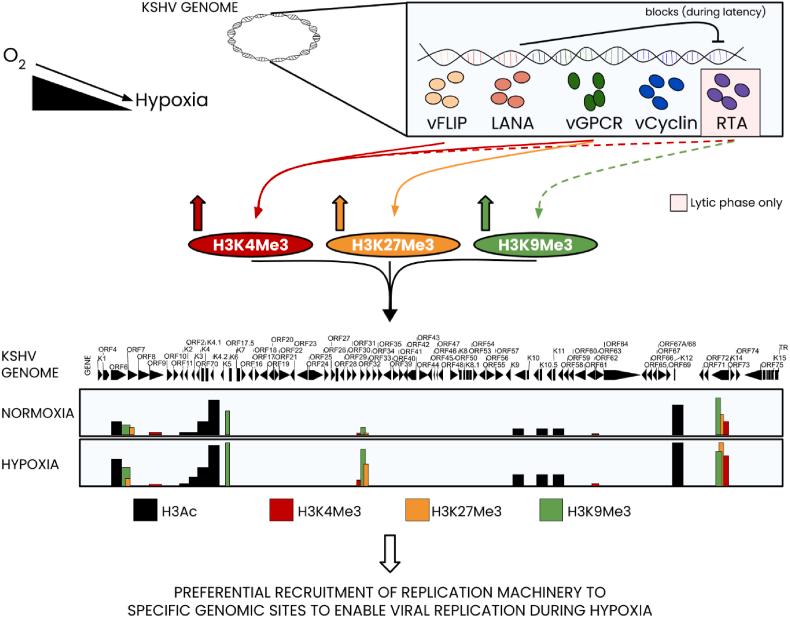
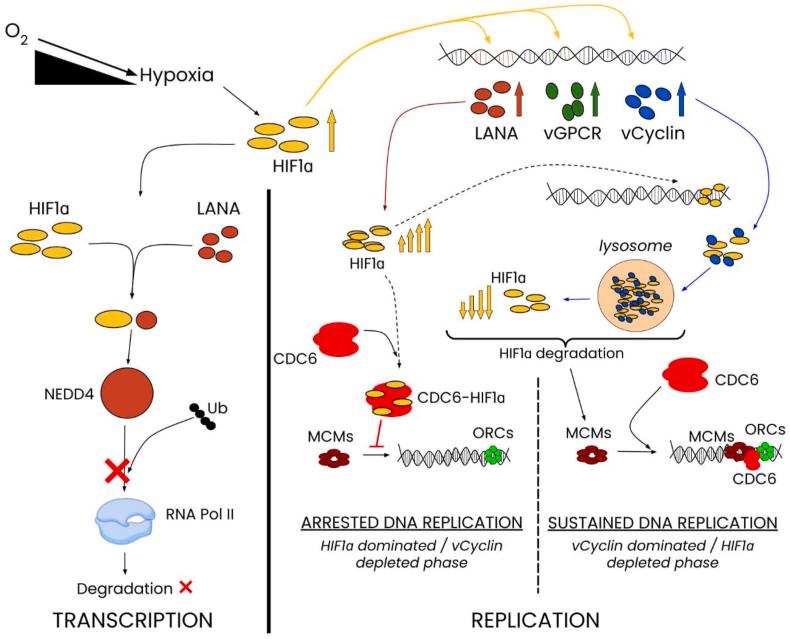
Hypoxic reactivation of Kaposi's sarcoma-associated herpesvirus (KSHV) refers to the phenomenon under low oxygen where the virus goes from latent to lytic replication. Typically, healthy cells generally cease cell division and DNA replication under hypoxic conditions due to limited resources, and the presence of physiological inhibitors. This restricted replication under hypoxic conditions is considered an employed strategy of the cell to minimize energy consumption. However, cancerous cells continuously replicate and divide in hypoxic conditions by reprogramming several aspects of their cell physiology, including but not limited to metabolism, cell cycle, DNA replication, transcription, translation, and the epigenome. KSHV infection, similar to cancerous cells, is known to bypass hypoxia-induced restrictions and undergo reactivation to produce progeny viruses. In previous studies we have mapped several aspects of cell physiology that are manipulated by KSHV through its latent antigens during hypoxic conditions, which allows for a permissive environment for its replication. We discuss the major strategies utilized by KSHV to bypass hypoxia-induced repression. We also describe the KSHV-encoded antigens responsible for modulating these cellular processes important for successful viral replication and persistence in hypoxia.
卡波西肉瘤相关疱疹病毒(KSHV)的低氧再激活是指在低氧条件下病毒从潜伏状态转变为裂解复制的现象。通常,由于资源有限以及生理抑制剂的存在,健康细胞在低氧条件下一般会停止细胞分裂和DNA复制。在低氧条件下这种受限的复制被认为是细胞为尽量减少能量消耗而采用的一种策略。然而,癌细胞通过重新编程其细胞生理学的几个方面,包括但不限于代谢、细胞周期、DNA复制、转录、翻译和表观基因组,在低氧条件下持续复制和分裂。与癌细胞类似,已知KSHV感染可绕过低氧诱导的限制并进行再激活以产生子代病毒。在先前的研究中,我们已经绘制了KSHV在低氧条件下通过其潜伏抗原操纵的细胞生理学的几个方面,这为其复制提供了一个允许的环境。我们讨论了KSHV用于绕过低氧诱导的抑制的主要策略。我们还描述了负责调节这些对病毒在低氧条件下成功复制和持续存在很重要的细胞过程的KSHV编码抗原。


 Zotero 插件