
解析炎症性疾病中的蛋白质组学表达:一项通过质谱分析对人类脑脊液中感染性、非感染性和创伤性脑损伤进行比较的探索。
Deciphering Proteomic Expression in Inflammatory Disorders: A Mass Spectrometry Exploration Comparing Infectious, Noninfectious, and Traumatic Brain Injuries in Human Cerebrospinal Fluid.
作者信息
Dyhrfort Philip, Lindblad Caroline, Widgren Anna, Virhammar Johan, Piehl Fredrik, Bergquist Jonas, Al Nimer Faiez, Rostami Elham
机构信息
Department of Medical Sciences, Uppsala University, Uppsala, Sweden.
Department of Neurosurgery, Uppsala University Hospital, Uppsala, Sweden.
出版信息
Neurotrauma Rep. 2024 Sep 20;5(1):857-873. doi: 10.1089/neur.2024.0050. eCollection 2024.
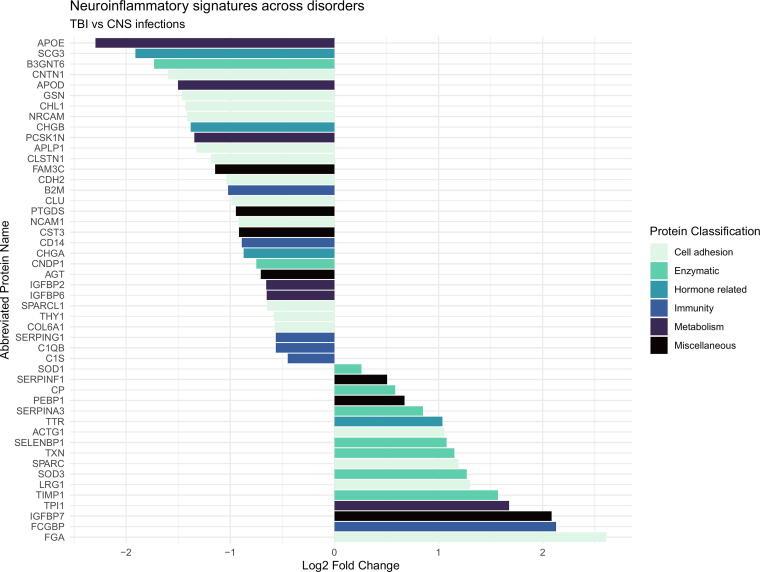
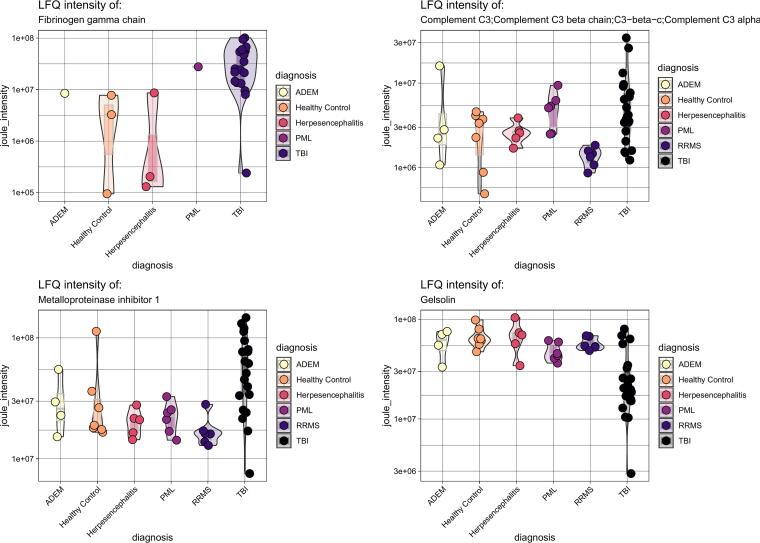
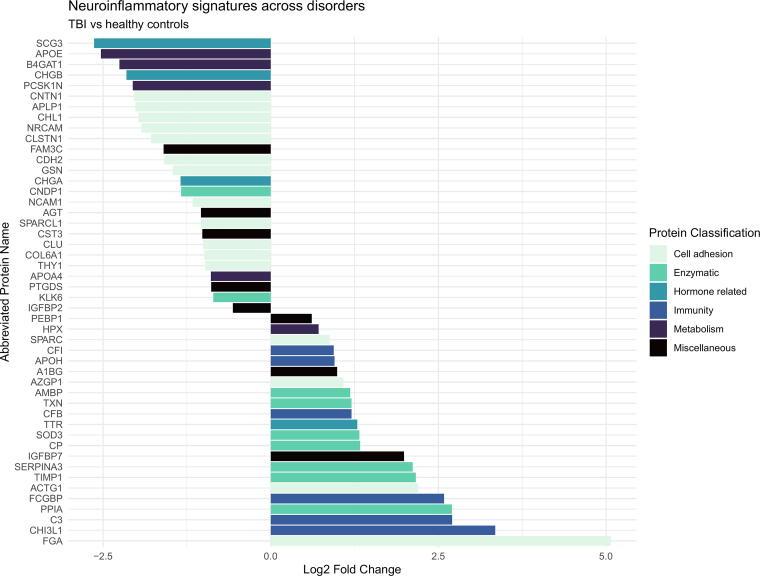
The central nervous system (CNS) evokes a complex inflammatory response to injury. Inflammatory cascades are present in traumatic, infectious, and noninfectious disorders affecting the brain. It contains a mixture of pro- and anti-inflammatory reactions involving well-known proteins, but also numerous proteins less explored in these processes. The aim of this study was to explore the distinct inflammatory response in traumatic brain injury (TBI) compared with other CNS injuries by utilization of mass-spectrometry. In total, 56 patients had their cerebrospinal fluid (CSF) analyzed with the use of mass-spectrometry. Among these, CSF was collected via an external ventricular drain (EVD) from = 21 patients with acute TBI. The resulting protein findings were then compared with CSF obtained by lumbar puncture from = 14 patients with noninfectious CNS disorders comprising relapsing-remitting multiple sclerosis, anti--methyl-d-aspartate-receptor encephalitis, acute disseminated encephalomyelitis, and = 14 patients with progressive multifocal leukoencephalopathy, herpes simplex encephalitis, and other types of viral meningitis. We also utilized = 7 healthy controls (HCs). In the comparison between TBI and noninfectious inflammatory CNS disorders, concentrations of 55 proteins significantly differed between the groups. Among them, 23 and 32 proteins were up- and downregulated, respectively, in the TBI group. No proteins were uniquely identified in either group. In the comparison of TBI and HC, 51 proteins were significantly different, with 24 and 27 proteins being up- and downregulated, respectively, in TBI. Two proteins (fibrinogen gamma chain and transketolase) were uniquely identified in all samples of the TBI group. Also in the last comparison, TBI versus infectious inflammatory CNS disorders, 51 proteins differed between the two groups, with 19 and 32 proteins being up- and downregulated, respectively, in TBI, and no unique proteins being identified. Due to large discrepancies between the groups compared, the following proteins were selected for further deeper analysis among those being differentially regulated: APOE, CFB, CHGA, CHI3L1, C3, FCGBP, FGA, GSN, IGFBP7, LRG1, SERPINA3, SOD3, and TTR. We found distinct proteomic profiles in the CSF of TBI patients compared with HC and different disease controls, indicating a specific interplay between inflammatory factors, metabolic response, and cell integrity. In relation to primarily infectious or inflammatory disorders, unique inflammatory pathways seem to be engaged, and could potentially serve as future treatment targets.
中枢神经系统(CNS)对损伤会引发复杂的炎症反应。炎症级联反应存在于影响大脑的创伤性、感染性和非感染性疾病中。它包含促炎和抗炎反应的混合,涉及知名蛋白质,也包括许多在这些过程中较少被探索的蛋白质。本研究的目的是通过质谱分析来探索创伤性脑损伤(TBI)与其他中枢神经系统损伤相比独特的炎症反应。总共56例患者的脑脊液(CSF)通过质谱进行分析。其中,通过外部脑室引流管(EVD)从21例急性TBI患者中收集脑脊液。然后将所得蛋白质结果与通过腰椎穿刺从14例非感染性中枢神经系统疾病患者(包括复发缓解型多发性硬化症、抗N-甲基-D-天冬氨酸受体脑炎、急性播散性脑脊髓炎)以及14例进行性多灶性白质脑病、单纯疱疹性脑炎和其他类型病毒性脑膜炎患者中获得的脑脊液进行比较。我们还纳入了7例健康对照(HCs)。在TBI与非感染性炎症性中枢神经系统疾病的比较中,两组之间55种蛋白质的浓度存在显著差异。其中,TBI组中分别有23种和32种蛋白质上调和下调。两组均未发现独特的蛋白质。在TBI与HC的比较中,51种蛋白质存在显著差异,TBI组中分别有24种和27种蛋白质上调和下调。在TBI组的所有样本中唯一鉴定出两种蛋白质(纤维蛋白原γ链和转酮醇酶)。同样在最后一组比较中,TBI与感染性炎症性中枢神经系统疾病,两组之间有51种蛋白质不同,TBI组中分别有19种和32种蛋白质上调和下调,未鉴定出独特蛋白质。由于所比较的组之间存在较大差异,在差异调节的蛋白质中选择以下蛋白质进行进一步深入分析:载脂蛋白E(APOE)、补体因子B(CFB)、嗜铬粒蛋白A(CHGA)、几丁质酶3样蛋白1(CHI3L1)、补体3(C3)、纤维连接蛋白结合蛋白(FCGBP)、纤维蛋白原A链(FGA)、凝溶胶蛋白(GSN)、胰岛素样生长因子结合蛋白7(IGFBP7)、富含亮氨酸α-2糖蛋白1(LRG1)、丝氨酸蛋白酶抑制剂A3(SERPINA3)、超氧化物歧化酶3(SOD3)和甲状腺素转运蛋白(TTR)。我们发现与HC和不同疾病对照相比,TBI患者脑脊液中的蛋白质组学特征不同,表明炎症因子、代谢反应和细胞完整性之间存在特定的相互作用。与主要的感染性或炎症性疾病相关,似乎有独特的炎症途径被激活,并且有可能作为未来的治疗靶点。

 Zotero 插件