
以用户为中心的个人用外骨骼设计:关于ABLE外骨骼设备对脊髓损伤个体在家庭和社区环境中执行技能的可行性和可用性的临床研究。
User-centered design of a personal-use exoskeleton: a clinical investigation on the feasibility and usability of the ABLE Exoskeleton device for individuals with spinal cord injury to perform skills for home and community environments.
作者信息
Nadorf Franziska, Wright Mark Andrew, López-Matas Helena, Porras Erika, Carnicero-Carmona Alfons, Hensel Cornelia, Franz Steffen, Weidner Norbert, Vidal Joan, Opisso Eloy, Rupp Rüdiger
机构信息
Spinal Cord Injury Center, Heidelberg University Hospital, Heidelberg, Germany.
Institut Guttmann, University Institute Attached to the Universitat Autònoma de Barcelona, Barcelona, Spain.
出版信息
Front Neurosci. 2024 Sep 26;18:1437358. doi: 10.3389/fnins.2024.1437358. eCollection 2024.
INTRODUCTION
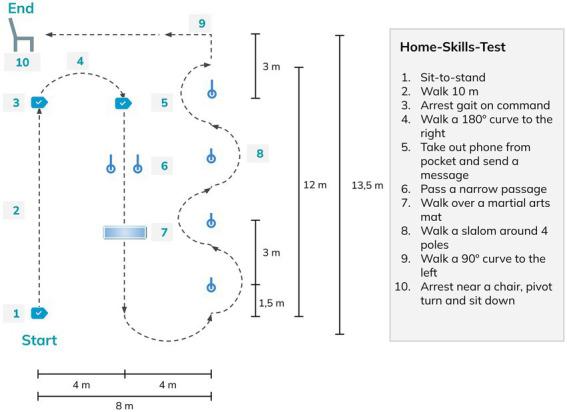
The ABLE Exoskeleton has been tested to be safe and feasible for persons with spinal cord injury (SCI) to complete basic skills in clinical settings but has not been tested for use in home and community environments. A user-centered design process was employed to test the feasibility of the current ABLE Exoskeleton (designed for clinical use) for persons with SCI to perform the basic and advanced skills required for home and community environments, to gain crucial feedback for the development of a novel personal-use exoskeleton.
METHODS
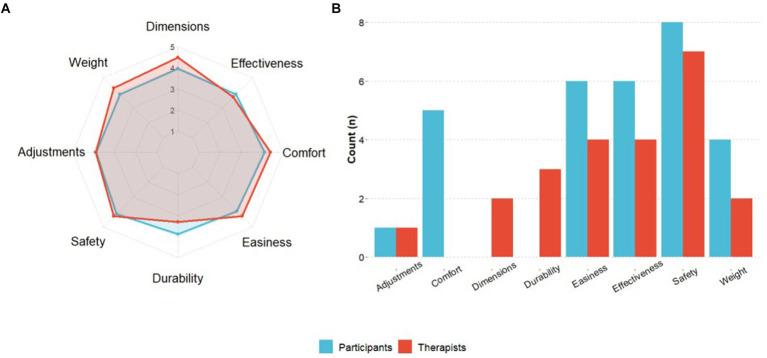
In this prospective pretest-posttest quasi-experimental study across two SCI centers (Germany, Spain), in-and outpatients with SCI were included into a 22-session training and assessment protocol, utilizing the ABLE Exoskeleton. Feasibility and usability measures [level of assistance (LoA) for basic and advanced skills, donning/doffing-time and LoA] were recorded together with safety outcomes, and participant and therapist satisfaction with the device.
RESULTS
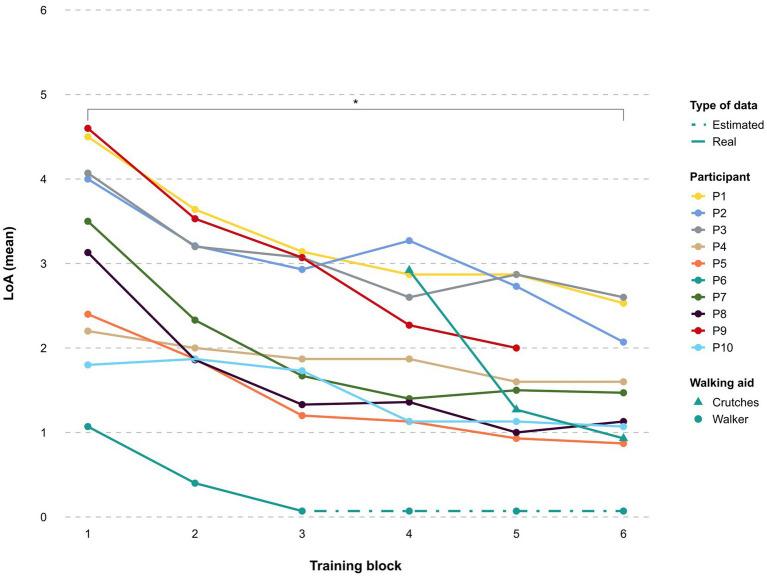
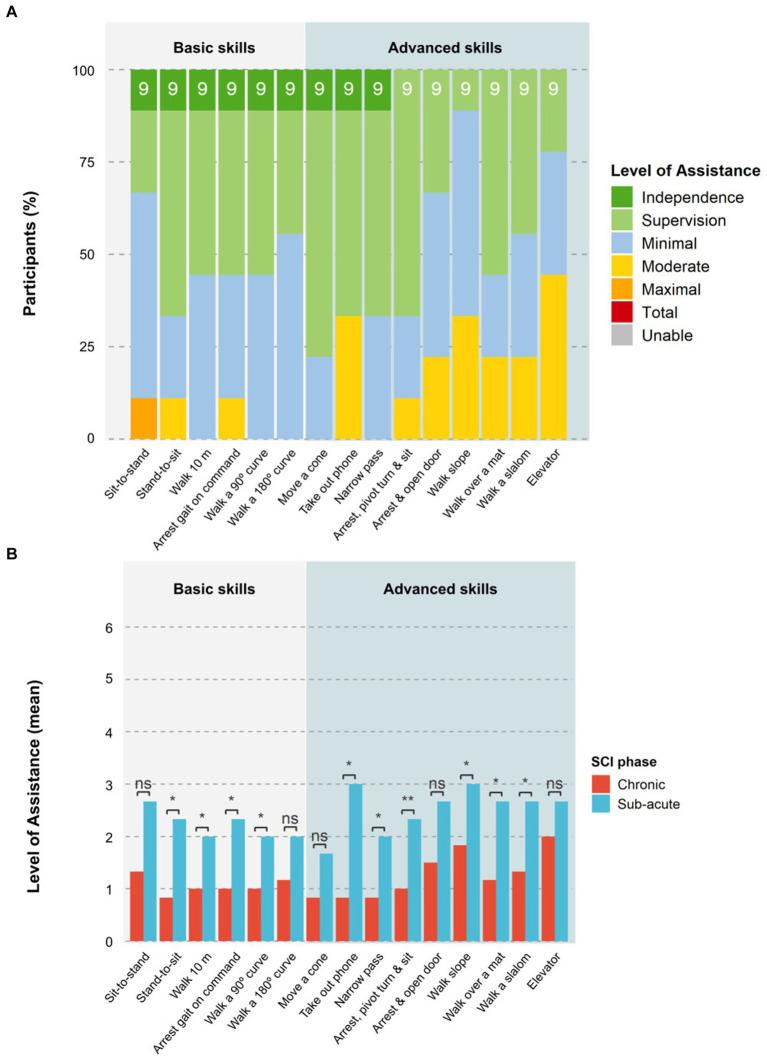
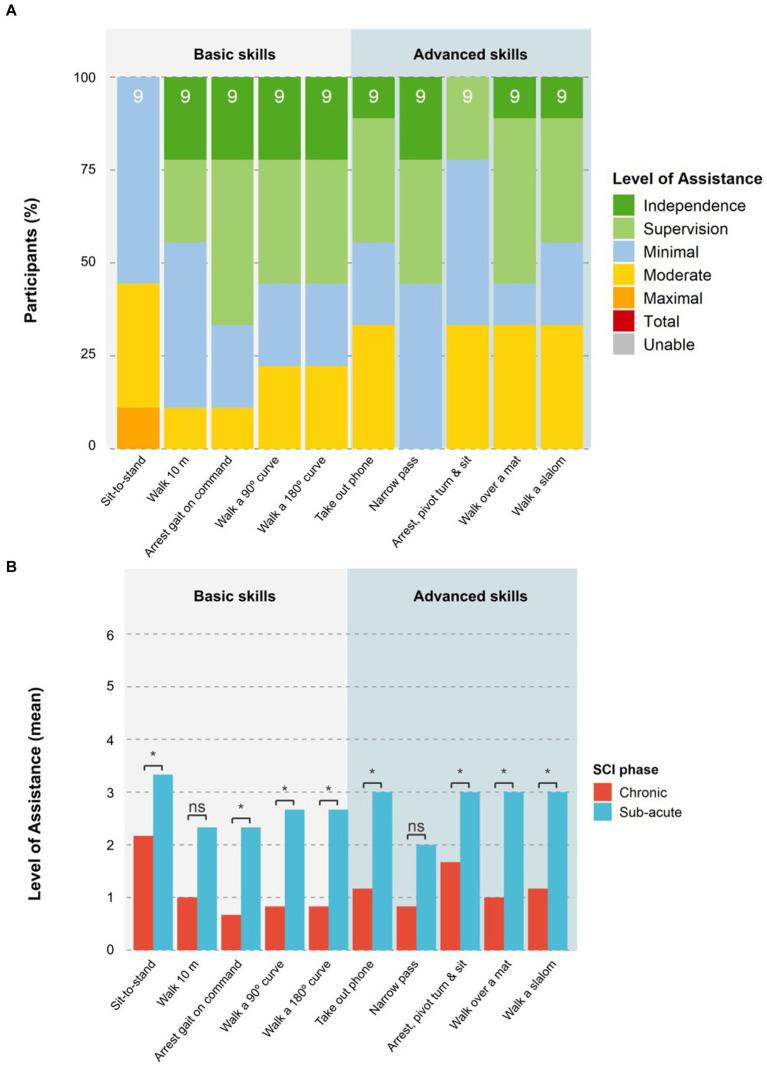
10 participants (44.4 ± 24 years), with SCI from C5 to T11, (American Spinal Injury Association Impairment Scale A-D) completed the study. In 209 sessions, six device-related adverse events (pain and skin lesions) were reported. Average total time for don and doff was 10:23 ± 3:30 min. Eight participants were able to complete don and doff with minimal assistance or less. Independence to carry out all skills in the device increased significantly for all participants ( < 0.05). Participants with chronic SCI required a significantly ( < 0.05) lower LoA for six of the nine advanced skills than those in the sub-acute phase.
DISCUSSION
This study shows that the ABLE Exoskeleton is safe, feasible and usable for people with SCI in respect to independent donning, doffing and performance of basic and advanced exoskeleton skills. The supervised exoskeleton use in the clinical environment was a highly valuable approach for identifying the challenging tasks and the necessary technological developments that need to be carried out for a personal-use exoskeleton, including a more independent sit-to-stand transition, faster speed of transitions between states and a richer display on the remote control for the user.
CLINICAL TRIAL REGISTRATION
引言
ABLE外骨骼已被测试对脊髓损伤(SCI)患者在临床环境中完成基本技能是安全可行的,但尚未在家庭和社区环境中进行测试。采用以用户为中心的设计流程,测试当前的ABLE外骨骼(专为临床使用设计)对SCI患者执行家庭和社区环境所需的基本和高级技能的可行性,以获取开发新型个人使用外骨骼的关键反馈。
方法
在这项跨越两个SCI中心(德国、西班牙)的前瞻性预测试-后测试准实验研究中,将SCI门诊和住院患者纳入一个为期22节的培训和评估方案,使用ABLE外骨骼。记录可行性和可用性指标[基本和高级技能的辅助水平(LoA)、穿脱时间和LoA]以及安全结果,以及参与者和治疗师对该设备的满意度。
结果
10名参与者(44.4±24岁),SCI损伤平面为C5至T11,(美国脊髓损伤协会损伤分级A-D级)完成了研究。在209节课程中,报告了6起与设备相关的不良事件(疼痛和皮肤损伤)。穿脱的平均总时间为10:23±3:30分钟。8名参与者能够在极少或无辅助的情况下完成穿脱。所有参与者在设备中执行所有技能的独立性显著提高(<0.05)。慢性SCI参与者在9项高级技能中的6项上所需的LoA显著低于亚急性期参与者(<0.05)。
讨论
本研究表明,ABLE外骨骼在独立穿脱以及执行基本和高级外骨骼技能方面对SCI患者是安全、可行且可用的。在临床环境中监督使用外骨骼是一种非常有价值的方法,可用于识别个人使用外骨骼所需面对的具有挑战性的任务以及需要进行的必要技术开发,包括更独立的坐立转换、更快的状态转换速度以及为用户在遥控器上提供更丰富的显示。
临床试验注册





 Zotero 插件