
超越骨吸收:破骨细胞作为骨形成的驱动因素
Beyond resorption: osteoclasts as drivers of bone formation.
作者信息
Xiang Qianfeng, Li Lei, Ji Wei, Gawlitta Debby, Walboomers X Frank, van den Beucken Jeroen J J P
机构信息
Radboudumc, Dentistry - Regenerative Biomaterials, Philips Van Leijdenlaan 25, Nijmegen, 6525EX, the Netherlands.
State Key Laboratory of Oral & Maxillofacial Reconstruction and Regeneration, Key Laboratory of Oral Biomedicine Ministry of Education, Hubei Key Laboratory of Stomatology, School & Hospital of Stomatology, Wuhan University, Wuhan, China.
出版信息
Cell Regen. 2024 Oct 11;13(1):22. doi: 10.1186/s13619-024-00205-x.
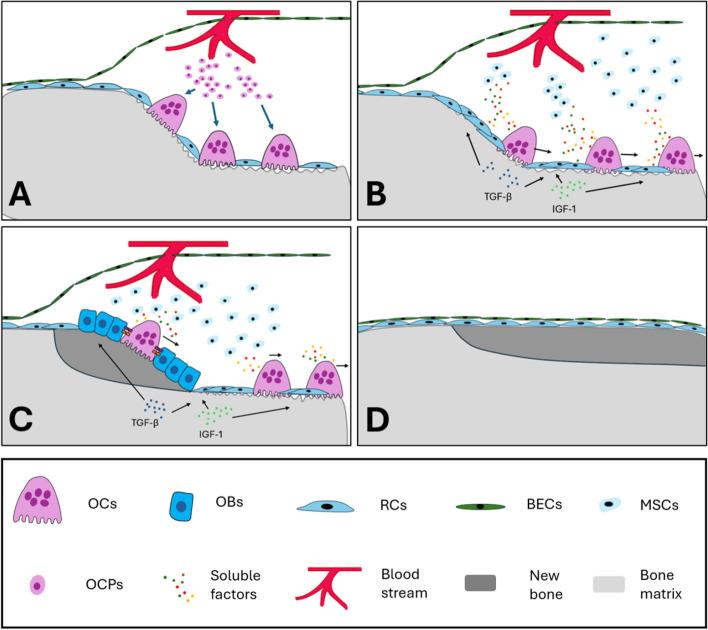
Emerging evidence illustrates that osteoclasts (OCs) play diverse roles beyond bone resorption, contributing significantly to bone formation and regeneration. Despite this, OCs remain mysterious cells, with aspects of their lifespan-from origin, fusion, alterations in cellular characteristics, to functions-remaining incompletely understood. Recent studies have identified that embryonic osteoclastogenesis is primarily driven by osteoclast precursors (OCPs) derived from erythromyeloid progenitors (EMPs). These precursor cells subsequently fuse into OCs essential for normal bone development and repair. Postnatally, hematopoietic stem cells (HSCs) become the primary source of OCs, gradually replacing EMP-derived OCs and assuming functional roles in adulthood. The absence of OCs during bone development results in bone structure malformation, including abnormal bone marrow cavity formation and shorter long bones. Additionally, OCs are reported to have intimate interactions with blood vessels, influencing bone formation and repair through angiogenesis regulation. Upon biomaterial implantation, activation of the innate immune system ensues immediately. OCs, originating from macrophages, closely interact with the immune system. Furthermore, evidence from material-induced bone formation events suggests that OCs are pivotal in these de novo bone formation processes. Nevertheless, achieving a pure OC culture remains challenging, and interpreting OC functions in vivo faces difficulties due to the presence of other multinucleated cells around bone-forming biomaterials. We here describe the fusion characteristics of OCPs and summarize reliable markers and morphological changes in OCs during their fusion process, providing guidance for researchers in identifying OCs both in vitro and in vivo. This review focuses on OC formation, characterization, and the roles of OCs beyond resorption in various bone pathophysiological processes. Finally, therapeutic strategies targeting OCs are discussed.
新出现的证据表明,破骨细胞(OCs)在骨吸收之外还发挥着多种作用,对骨形成和再生有重大贡献。尽管如此,破骨细胞仍然是神秘的细胞,其生命周期的各个方面——从起源、融合、细胞特征的改变到功能——仍未被完全理解。最近的研究发现,胚胎破骨细胞生成主要由源自红髓系祖细胞(EMPs)的破骨细胞前体(OCPs)驱动。这些前体细胞随后融合形成对正常骨骼发育和修复至关重要的破骨细胞。出生后,造血干细胞(HSCs)成为破骨细胞的主要来源,逐渐取代源自EMPs的破骨细胞,并在成年期发挥功能作用。骨骼发育过程中破骨细胞的缺失会导致骨骼结构畸形,包括异常的骨髓腔形成和长骨变短。此外,据报道破骨细胞与血管有密切相互作用,通过调节血管生成影响骨形成和修复。生物材料植入后,先天性免疫系统会立即被激活。源自巨噬细胞的破骨细胞与免疫系统密切相互作用。此外,材料诱导的骨形成事件的证据表明,破骨细胞在这些新生骨形成过程中起关键作用。然而,实现纯破骨细胞培养仍然具有挑战性,并且由于骨形成生物材料周围存在其他多核细胞,在体内解释破骨细胞功能面临困难。我们在此描述破骨细胞前体的融合特征,并总结破骨细胞在融合过程中的可靠标志物和形态变化,为研究人员在体外和体内识别破骨细胞提供指导。本综述重点关注破骨细胞的形成、特征以及破骨细胞在各种骨病理生理过程中除吸收作用之外的作用。最后,讨论了针对破骨细胞的治疗策略。


 Zotero 插件