
使用面对面移动技术对希腊正常发育儿童进行神经发育障碍的自动检测:随机对照试验。
Automated Detection of Neurodevelopmental Disorders Using Face-to-Face Mobile Technology Among Typically Developing Greek Children: Randomized Controlled Trial.
机构信息
Department of Speech and Language Therapy, School of Health Sciences, University of Ioannina, Ioannina, Greece.
Laboratory of New Technologies and Distance Learning, Department of Early Childhood Education, University of Ioannina, Ioannina, Greece.
出版信息
JMIR Form Res. 2024 Oct 11;8:e53465. doi: 10.2196/53465.
BACKGROUND
Neurodevelopmental disorders (NDs) are characterized by heterogeneity, complexity, and interactions among multiple domains with long-lasting effects in adulthood. Early and accurate identification of children at risk for NDs is crucial for timely intervention, yet many cases remain undiagnosed, leading to missed opportunities for effective interventions. Digital tools can help clinicians assist and identify NDs. The concept of using serious games to enhance health care has gained attention among a growing group of scientists, entrepreneurs, and clinicians.
OBJECTIVE
This study aims to explore the core principles of automated mobile detection of NDs in typically developing Greek children, using a serious game developed within the SmartSpeech project, designed to evaluate multiple developmental domains through principal component analysis (PCA).
METHODS
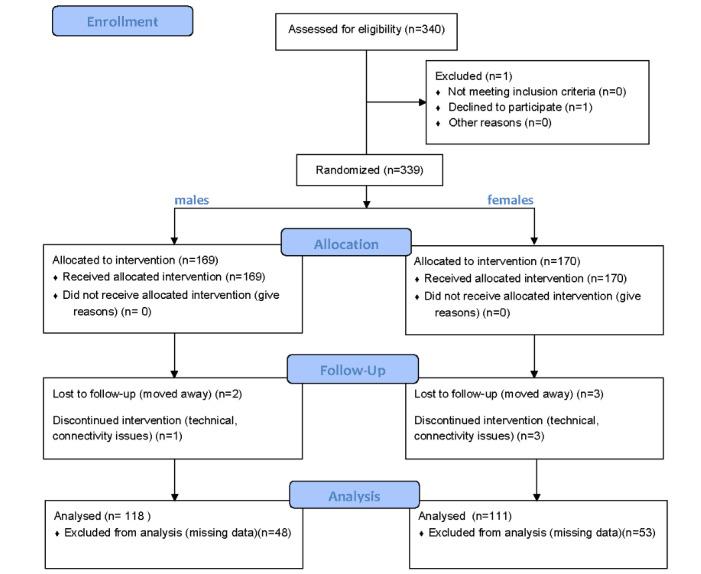
A total of 229 typically developing children aged 4 to 12 years participated in the study. The recruitment process involved open calls through public and private health and educational institutions across Greece. Parents were thoroughly informed about the study's objectives and procedures, and written consent was obtained. Children engaged under the clinician's face-to-face supervision with the serious game "Apsou," which assesses 18 developmental domains, including speech, language, psychomotor, cognitive, psychoemotional, and hearing abilities. Data from the children's interactions were analyzed using PCA to identify key components and underlying principles of ND detection.
RESULTS
A sample of 229 typically developing preschoolers and early school-aged children played the Apsou mobile serious game for automated detection of NDs. Performing a PCA, the findings identified 5 main components accounting for about 80% of the data variability that potentially have significant prognostic implications for a safe diagnosis of NDs. Varimax rotation explained 61.44% of the total variance. The results underscore key theoretical principles crucial for the automated detection of NDs. These principles encompass communication skills, speech and language development, vocal processing, cognitive skills and sensory functions, and visual-spatial skills. These components align with the theoretical principles of child development and provide a robust framework for automated ND detection.
CONCLUSIONS
The study highlights the feasibility and effectiveness of using serious games for early ND detection in children. The identified principal components offer valuable insights into critical developmental domains, paving the way for the development of advanced machine learning applications to support highly accurate predictions and classifications for automated screening, diagnosis, prognosis, or intervention planning in ND clinical decision-making. Future research should focus on validating these findings across diverse populations integrating additional features such as biometric data and longitudinal tracking to enhance the accuracy and reliability of automated detection systems.
TRIAL REGISTRATION
ClinicalTrials.gov NCT06633874; https://clinicaltrials.gov/study/NCT06633874.
INTERNATIONAL REGISTERED REPORT IDENTIFIER (IRRID): RR2-https://doi.org/10.3390/signals4020021.
背景
神经发育障碍(NDs)的特点是具有异质性、复杂性和多个领域之间的相互作用,并且会对成年后的生活产生持久的影响。早期、准确地识别出有患 NDs 风险的儿童对于及时干预至关重要,但许多病例仍未得到诊断,从而错过了进行有效干预的机会。数字工具可以帮助临床医生进行辅助诊断和识别 NDs。使用严肃游戏来增强医疗保健的概念已经引起了越来越多的科学家、企业家和临床医生的关注。
目的
本研究旨在探索使用专为 SmartSpeech 项目开发的严肃游戏自动检测希腊典型发育儿童 NDs 的核心原则,该游戏旨在通过主成分分析(PCA)评估多个发育领域。
方法
共有 229 名 4 至 12 岁的典型发育儿童参与了这项研究。通过希腊各地的公共和私人卫生和教育机构的公开呼吁进行招募。向家长详细介绍了研究的目的和程序,并获得了书面同意。在临床医生的监督下,孩子们使用严肃游戏“apsou”进行互动,该游戏评估了 18 个发育领域,包括言语、语言、心理运动、认知、心理情绪和听力能力。使用 PCA 分析儿童互动数据,以识别 ND 检测的关键组成部分和潜在原则。
结果
对 229 名典型的学龄前和小学年龄段的儿童进行了 apsou 移动严肃游戏的测试,以自动检测 NDs。进行 PCA 后,发现了 5 个主要成分,占数据变异性的约 80%,这些成分可能对安全诊断 NDs 具有重要的预后意义。方差极大旋转解释了总方差的 61.44%。研究结果强调了对自动 ND 检测至关重要的关键理论原则。这些原则包括沟通技巧、言语和语言发展、语音处理、认知技能和感觉功能以及视觉空间技能。这些组成部分与儿童发展的理论原则一致,为自动 ND 检测提供了一个强大的框架。
结论
该研究强调了使用严肃游戏进行儿童早期 ND 检测的可行性和有效性。确定的主要成分提供了对关键发育领域的有价值的见解,为开发先进的机器学习应用程序铺平了道路,这些应用程序可以支持高度准确的预测和分类,从而实现自动化筛查、诊断、预后或干预计划在 ND 临床决策中的应用。未来的研究应集中在验证这些发现的有效性,在不同的人群中进行验证,并整合其他功能,如生物识别数据和纵向跟踪,以提高自动检测系统的准确性和可靠性。
试验注册
ClinicalTrials.gov NCT06633874;https://clinicaltrials.gov/study/NCT06633874。
国际注册报告标识符(IRRID):RR2-https://doi.org/10.3390/signals4020021。

 Zotero 插件