
逆转录转座子的生命周期及其对细胞反应的影响。
Retrotransposon life cycle and its impacts on cellular responses.
机构信息
Laboratory for Retrotransposon Dynamics, RIKEN Center for Integrative Medical Sciences, Yokohama, Japan.
Department of Gene Mechanisms, Graduate School of Biostudies, Kyoto University, Kyoto, Japan.
出版信息
RNA Biol. 2024 Jan;21(1):11-27. doi: 10.1080/15476286.2024.2409607. Epub 2024 Oct 13.
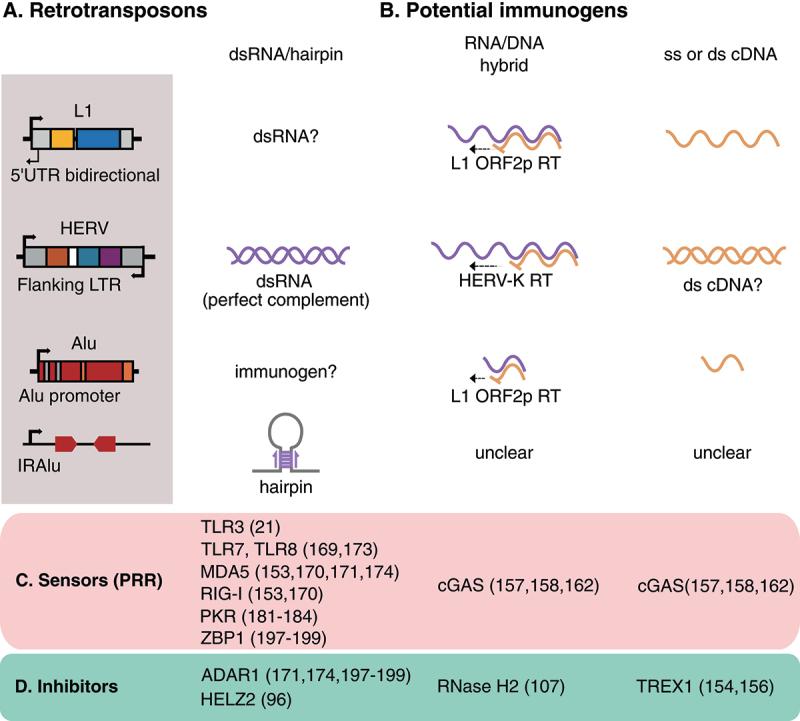
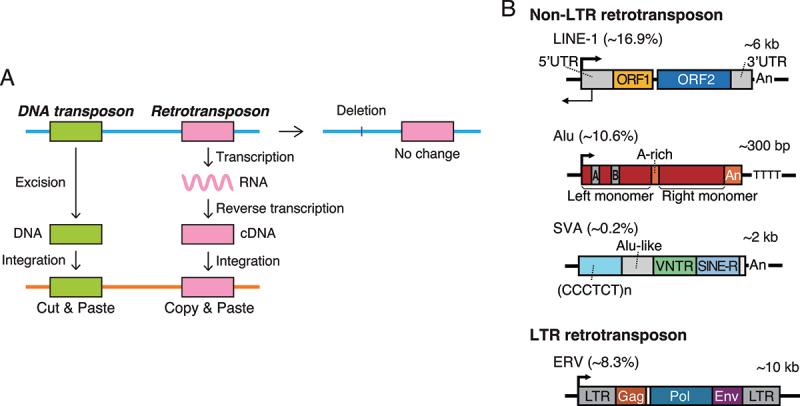
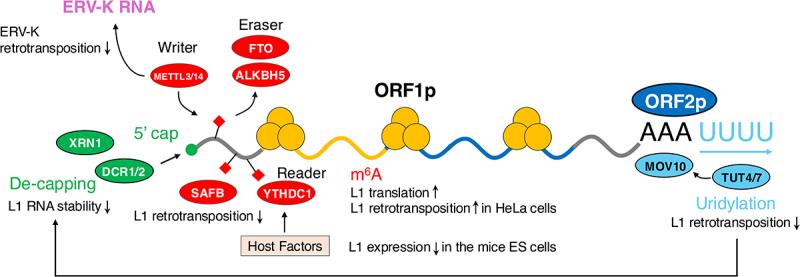
Approximately 45% of the human genome is comprised of transposable elements (TEs), also known as mobile genetic elements. However, their biological function remains largely unknown. Among them, retrotransposons are particularly abundant, and some of the copies are still capable of mobilization within the genome through RNA intermediates. This review focuses on the life cycle of human retrotransposons and summarizes their regulatory mechanisms and impacts on cellular processes. Retrotransposons are generally epigenetically silenced in somatic cells, but are transcriptionally reactivated under certain conditions, such as tumorigenesis, development, stress, and ageing, potentially leading to genetic instability. We explored the dual nature of retrotransposons as genomic parasites and regulatory elements, focusing on their roles in genetic diversity and innate immunity. Furthermore, we discuss how host factors regulate retrotransposon RNA and cDNA intermediates through their binding, modification, and degradation. The interplay between retrotransposons and the host machinery provides insight into the complex regulation of retrotransposons and the potential for retrotransposon dysregulation to cause aberrant responses leading to inflammation and autoimmune diseases.
人类基因组约有 45%由转座元件(TEs)组成,也称为移动遗传元件。然而,它们的生物学功能在很大程度上仍然未知。其中,逆转座子特别丰富,一些拷贝仍然能够通过 RNA 中间体在基因组内移动。本文重点介绍了人类逆转座子的生命周期,并总结了它们的调节机制及其对细胞过程的影响。逆转座子在体细胞中通常被表观遗传沉默,但在某些条件下,如肿瘤发生、发育、应激和衰老,会被转录重新激活,可能导致遗传不稳定性。我们探讨了逆转座子作为基因组寄生虫和调节元件的双重性质,重点研究了它们在遗传多样性和先天免疫中的作用。此外,我们还讨论了宿主因子如何通过结合、修饰和降解来调节逆转座子 RNA 和 cDNA 中间体。逆转座子与宿主机制之间的相互作用深入了解了逆转座子的复杂调节以及逆转座子失调可能导致异常反应,从而引发炎症和自身免疫性疾病的机制。

 Zotero 插件