
基于肾小球滤过率的缩放方法是否足以预测具有被动肾小管重吸收的药物的儿科肾清除率?来自生理药代动力学建模的见解。
Is the GFR-based scaling approach adequate for predicting pediatric renal clearance of drugs with passive tubular reabsorption? Insights from PBPK modeling.
作者信息
Li Sanwang, Ye Xuexin, Wang Qiushi, Cheng Zeneng, Liu Feiyan, Xie Feifan
机构信息
Division of Biopharmaceutics and Pharmacokinetics, Xiangya School of Pharmaceutical Sciences, Central South University, Changsha, China.
Department of Pharmacy, The Second Xiangya Hospital, Central South University, Changsha, China.
出版信息
CPT Pharmacometrics Syst Pharmacol. 2025 Jan;14(1):152-163. doi: 10.1002/psp4.13254. Epub 2024 Oct 15.
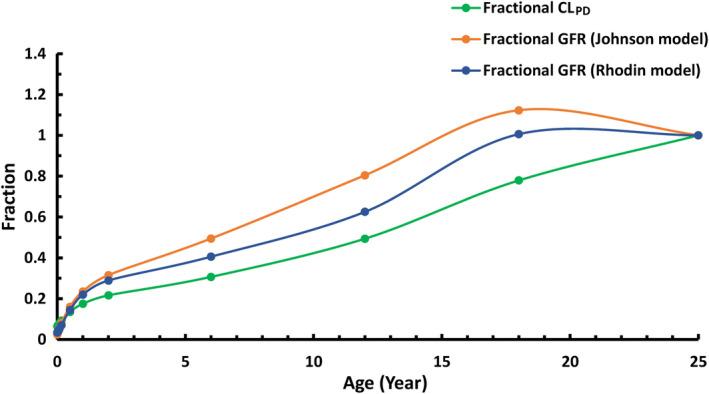
Empirical maturation models (e.g., Johnson and Rhodin models) for glomerular filtration rate (GFR) are commonly used as scaling factors for predicting pediatric renal clearance, but their predictive performance for drugs featured with tubular reabsorption is poorly understood. This study investigated the adequacy of GFR-based scaling models for predicting pediatric renal clearance in drugs with passive tubular reabsorption by comparing with a mechanistic kidney model (Mech-KiM) that encompasses the physiological processes of glomerular filtration, tubular secretion, and reabsorption. The analysis utilized hypothetical drugs with varying fractions of tubular reabsorption (F), alongside the model drug metronidazole, which has a F of 96%. Our simulations showed that when F is ≤70%, the discrepancies between the GFR-based scaling methods and the Mech-KiM model in predicting pediatric renal clearance were generally within a twofold range throughout childhood. However, for drugs with substantial tubular reabsorption (e.g., F > 70%), discrepancies greater than twofold were observed between the GFR-based scaling methods and the Mech-KiM model in predicting renal clearance for young children. In neonates, the differences ranged from 5- to 10-fold when the adult F was 95%. Pediatric physiologically based pharmacokinetic (PBPK) modeling of metronidazole revealed that using a GFR-based scaling method (Johnson model) significantly overestimated drug concentrations in children under 2 months, whereas utilizing the Mech-KiM model for renal clearance predictions yielded estimates closely aligned with observed concentrations. Our study demonstrates that using GFR-based scaling models to predict pediatric renal clearance might be inadequate for drugs with extensive passive tubular reabsorption (e.g., F > 70%).
肾小球滤过率(GFR)的经验性成熟模型(如约翰逊模型和罗丁模型)通常用作预测小儿肾清除率的比例因子,但对于具有肾小管重吸收特性的药物,其预测性能尚不清楚。本研究通过与一个包含肾小球滤过、肾小管分泌和重吸收生理过程的机制性肾脏模型(Mech-KiM)进行比较,研究了基于GFR的比例模型在预测具有被动肾小管重吸收的药物小儿肾清除率方面的适用性。该分析使用了具有不同肾小管重吸收分数(F)的假设药物,以及模型药物甲硝唑,其F为96%。我们的模拟结果表明,当F≤70%时,基于GFR的比例方法与Mech-KiM模型在预测小儿肾清除率方面的差异在整个儿童期通常在两倍范围内。然而,对于具有大量肾小管重吸收的药物(如F>70%),基于GFR的比例方法与Mech-KiM模型在预测幼儿肾清除率方面观察到的差异大于两倍。在新生儿中,当成人F为95%时,差异范围为5至10倍。甲硝唑的小儿生理药代动力学(PBPK)模型显示,使用基于GFR的比例方法(约翰逊模型)显著高估了2个月以下儿童的药物浓度,而使用Mech-KiM模型进行肾清除率预测得到的估计值与观察到的浓度密切一致。我们的研究表明,对于具有广泛被动肾小管重吸收的药物(如F>70%),使用基于GFR的比例模型来预测小儿肾清除率可能是不够的。



 Zotero 插件