
在大脑中催化胆固醇降解的细胞色素P450中的单核苷酸多态性与帕金森病有关。
SNPs in cytochromes P450 catalyzing cholesterol degradation in brain are associated with Parkinson's disease.
作者信息
Petkova-Kirova Polina, Kolchina Anastasia, Baas Stephan, Wagenpfeil Gudrun, Unger Marcus Michael, Schulze-Hentrich Julia Maria, Bernhardt Rita
机构信息
Institut für Biochemie, Fachbereich Biologie, Naturwissenschaftlich-Technische Fakultät, Universität des Saarlandes, Saarbrücken, Germany.
Institute of Neurobiology, Bulgarian Academy of Sciences, Sofia, Bulgaria.
出版信息
Front Pharmacol. 2024 Sep 30;15:1477009. doi: 10.3389/fphar.2024.1477009. eCollection 2024.
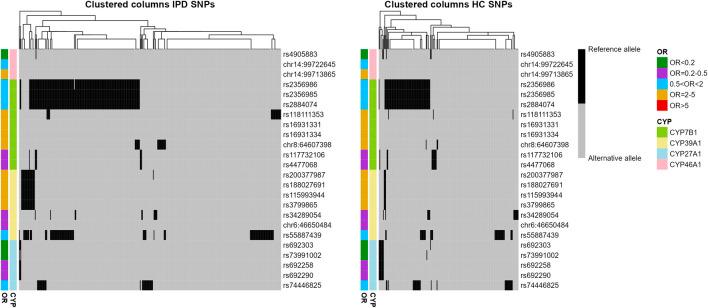
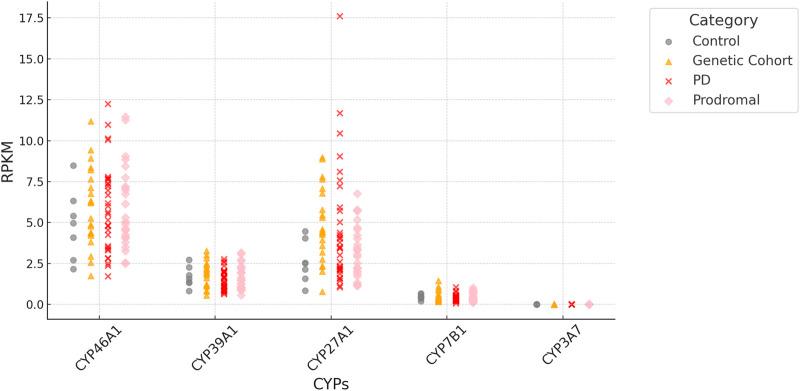
Besides being an essential structural component of plasma membranes and the precursor of many functional compounds and signaling molecules, cholesterol was also proposed to play a role in the etiology and/or manifestation of Parkinson's disease (PD). However, so far systematic investigations on the role of cholesterol and its metabolites present in the brain for the etiology of PD are missing. Here, we investigate for the first time the association of PD with SNPs in the genes of four cytochromes P450 (P450), CYP46A1, CYP39A1, CYP27A1 and CYP7B1, which are critical for the degradation of cholesterol in the brain. Analyzing 1,349 individuals from the PPMI data base, we found 24 SNPs in these four genes, which are significantly over- or under-represented in patients suffering from idiopathic PD (IPD). Studying each of the 362 IPD patients individually, we found that most patients (45%) showed only one associated SNP in one of the four P450 genes, while 31% displayed two associated SNPs and 18% three associated SNPs. The occurrence of some associated SNPs is in the same order of magnitude as SNPs in the GBA (beta-glucocerebrosidase) and thus might reflect a genetic predisposition for PD. As all 24 SNPs were located in introns and 3' untranslated regions, we evaluated the prospective regulatory impact of the surrounding genomic regions by using transcriptome and epigenome data from the Foundational Data Initiative for Parkinson Disease (FOUNDIN-PD). FOUNDIN-PD provides gene expression, open chromatin and DNA methylation data in a cohort of 89 induced pluripotent stem cell (iPSC) lines differentiated to dopaminergic (DA) neurons derived from people in the PPMI study. Indeed, two of the 24 SNPs, one in CYP7B1 (rs118111353) and the other one in CYP27A1 (rs74446825), were localized within a region of open chromatin in differentiated neurons. Interestingly, all iPSC lines with open chromatin in rs118111353 showed the reference allele. As all four P450, CYP46A1, CYP39A1, CYP27A1 and CYP7B1, are expressed in dopaminergic neurons, we discuss further functional studies to connect SNPs in regulatory regions with gene expression levels. Finally, potential possibilities for personalized therapeutic treatment of patients with SNPs in the four investigated P450 are discussed.
除了作为质膜的重要结构成分以及许多功能化合物和信号分子的前体之外,胆固醇还被认为在帕金森病(PD)的病因和/或表现中起作用。然而,到目前为止,关于大脑中存在的胆固醇及其代谢物在PD病因中的作用的系统性研究尚属空白。在此,我们首次研究了PD与四种细胞色素P450(P450)基因,即CYP46A1、CYP39A1、CYP27A1和CYP7B1中的单核苷酸多态性(SNP)的关联,这些基因对大脑中胆固醇的降解至关重要。通过分析帕金森病进展标记物倡议(PPMI)数据库中的1349名个体,我们在这四个基因中发现了24个SNP,这些SNP在特发性帕金森病(IPD)患者中显著过度或不足表达。对362名IPD患者逐一进行研究,我们发现大多数患者(45%)在四个P450基因之一中仅显示一个相关SNP,而31%的患者显示两个相关SNP,18%的患者显示三个相关SNP。一些相关SNP的出现频率与葡萄糖脑苷脂酶(GBA)基因中的SNP处于同一数量级,因此可能反映了PD的遗传易感性。由于所有24个SNP均位于内含子和3'非翻译区,我们利用帕金森病基础数据倡议(FOUNDIN-PD)的转录组和表观基因组数据评估了周围基因组区域的潜在调控影响。FOUNDIN-PD提供了来自PPMI研究中89个诱导多能干细胞(iPSC)系分化为多巴胺能(DA)神经元的队列中的基因表达、开放染色质和DNA甲基化数据。实际上,24个SNP中的两个,一个在CYP7B1(rs118111353)中,另一个在CYP27A1(rs74446825)中,位于分化神经元的开放染色质区域内。有趣的是,rs118111353中具有开放染色质的所有iPSC系均显示参考等位基因。由于所有四个P450,即CYP46A1、CYP39A1、CYP27A1和CYP7B1,均在多巴胺能神经元中表达,我们讨论了进一步的功能研究,以将调控区域中的SNP与基因表达水平联系起来。最后,讨论了对四个被研究的P450基因中存在SNP的患者进行个性化治疗的潜在可能性。


 Zotero 插件