
炎症性肠病患者代谢和肠道微生物健康的饮食决定因素。
Dietary Determinants of Metabolic and Gut Microbial Health in Patients with Inflammatory Bowel Disease.
机构信息
School of Clinical Medicine, St Vincent's Healthcare Campus, Faculty of Medicine & Health, University of New South Wales, Sydney 2010, Australia.
Department of Gastroenterology and Hepatology, St Vincent's Hospital, Sydney 2010, Australia.
出版信息
Nutrients. 2024 Sep 24;16(19):3233. doi: 10.3390/nu16193233.
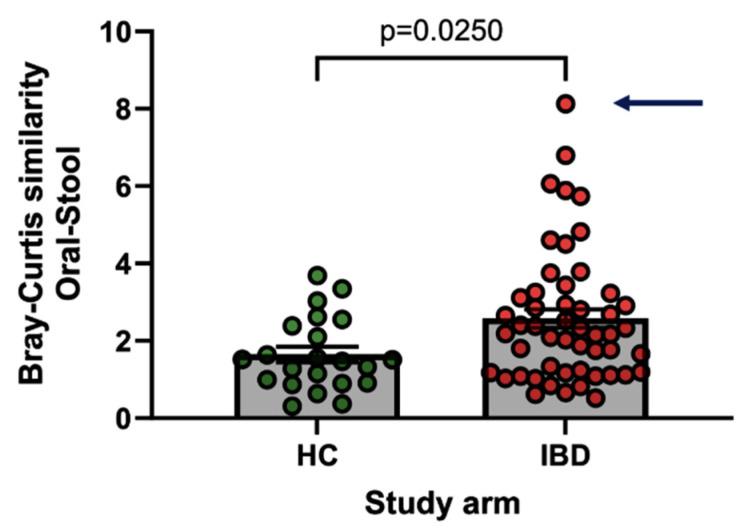
Diet has been linked to gut dysbiosis and the onset, course, and response to treatment of patients with IBD and metabolic disease. : This single-centre prospective case-control study investigated the relationship between dietary intake, metabolic profile, and stool microbial composition in 57 individuals with IBD in clinical remission and 24 healthy individuals (HC). Participants' baseline anthropometric measurements, serum metabolic parameters, lipid profiles, and oral and stool samples for microbiota testing were collected. Their dietary intake and physical activity were documented. A partially corrected correlation was performed to examine the associations between variables and -values adjusted for multiple comparisons using the Benjamini-Hochberg equation (adj-). In participants with IBD, the intake of saturated fat correlated positively, and the intake of dietary fibre correlated negatively with anthropometric indices (saturated fat and BMI: r = 0.37, adj- = 0.04, fibre and BMI: r = -0.45, adj- = 0.01). Higher anthropometric indices were associated with poorer glucose control and a less favourable serum lipid profile (BMI and insulin: r = 0.48, < 0.01, WHR and triglycerides: r = 0.57, < 0.01). The stool microbiota of participants in the IBD group was less diverse and more similar to their oral microbiota than was observed in the HC group (Mann-Whitney U test = 0.03). Within the IBD group, a higher intake of added sugar and processed meat and a higher serum insulin level was associated with lower stool microbial alpha diversity (processed meat intake and Shannon's diversity: r = -0.43, adj- = 0.02; added sugar and Shannon's diversity: r = -0.39, adj- = 0.03; insulin and Shannon's diversity: r = -0.45, adj- = 0.02). Neither the dietary intake nor stool microbial composition correlated with the risk of disease flaring. : Our findings suggest that dietary intake is associated with the metabolic health and gut microbial composition of IBD patients.
饮食与肠道菌群失调以及 IBD 和代谢疾病患者的发病、病程和治疗反应有关。本单中心前瞻性病例对照研究调查了 57 例临床缓解期 IBD 患者和 24 例健康对照(HC)的饮食摄入、代谢特征和粪便微生物组成之间的关系。收集了参与者的基线人体测量学测量、血清代谢参数、血脂谱以及用于微生物检测的口腔和粪便样本。记录了他们的饮食摄入和身体活动情况。进行了部分校正相关性分析,以检查变量之间的关联,并用 Benjamini-Hochberg 方程(adj-)校正多重比较的 -值。在 IBD 患者中,饱和脂肪的摄入量与人体测量指数呈正相关,膳食纤维的摄入量与人体测量指数呈负相关(饱和脂肪与 BMI:r = 0.37,adj- = 0.04,纤维与 BMI:r = -0.45,adj- = 0.01)。较高的人体测量指数与较差的血糖控制和较差的血清血脂谱相关(BMI 和胰岛素:r = 0.48,<0.01,WHR 和甘油三酯:r = 0.57,<0.01)。与 HC 组相比,IBD 组参与者的粪便微生物群多样性较低,且与口腔微生物群更为相似(Mann-Whitney U 检验 = 0.03)。在 IBD 组中,较高的添加糖和加工肉类摄入量以及较高的血清胰岛素水平与粪便微生物 alpha 多样性较低相关(加工肉类摄入量和 Shannon 多样性:r = -0.43,adj- = 0.02;添加糖和 Shannon 多样性:r = -0.39,adj- = 0.03;胰岛素和 Shannon 多样性:r = -0.45,adj- = 0.02)。饮食摄入和粪便微生物组成均与疾病复发风险无关。我们的研究结果表明,饮食摄入与 IBD 患者的代谢健康和肠道微生物组成有关。

 Zotero 插件