
晚期糖基化终产物与中国成年人睡眠障碍的关联。
Associations of Advanced Glycation End Products with Sleep Disorders in Chinese Adults.
机构信息
Department of Nutrition and Food Hygiene, Hubei Key Laboratory of Food Nutrition and Safety, School of Public Health, Tongji Medical College, Huazhong University of Science and Technology, Wuhan 430030, China.
Ministry of Education Key Lab of Environment and Health, School of Public Health, Tongji Medical College, Huazhong University of Science and Technology, Wuhan 430030, China.
出版信息
Nutrients. 2024 Sep 27;16(19):3282. doi: 10.3390/nu16193282.
BACKGROUND
Advanced glycation end products (AGEs), a group of food processing byproducts, have been implicated in the development of various diseases. However, the relationship between circulating AGEs and sleep disorders remains uncertain.
METHODS
This cross-sectional study elucidated the association of plasma AGEs with sleep disorders among 1732 Chinese adults who participated in the initial visit (2019-2020) of the Tongji-Shenzhen Cohort (TJSZC). Sleep behavior was assessed using self-reported questionnaires and precise accelerometers. Plasma levels of AGEs, including Nε-(Carboxymethyl)lysine (CML), Nε-(Carboxyethyl)lysine (CEL), and Nδ-(5-hydro-5-methyl-4-imidazolone-2-yl)-ornithine (MG-H1), were quantified by ultra-high performance liquid chromatography-tandem mass spectrometry (UPLC-MS/MS).
RESULTS
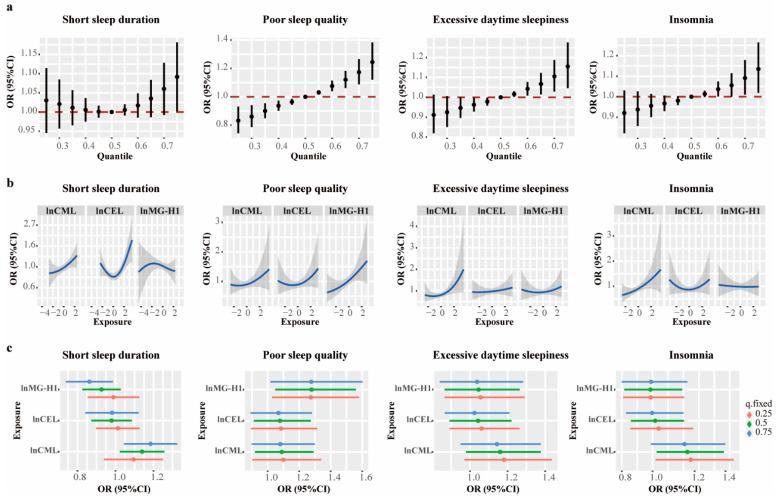
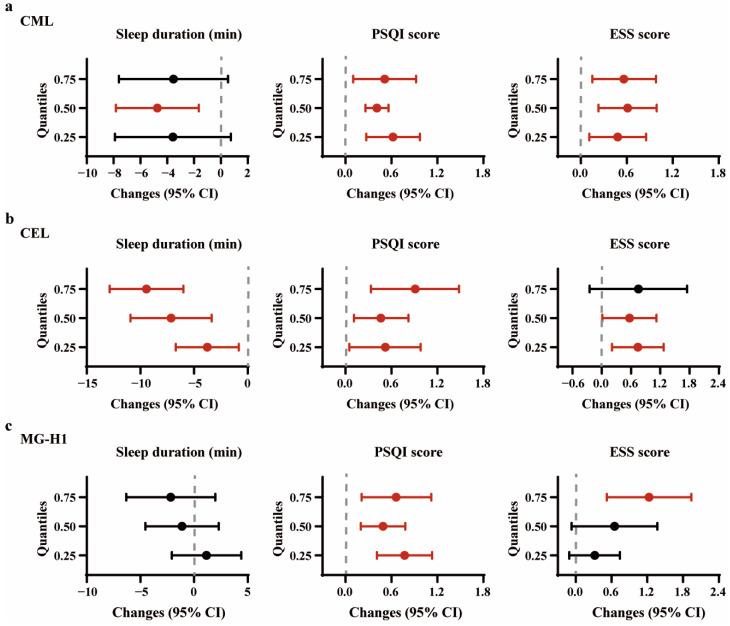
In logistic regression, per IQR increment in individual AGEs was associated with an increased odds ratio of short sleep duration (CML: 1.11 [1.00, 1.23]; CEL: 1.16, [1.04, 1.30]), poor sleep quality (CML: 1.33 [1.10, 1.60]; CEL: 1.53, [1.17, 2.00]; MG-H1: 1.61 [1.25, 2.07]), excessive daytime sleepiness (CML: 1.33 [1.11, 1.60]; MG-H1: 1.39 [1.09, 1.77]), and insomnia (CML: 1.29 [1.05, 1.59]). Furthermore, in weighted quantile sum regression and Bayesian kernel machine regression analyses, elevated overall exposure levels of plasma AGEs were associated with an increased risk of sleep disorders, including short sleep duration, poor sleep quality, excessive daytime sleepiness, and insomnia, with CML being identified as the leading contributor. Insufficient vegetable intake and higher dietary fat intake was associated with an increase in plasma CEL.
CONCLUSIONS
These findings support a significant association between plasma AGEs and sleep disorders, indicating that AGEs may adversely influence sleep health and reducing the intake of AGEs may facilitate preventing and ameliorating sleep disorders.
背景
晚期糖基化终产物(AGEs)是一组食品加工副产物,与多种疾病的发生有关。然而,循环 AGEs 与睡眠障碍之间的关系尚不确定。
方法
本横断面研究通过问卷调查和精确加速度计评估睡眠行为,阐明了 1732 名中国成年人(参加了同济-深圳队列(TJSZC)的首次访视(2019-2020 年))血浆 AGEs 与睡眠障碍之间的关系。采用超高效液相色谱-串联质谱法(UPLC-MS/MS)定量检测血浆 AGEs 水平,包括 Nε-(羧甲基)赖氨酸(CML)、Nε-(羧乙基)赖氨酸(CEL)和 Nδ-(5-羟-5-甲基-4-咪唑啉-2-基)-鸟氨酸(MG-H1)。
结果
在逻辑回归中,个体 AGEs 的每 IQR 增加与短睡眠时间(CML:1.11[1.00,1.23];CEL:1.16[1.04,1.30])、睡眠质量差(CML:1.33[1.10,1.60];CEL:1.53[1.17,2.00];MG-H1:1.61[1.25,2.07])、日间嗜睡(CML:1.33[1.11,1.60];MG-H1:1.39[1.09,1.77])和失眠(CML:1.29[1.05,1.59])的几率比增加相关。此外,在加权分位数总和回归和贝叶斯核机器回归分析中,血浆 AGEs 总暴露水平升高与睡眠障碍风险增加相关,包括短睡眠时间、睡眠质量差、日间嗜睡和失眠,其中 CML 被确定为主要贡献者。蔬菜摄入量不足和较高的膳食脂肪摄入量与 CEL 血浆水平升高有关。
结论
这些发现支持了血浆 AGEs 与睡眠障碍之间的显著关联,表明 AGEs 可能对睡眠健康产生不利影响,减少 AGEs 的摄入可能有助于预防和改善睡眠障碍。
 Zotero 插件