
ALBI评分在局部晚期原发性肝癌立体定向体部放射治疗患者中的作用:两项前瞻性研究的汇总分析
The role of ALBI score in patients treated with stereotactic body radiotherapy for locally advanced primary liver tumors: a pooled analysis of two prospective studies.
作者信息
Gkika Eleni, Radicioni Gianluca, Eichhorst Alexandra, Kirste Simon, Sprave Tanja, Nicolay Nils Henrik, Fichtner-Feigl Stefan, Thimme Robert, Wiehle Rolf, Brunner Thomas B, Grosu Anca-Ligia
机构信息
Department of Radiation Oncology, Medical Center - University of Freiburg, Freiburg, Germany.
German Cancer Consortium (DKTK) Partner Site Freiburg, Freiburg, Germany.
出版信息
Front Oncol. 2024 Oct 3;14:1427332. doi: 10.3389/fonc.2024.1427332. eCollection 2024.
INTRODUCTION
To evaluate the outcomes after stereotactic body radiotherapy (SBRT) for locally advanced primary liver cancer.
MATERIALS AND METHODS
Patients with locally advanced liver cancer unsuitable for other loco-regional treatments were treated with SBRT with 50-60 Gy in 3-12 fractions in two consecutive prospective trials.
RESULTS
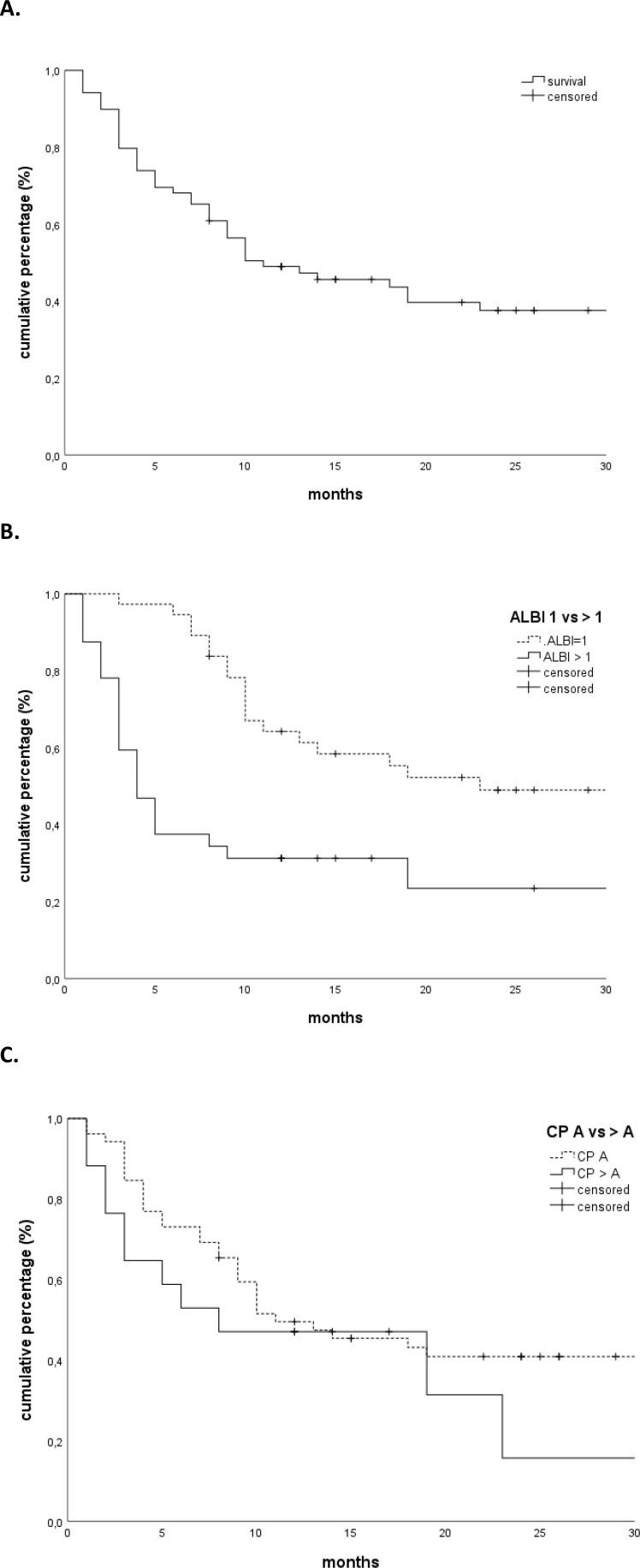
A total of 83 patients were included, of whom 14 were excluded, leaving 69 evaluable patients with 74 treated lesions. A total of 50 patients had hepatocellular carcinoma (HCC), and 11 patients had cholangiocarcinoma (CCC). Approximately 76% had a Child-Pugh (CP) score of A, while 54% had an albumin-bilirubin (ALBI) score of 1. With a median follow-up of 29 months, the median overall survival (OS) was 11 months, and the progression-free survival (PFS) was 18 months. The ALBI score was an important predictor of overall survival (HR 2.094, p = 0.001), which remained significant also in the multivariate analysis. Patients with an ALBI grade of ≥1 had an OS of 4 months versus 23 months in patients with an ALBI grade of 1 (p ≤ 0.001). The local control at 1 and 2 years was 91%. Thirteen patients developed grade ≥ 3 toxicities, of whom nine patients experienced liver toxicities. Patients with a higher ALBI score had a high risk for developing hepatic failure (OR 6.136, p = 0.006).
DISCUSSION
SBRT is a very effective treatment with low toxicity and should be considered as a local treatment option in patients with HCC and CCC. Patients with a higher ALBI grade are at risk for developing toxicities after SBRT and have a significantly lower survival rate.
引言
评估立体定向体部放疗(SBRT)治疗局部晚期原发性肝癌的疗效。
材料与方法
在两项连续的前瞻性试验中,对不适合其他局部区域治疗的局部晚期肝癌患者采用SBRT治疗,剂量为50 - 60 Gy,分3 - 12次。
结果
共纳入83例患者,其中14例被排除,剩余69例可评估患者,共74个治疗病灶。50例为肝细胞癌(HCC),11例为胆管癌(CCC)。约76%的患者Child-Pugh(CP)评分为A,而54%的患者白蛋白-胆红素(ALBI)评分为1。中位随访29个月,中位总生存期(OS)为11个月,无进展生存期(PFS)为18个月。ALBI评分是总生存期的重要预测指标(HR 2.094,p = 0.001),在多因素分析中也具有显著性。ALBI分级≥1的患者OS为4个月,而ALBI分级为1的患者为23个月(p≤0.001)。1年和2年的局部控制率为91%。13例患者发生≥3级毒性反应,其中9例出现肝脏毒性反应。ALBI评分较高的患者发生肝衰竭的风险较高(OR 6.136,p = 0.006)。
讨论
SBRT是一种毒性低且非常有效的治疗方法,应被视为HCC和CCC患者的局部治疗选择之一。ALBI分级较高的患者在SBRT后有发生毒性反应的风险,且生存率显著较低。
 Zotero 插件