
揭示生活方式和代谢因素与子宫内膜癌之间的因果关联:孟德尔随机化研究的证据。
Unraveling the causal association between lifestyle and metabolic factors with endometrial cancer: evidence from a Mendelian randomization study.
作者信息
Zhang Xu, Pu Caiyu, Wang Li, Lin Xiaona, Lai Hansu, Wu Shanshan, Wan Jing
机构信息
Department of Gynecology, The Third Affiliated Hospital of Sun Yat-Sen University, Guangzhou, Guangdong, China.
Department of Thoracic Surgery, The First Affiliated Hospital of Jinan University, Guangzhou, China; Institute of Precision Cancer Medicine and Pathology, School of Medicine, Jinan University, Guangzhou, China.
出版信息
Discov Oncol. 2024 Oct 20;15(1):575. doi: 10.1007/s12672-024-01439-6.
BACKGROUND
Endometrial carcinoma (EC) remain a malignancy with incompletely understood risk factors. To address this knowledge gap, we employed mendelian randomization study to investigate potential protective and risk elements associated with endometrial cancer.
METHODS
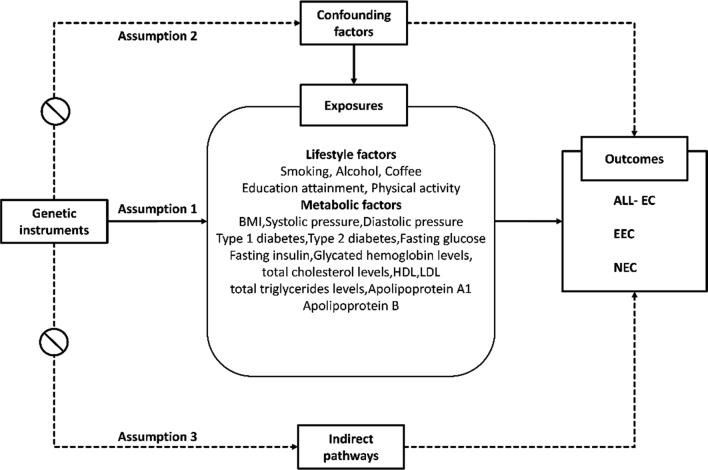
We conducted a two-sample Mendelian randomization (MR) study using genetic association data for overall EC and its subtypes from a large-scale genome-wide association study (GWAS). This GWAS encompassed 12,906 EC patients and 108,979 healthy controls. The EC cases were further categorized into 8758 endometrioid and 1230 non-endometrioid subtypes. To serve as instrumental variables, we identified independent genetic variants strongly associated with 5 lifestyle factors and 14 metabolic factors from relevant GWASs. Subsequently, we conducted univariable Mendelian randomization (MR) analyses.
RESULTS
Our study revealed the relationship among EC with lifetime smoking index (OR: 1.43; 95% CI 1.05-1.96), frequency of alcohol consumption (OR:1.23; 95% CI 1.04-1.45), body mass index (BMI) (OR:1.82; 95% CI 1.64-2.01), type 2 diabetes mellitus (T2DM) (OR:1.06; 95% CI 1.00-1.12), and fasting insulin (OR:1.97; 95% CI 1.30-2.98). Conversely, inverse associations with EC were observed for education level (OR:0.72, 95% CI 0.62-0.83), moderate-level physical exercise (OR 0.35, 95% CI 0.15-0.84), and low-density lipoproteins (LDL) (OR 0.91, 95% CI 0.84-0.99).
CONCLUSIONS
Our findings underscore a causal association between genetically predicted lifetime smoking index, alcohol intake frequency, BMI, T2DM, and fasting insulin with EC risk. Furthermore, our study highlights the potential protective effects of a high education level, moderate-intensity physical exercise, and LDL reduction against EC risk. This MR analysis provided valuable insights into underlying EC risk mechanisms and paved new ways for EC prevention strategies.
背景
子宫内膜癌(EC)仍然是一种风险因素尚未完全明确的恶性肿瘤。为了填补这一知识空白,我们采用孟德尔随机化研究来调查与子宫内膜癌相关的潜在保护因素和风险因素。
方法
我们使用来自大规模全基因组关联研究(GWAS)的总体EC及其亚型的遗传关联数据进行了一项两样本孟德尔随机化(MR)研究。这项GWAS纳入了12906例EC患者和108979例健康对照。EC病例进一步分为8758例子宫内膜样癌和1230例非子宫内膜样癌亚型。为了作为工具变量,我们从相关GWAS中确定了与5种生活方式因素和14种代谢因素密切相关的独立遗传变异。随后,我们进行了单变量孟德尔随机化(MR)分析。
结果
我们的研究揭示了EC与终生吸烟指数(比值比:1.43;95%置信区间1.05 - 1.96)、饮酒频率(比值比:1.23;95%置信区间1.04 - 1.45)、体重指数(BMI)(比值比:1.82;95%置信区间1.64 - 2.01)、2型糖尿病(T2DM)(比值比:1.06;95%置信区间1.00 - 1.12)和空腹胰岛素(比值比:1.97;95%置信区间1.30 - 2.98)之间的关系。相反,观察到教育水平(比值比:0.72,95%置信区间0.62 - 0.83)、中等强度体育锻炼(比值比0.35,95%置信区间0.15 - 0.84)和低密度脂蛋白(LDL)(比值比0.91,95%置信区间0.84 - 0.99)与EC呈负相关。
结论
我们的研究结果强调了遗传预测的终生吸烟指数、饮酒频率、BMI、T2DM和空腹胰岛素与EC风险之间的因果关系。此外,我们的研究突出了高教育水平、中等强度体育锻炼和降低LDL对EC风险的潜在保护作用。这项MR分析为EC潜在风险机制提供了有价值的见解,并为EC预防策略开辟了新途径。


 Zotero 插件