
植物化学特征分析及精油协同现代抗生素对抗耐药菌的增效作用
Phytochemical Characterization and Synergistic Antibacterial Effects of Essential Oil as Adjuvants to Modern Antibiotics in Combating Drug Resistance.
机构信息
Guangdong Engineering Technological Research Center of Clinical Molecular Diagnosis and Antibody Drugs, Meizhou Academy of Medical Sciences, Meizhou People's Hospital (Huangtang Hospital), Meizhou, 514031, People's Republic of China.
Department of Biotechnology, University Institute of Biotechnology, Chandigarh University, Mohali, Punjab, India.
出版信息
Drug Des Devel Ther. 2024 Oct 15;18:4601-4614. doi: 10.2147/DDDT.S489517. eCollection 2024.
BACKGROUND
The global threat of multi-drug-resistant bacteria has severely limited the options available for effective antibiotics. This study focuses on the antimicrobial activity and phytochemical characterization of extracts, aiming to identify novel plant-based therapeutic agents.
METHODS
specimens-leaves and inflorescence. Specimens were cleaned, sterilized, dried, and ground into a fine powder. Extracts were obtained using methanol and petroleum ether via a Soxhlet apparatus, followed by fractionation with chloroform, n-butanol, and ethyl acetate. Volatile oil was extracted through hydro distillation using a Clevenger apparatus. Phytochemical analysis was conducted to identify bioactive compounds. Biophysical techniques, including UV-visible spectrophotometry, TLC, HPLC, GC-MS, FTIR, and NMR, were employed for characterization. Antimicrobial activity was tested against ATCC25922 and ATCC25922 using agar well and disc diffusion methods, and synergistic effects were assessed with erythromycin and amoxicillin.
RESULTS
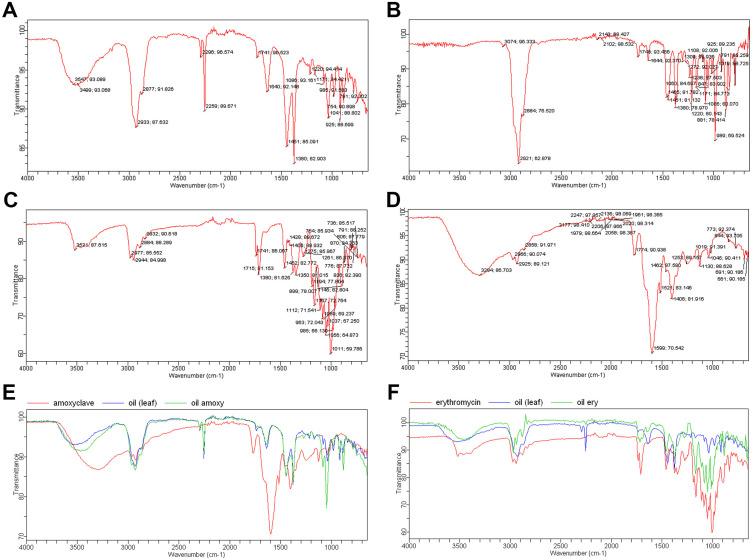
Methanol extract exhibited bacteriostatic activity with inhibition zones of 13.0 ± 0.2 mm for both and . Petroleum ether, chloroform, n-butanol, and ethyl acetate fractions showed varying inhibition zones. Erythromycin demonstrated bactericidal activity, which was enhanced synergistically when combined with methanol extract and volatile oil, increasing inhibition zones against . Phytochemical analysis identified phenols, flavonoids, tannins, coumarins, alkaloids, terpenoids, saponins, and glycosides. FTIR analysis revealed functional groups such as amines, aldehydes, nitriles, alkenes, and sulfones. GC-MS identified 24 compounds, with α-pinene, caryophyllene, and carene as major components. NMR spectra indicated no complex formation between oils and antibiotics, suggesting the compounds act as synergists.
CONCLUSION
The extracts possess significant antimicrobial activity and synergistic potential, particularly against . The presence of various bioactive compounds suggests a promising role in developing new plant-based therapeutics.
背景
全球范围内多重耐药菌的威胁严重限制了有效抗生素的选择。本研究专注于 的抗菌活性和植物化学特征分析,旨在寻找新型植物治疗剂。
方法
采集叶片和花序样本。样本经过清洗、消毒、干燥和粉碎成细粉。使用甲醇和石油醚通过索氏提取器提取提取物,然后用氯仿、正丁醇和乙酸乙酯进行分段。通过克利夫兰挥发油提取器进行水蒸馏提取挥发油。进行植物化学分析以鉴定生物活性化合物。采用紫外可见分光光度法、TLC、HPLC、GC-MS、FTIR 和 NMR 等生物物理技术进行表征。采用琼脂孔和纸片扩散法对 ATCC25922 和 ATCC25922 进行抗菌活性测试,并与红霉素和阿莫西林评估协同作用。
结果
甲醇提取物对 和 均表现出抑菌活性,抑菌圈直径分别为 13.0 ± 0.2mm。石油醚、氯仿、正丁醇和乙酸乙酯馏分显示出不同的抑菌圈。红霉素表现出杀菌活性,与甲醇提取物和挥发油联合使用时协同增强,增加对 的抑菌圈。植物化学分析鉴定出酚类、类黄酮、单宁、香豆素、生物碱、萜类、皂苷和糖苷。FTIR 分析显示出胺、醛、腈、烯烃和砜等功能基团。GC-MS 鉴定出 24 种化合物,主要成分包括α-蒎烯、石竹烯和蒈烯。NMR 谱表明油与抗生素之间没有复杂形成,表明这些化合物作为协同剂发挥作用。
结论
提取物具有显著的抗菌活性和协同潜力,特别是针对 。存在各种生物活性化合物表明在开发新型植物治疗剂方面具有广阔前景。


 Zotero 插件