
人口健康方法早期实施阶段卫生系统领导者心理模型的组织案例研究
An Organizational Case Study of Mental Models among Health System Leaders during Early-Stage Implementation of a Population Health Approach.
作者信息
Terpou Braeden A, Bird Marissa, Srinivasan Diya, Bains Shalu, Rosella Laura C, Desveaux Laura
机构信息
Institute for Better Health, Trillium Health Partners, Mississauga, Ontario, Canada.
Institute of Health Policy, Management, and Evaluation, University of Toronto, Toronto, Ontario, Canada.
出版信息
J Healthc Leadersh. 2024 Oct 16;16:389-401. doi: 10.2147/JHL.S475322. eCollection 2024.
PURPOSE
As the COVID-19 pandemic recedes, the importance of population health has come into sharp focus, prompting many health systems to explore leveraging population health data (PHD) for operational planning. This approach requires that healthcare leaders embrace the dual priorities of maintaining excellence in patient care while promoting the overall health of populations. However, many leaders are new to population-based thinking, posing a threat to successful operationalization if mental models are not aligned.
PATIENTS AND METHODS
This qualitative case study explored the alignment of mental models among 13 senior leaders at Trillium Health Partners (THP), one of Canada's largest community hospitals, as they embark on embedding PHD within operational workflows.
RESULTS
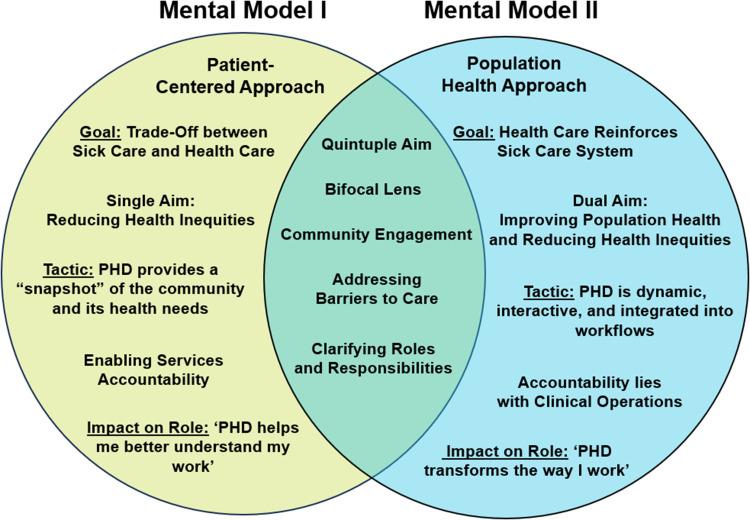
All leaders recognized the necessity of adopting a population health approach amid resource constraints and growing pressures. When discussing the operationalization of PHD, two distinct mental models emerged among leaders: one focused on patient care and the other on population health. While executive leaders demonstrated a fluidity in their thinking between the two, programmatic leaders favoured one over the other. For example, some viewed the organization's focus on PHD as competing with their patient care responsibilities, while others saw the use of PHD as a solution to the organization's operational pressures. Despite these divergences, leaders unanimously stressed the importance of increasing the organization's risk tolerance and devolving decision-making as a necessary precursor to realizing the transformation to a PHD-driven approach.
CONCLUSION
These divergent mental models highlight a need to clarify the shared vision for the use of PHD along with its impact on leadership roles and accountabilities. These findings illustrate the current state from which THP aims to evolve and underscore the importance of aligning leaders' mental models as a critical step to facilitating successful integration of PHD and advancing a collective vision for healthcare transformation.
目的
随着新冠疫情逐渐消退,人群健康的重要性已成为人们关注的焦点,促使许多医疗系统探索利用人群健康数据(PHD)进行运营规划。这种方法要求医疗保健领导者在保持卓越的患者护理水平的同时,将促进人群的整体健康作为双重优先事项。然而,许多领导者对基于人群的思维方式并不熟悉,如果思维模式不一致,可能会对成功实施构成威胁。
患者与方法
本定性案例研究探讨了加拿大最大的社区医院之一翠菊健康伙伴(THP)的13位高级领导者在将PHD融入运营工作流程时,其思维模式的一致性。
结果
所有领导者都认识到在资源有限和压力不断增加的情况下,采用人群健康方法的必要性。在讨论PHD的实施时,领导者中出现了两种不同的思维模式:一种侧重于患者护理,另一种侧重于人群健康。虽然行政领导者在两者之间的思维较为灵活,但项目领导者则更倾向于其中一种。例如,一些人认为组织对PHD的关注与他们的患者护理职责相冲突,而另一些人则认为使用PHD是解决组织运营压力的一种方法。尽管存在这些分歧,但领导者一致强调提高组织的风险承受能力和下放决策权的重要性,认为这是实现向PHD驱动方法转变的必要前提。
结论
这些不同的思维模式凸显了有必要明确使用PHD的共同愿景及其对领导角色和职责的影响。这些发现说明了THP旨在发展的现状,并强调了使领导者的思维模式保持一致的重要性,这是促进PHD成功整合和推进医疗保健转型集体愿景的关键一步。
 Zotero 插件