
便秘与淀粉样蛋白-β负荷较高的认知未受损老年成年人的正电子发射断层扫描及血液生物标志物之间的关联
The Association Between Constipation and Positron Emission Tomography and Blood-Based Biomarkers in Older Cognitively Unimpaired Adults with Higher Amyloid-β Burden.
作者信息
Chu Heling, Huang Chuyi, Xie Fang, Guo Qihao
机构信息
Department of Gerontology, Shanghai Sixth People's Hospital Affiliated to Shanghai Jiao Tong University School of Medicine, No. 600, Yi Shan Road, Shanghai, China.
Health Management Center, Renji Hospital, School of Medicine, Shanghai Jiaotong University, Shanghai, China.
出版信息
Neurol Ther. 2024 Dec;13(6):1701-1715. doi: 10.1007/s40120-024-00666-x. Epub 2024 Oct 22.
INTRODUCTION
Constipation may be linked to cognitive decline and a higher risk of Alzheimer's disease (AD). We aimed to investigate the association between constipation and positron emission tomography (PET) and blood-based AD biomarkers in older cognitively unimpaired (CU) adults with higher Aβ burden.
METHODS
Constipation was diagnosed according to Rome IV criteria and the severity of constipation was evaluated by using a validated self-reported questionnaire. The participants underwent the examination of plasma AD biomarkers and F-florbetapir PET and F-MK6240 PET scans; the latter was only performed in the validation cohort. Correlation and multiple linear regression analyses were used to investigate the association between constipation and AD biomarkers.
RESULTS
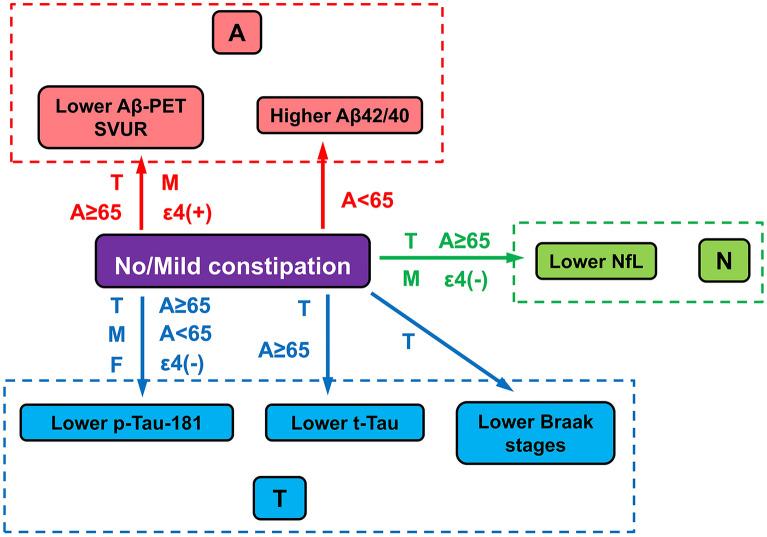
Two cohorts were included in our study. A total of 404 older participants with 126 of whom Aβ-PET positive were enrolled in the development cohort. Multiple linear regression analysis showed constipation was associated with plasma t-Tau, p-Tau-181, and neurofilament light chain (NfL) in participants with Aβ-PET (+). Meanwhile, no/mild constipation was associated with lower Aβ-PET standard uptake value ratio. The association between constipation and plasma biomarkers was different in the subgroups stratified by age, sex and APOE ε4 genotype. The above associations were further validated in the validation cohort containing 36 Aβ-PET (+) participants. Importantly, no/mild constipation was associated with less Tau burden evaluated by F-MK6240 PET Braak stages.
CONCLUSION
Our data indicate that no/mild constipation may be associated with lower plasma t-Tau, p-Tau-181, and NfL as well as less Aβ and Tau burden in older CU adults with Aβ deposition. Improving constipation and being away from defecation disorders may help reduce the risk of AD development.
引言
便秘可能与认知能力下降以及患阿尔茨海默病(AD)的风险增加有关。我们旨在研究便秘与淀粉样蛋白负担较高的认知未受损(CU)老年成年人的正电子发射断层扫描(PET)及血液AD生物标志物之间的关联。
方法
根据罗马IV标准诊断便秘,并使用经过验证的自我报告问卷评估便秘的严重程度。参与者接受了血浆AD生物标志物检查以及F-氟代贝他吡PET和F-MK6240 PET扫描;后者仅在验证队列中进行。采用相关性和多元线性回归分析来研究便秘与AD生物标志物之间的关联。
结果
我们的研究纳入了两个队列。共有404名老年参与者,其中126名淀粉样蛋白PET呈阳性,被纳入了开发队列。多元线性回归分析表明,在淀粉样蛋白PET(+)的参与者中,便秘与血浆总tau蛋白(t-Tau)、磷酸化tau蛋白181(p-Tau-181)和神经丝轻链(NfL)有关。同时,无/轻度便秘与较低的淀粉样蛋白PET标准摄取值比率有关。在按年龄、性别和APOE ε4基因型分层的亚组中,便秘与血浆生物标志物之间的关联有所不同。上述关联在包含36名淀粉样蛋白PET(+)参与者的验证队列中得到了进一步验证。重要的是,无/轻度便秘与通过F-MK6240 PET Braak分期评估的tau蛋白负担较轻有关。
结论
我们的数据表明,在有淀粉样蛋白沉积的老年CU成年人中,无/轻度便秘可能与较低的血浆t-Tau、p-Tau-181和NfL以及较少的淀粉样蛋白和tau蛋白负担有关。改善便秘并避免排便障碍可能有助于降低患AD的风险。

 Zotero 插件