
比较内镜检查与基于生物标志物的胃癌筛查的参与率和中期有效性:一项整群随机对照试验
Comparing Participation and Interim Effectiveness of Endoscopy and Biomarker-Based Screening for Gastric Cancer: A Cluster Randomized Controlled Trial.
作者信息
Xiao Haifan, Luo Hao, Qin Ang, Shu Wenxian, Liu Xiangyu, Xiao Fengfan, Liao Xianzhen, Shi Zhaohui, Zou Yanhua, Xu Kekui, Cao Shiyu, Li Can, Hu Yingyun, Zhang Senmao, Guo Jia, Wang Shiyu, Yan Shipeng
机构信息
The Department of Cancer Prevention and Control, Hunan Cancer Hospital/The Affiliated Cancer Hospital of Xiangya School of Medicine, Central South University/Hunan Cancer Prevention and Treatment Center, 283 Tongzipo Road, Changsha 410013, China.
Xiangtan Center for Disease Control and Prevention, No. 12 North Second Ring Road, Economic& Technology Development Zone, Xiangtan 411100, China.
出版信息
J Cancer. 2024 Oct 7;15(18):6110-6121. doi: 10.7150/jca.99100. eCollection 2024.
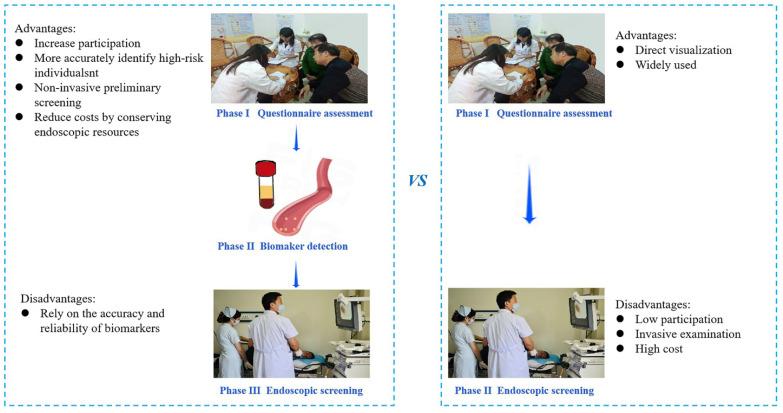
To improve compliance with endoscopic screening for gastric cancer (GC), we assessed five biomarkers-pepsinogen I (PG I), pepsinogen II (PG II), PG I/II ratio, helicobacter pylori antibody (HP-Ab), and gastrin 17 (G17) - for secondary GC screening by comparing participation and effectiveness of traditional endoscopy and biomarker-based screening in a randomized trial with baseline results. Seventy-four communities were randomly assigned to traditional endoscopy arm (TEA) or biomarker-based endoscopy arm (BEA). TEA uses a questionnaire for risk assessment, and BEA combines a questionnaire with biomarker detection. High-risk individuals in both arms underwent endoscopic screening. Participation and interim screening effectiveness in two arms were reported with baseline analysis. In total, 5,798 participants in TEA and 5,158 in BEA were recruited, with a participation rate of 26.9%. BEA showed a significantly lower high-risk rate than TEA (15.2% vs. 38.9%) and a higher endoscopic participation rate for high-risk individuals (64.9% vs. 53.0%). The endoscopic screening results showed that there was no significant difference in detection rate of GC abnormalities between the two arms. Education level, frequent drinking, hot, rough and hard food consumption, family history of GC, and history of reflux esophagitis or gastropathy influenced participation rates in biomarker-based screening. Age group, sex and regular consumption of meat, eggs and milk products were associated with stomach abnormalities.Cumulative incidence and specific death rates did not significantly differ in intention-to-screen and per-protocol analyses. Biomarker-based screening effectively identifies high-risk individuals and increases endoscopic participation, providing value insights for improving screening efficiency as a secondary procedure.
为提高胃癌(GC)内镜筛查的依从性,我们评估了五种生物标志物——胃蛋白酶原I(PG I)、胃蛋白酶原II(PG II)、PG I/II比值、幽门螺杆菌抗体(HP-Ab)和胃泌素17(G17)——用于胃癌二级筛查,通过在一项随机试验中比较传统内镜检查和基于生物标志物的筛查的参与度和有效性,并分析基线结果。74个社区被随机分配到传统内镜检查组(TEA)或基于生物标志物的内镜检查组(BEA)。TEA使用问卷进行风险评估,BEA则将问卷与生物标志物检测相结合。两组中的高危个体均接受内镜筛查。通过基线分析报告了两组的参与度和中期筛查有效性。总共招募了TEA组的5798名参与者和BEA组的5158名参与者,参与率为26.9%。BEA组的高危率显著低于TEA组(15.2%对38.9%),高危个体的内镜参与率更高(64.9%对53.0%)。内镜筛查结果显示,两组之间GC异常检出率无显著差异。教育水平、频繁饮酒、食用热、粗糙和硬质食物、GC家族史以及反流性食管炎或胃病病史影响了基于生物标志物筛查的参与率。年龄组、性别以及肉类、蛋类和奶制品的经常食用与胃部异常有关。在意向性筛查和符合方案分析中,累积发病率和特定死亡率无显著差异。基于生物标志物的筛查有效地识别高危个体并提高内镜参与度,为作为二级程序提高筛查效率提供了有价值的见解。


 Zotero 插件