
肿瘤相关巨噬细胞和 CD8+ T 细胞:HBV 相关 HCC 发病机制中的双重作用者。
Tumor-associated macrophages and CD8+ T cells: dual players in the pathogenesis of HBV-related HCC.
机构信息
Clinical Molecular Medicine Testing Center, The First Affiliated Hospital of Chongqing Medical University, Chongqing, China.
Western (Chongqing) Collaborative Innovation Center for Intelligent Diagnostics and Digital Medicine, Chongqing, China.
出版信息
Front Immunol. 2024 Oct 10;15:1472430. doi: 10.3389/fimmu.2024.1472430. eCollection 2024.
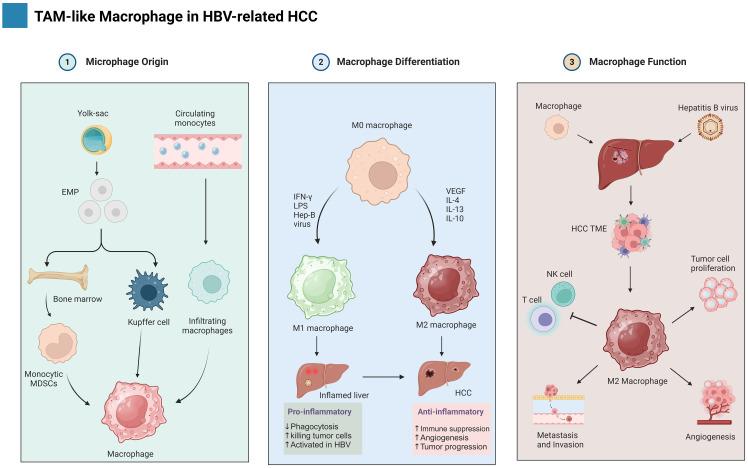
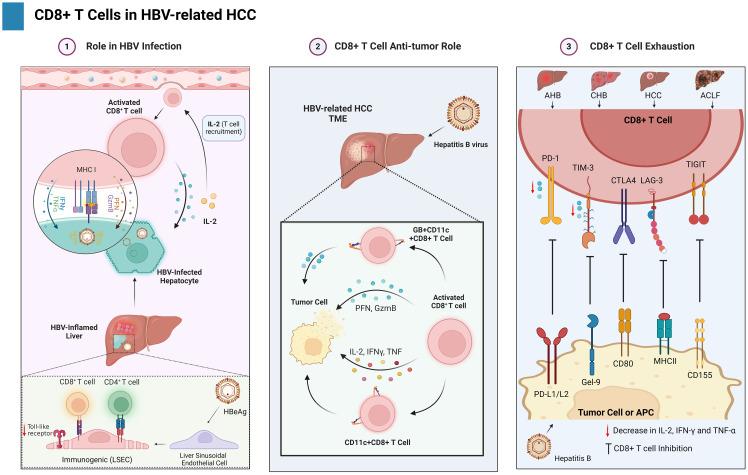
HBV infection is a key risk factor for the development and progression of hepatocellular carcinoma (HCC), a highly invasive tumor, and is characterized by its persistent immunosuppressive microenvironment. This review provides an in-depth analysis of HBV-related HCC and explores the interactions between neutrophils, natural killer cells, and dendritic cells, examining their roles in regulating tumor-associated macrophages and CD8+ T cells and shaping the tumor microenvironment. Two critical players in the immunosuppressive milieu of HBV-related HCC are CD8+ T cells and tumor-associated macrophages (TAMs). The study explores how TAMs, initially recruited to combat infection, transform, adopting a tumor-promoting phenotype, turning against the body, promoting tumor cell proliferation, suppressing anti-tumor immunity, and assisting in the spread of cancer. Meanwhile, CD8+ T cells, crucial for controlling HBV infection, become dysfunctional and exhausted in response to persistent chronic viral inflammation. The review then dissects how TAMs manipulate this immune response, further depleting CD8+ T cell functions through mechanisms like arginine deprivation and creating hypoxic environments that lead to exhaustion. Finally, it explores the challenges and promising therapeutic avenues that target TAMs and CD8+ T cells, either separately or in combination with antiviral therapy and personalized medicine approaches, offering hope for improved outcomes in HBV-related HCC.
HBV 感染是肝细胞癌(HCC)发生和进展的关键风险因素,HCC 是一种高度侵袭性肿瘤,其特征是持续的免疫抑制微环境。本综述深入分析了 HBV 相关 HCC,并探讨了中性粒细胞、自然杀伤细胞和树突状细胞之间的相互作用,研究它们在调节肿瘤相关巨噬细胞和 CD8+T 细胞以及塑造肿瘤微环境中的作用。CD8+T 细胞和肿瘤相关巨噬细胞(TAMs)是 HBV 相关 HCC 免疫抑制微环境中的两个关键参与者。本研究探讨了 TAMs 如何最初被招募来对抗感染,但随后发生转化,采用促肿瘤表型,转而对抗机体,促进肿瘤细胞增殖,抑制抗肿瘤免疫,并协助癌症扩散。与此同时,CD8+T 细胞在控制 HBV 感染方面至关重要,但在持续的慢性病毒炎症反应中会出现功能障碍和耗竭。本综述进一步剖析了 TAMs 如何通过精氨酸剥夺和创造导致衰竭的缺氧环境等机制来操纵这种免疫反应,从而进一步耗尽 CD8+T 细胞的功能。最后,探讨了针对 TAMs 和 CD8+T 细胞的治疗方法的挑战和前景,包括单独或与抗病毒治疗和个体化医学方法联合应用,为改善 HBV 相关 HCC 的治疗结果带来了希望。


 Zotero 插件