
自闭症患者循环血浆代谢物的因果代谢组学和脂质组学分析:一项具有独立队列验证的综合孟德尔随机化研究
Causal Metabolomic and Lipidomic Analysis of Circulating Plasma Metabolites in Autism: A Comprehensive Mendelian Randomization Study with Independent Cohort Validation.
作者信息
Li Zhifan, Li Yanrong, Tang Xinrong, Xing Abao, Lin Jianlin, Li Junrong, Ji Junjun, Cai Tiantian, Zheng Ke, Lingampelly Sai Sachin, Li Kefeng
机构信息
Big Data and Internet of Things Program, Faculty of Applied Sciences, Macao Polytechnic University, Macao 999078, China.
Center for Artificial Intelligence-Driven Drug Discovery, Faculty of Applied Sciences, Macao Polytechnic University, Macao 999078, China.
出版信息
Metabolites. 2024 Oct 17;14(10):557. doi: 10.3390/metabo14100557.
BACKGROUND
The increasing prevalence of autism spectrum disorder (ASD) highlights the need for objective diagnostic markers and a better understanding of its pathogenesis. Metabolic differences have been observed between individuals with and without ASD, but their causal relevance remains unclear.
METHODS
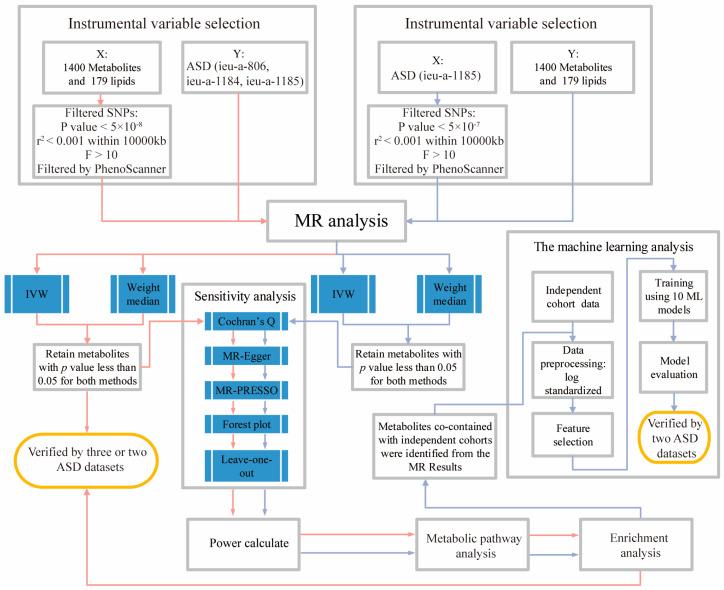
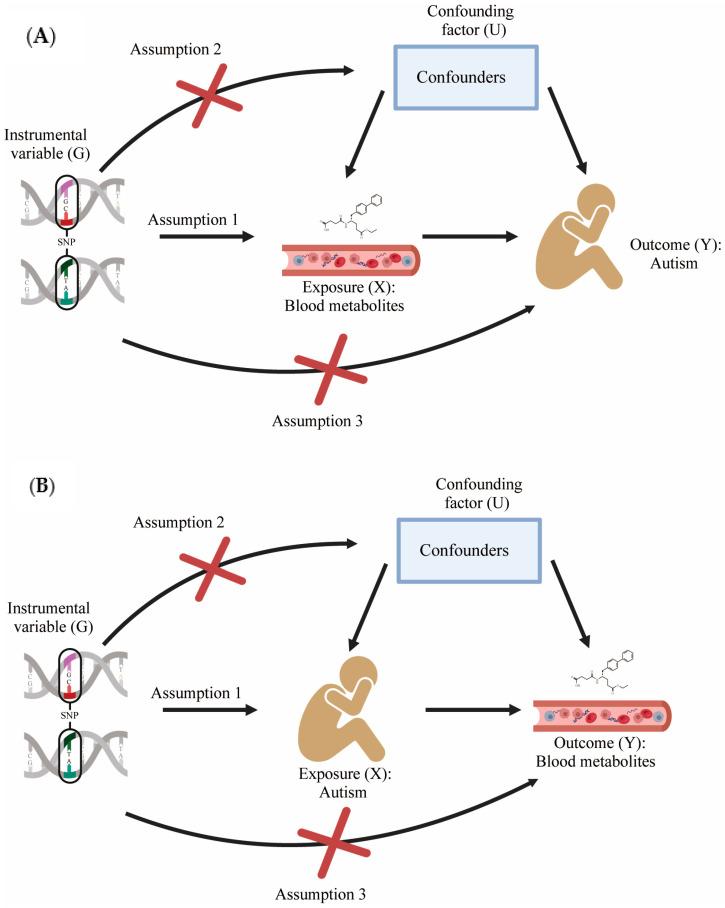
Bidirectional two-sample Mendelian randomization (MR) was used to assess causal associations between circulating plasma metabolites and ASD using large-scale genome-wide association study (GWAS) datasets-comprising 1091 metabolites, 309 ratios, and 179 lipids-and three European autism datasets (PGC 2015: = 10,610 and 10,263; 2017: = 46,351). Inverse-variance weighted (IVW) and weighted median methods were employed, along with robust sensitivity and power analyses followed by independent cohort validation.
RESULTS
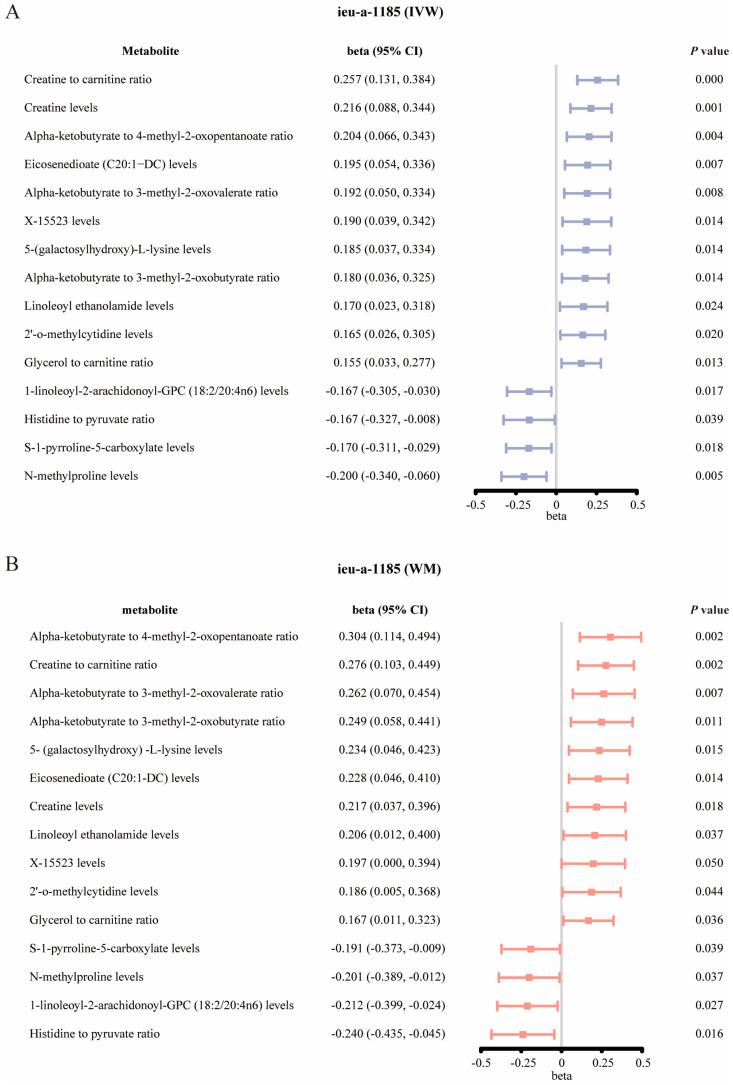
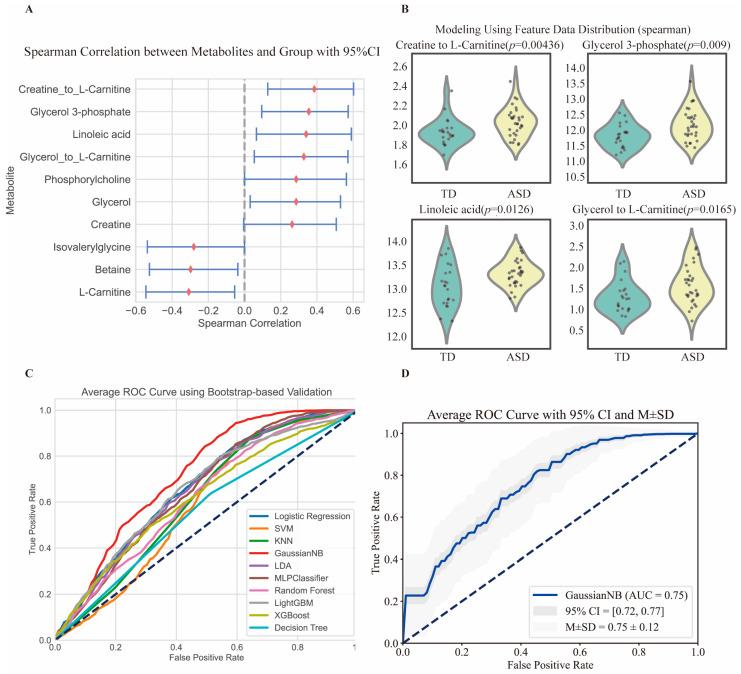
Higher genetically predicted levels of sphingomyelin (SM) (d17:1/16:0) (OR, 1.129; 95% CI, 1.024-1.245; = 0.015) were causally linked to increased ASD risk. Additionally, ASD children had higher plasma creatine/carnitine ratios. These MR findings were validated in an independent US autism cohort using machine learning analysis.
CONCLUSION
Utilizing large datasets, two MR approaches, robust sensitivity analyses, and independent validation, our novel findings provide evidence for the potential roles of metabolomics and circulating metabolites in ASD diagnosis and etiology.
背景
自闭症谱系障碍(ASD)的患病率不断上升,凸显了对客观诊断标志物的需求以及对其发病机制的更好理解。已观察到患有和未患有ASD的个体之间存在代谢差异,但其因果关系仍不清楚。
方法
使用双向双样本孟德尔随机化(MR),利用大规模全基因组关联研究(GWAS)数据集(包括1091种代谢物、309种比率和179种脂质)以及三个欧洲自闭症数据集(PGC 2015:病例组=10610例,对照组=10263例;2017年:病例组=46351例)评估循环血浆代谢物与ASD之间的因果关联。采用逆方差加权(IVW)和加权中位数方法,以及稳健的敏感性和效能分析,随后进行独立队列验证。
结果
遗传预测的鞘磷脂(SM)(d17:1/16:0)水平较高(优势比,1.129;95%可信区间,1.024 - 1.245;P = 0.015)与ASD风险增加存在因果关系。此外,ASD儿童的血浆肌酸/肉碱比率较高。这些MR研究结果在一个独立的美国自闭症队列中通过机器学习分析得到了验证。
结论
利用大型数据集、两种MR方法、稳健的敏感性分析和独立验证,我们的新发现为代谢组学和循环代谢物在ASD诊断和病因学中的潜在作用提供了证据。



 Zotero 插件