
陈皮衍生的碳点:一种用于检测自来水和饮用水样品中铜(II)的多功能荧光探针。
Mandarin Peels-Derived Carbon Dots: A Multifaceted Fluorescent Probe for Cu(II) Detection in Tap and Drinking Water Samples.
作者信息
El-Azazy Marwa, AlReyashi Alaa, Al-Saad Khalid, Al-Hashimi Nessreen, Al-Ghouti Mohammad A, Shibl Mohamed F, Alahzm Abdulrahman, El-Shafie Ahmed S
机构信息
Department of Chemistry and Earth Sciences, College of Arts and Sciences, Qatar University, Doha 2713, Qatar.
Environmental Sciences Program, Department of Biological and Environmental Sciences, College of Arts and Sciences, Qatar University, Doha 2713, Qatar.
出版信息
Nanomaterials (Basel). 2024 Oct 17;14(20):1666. doi: 10.3390/nano14201666.
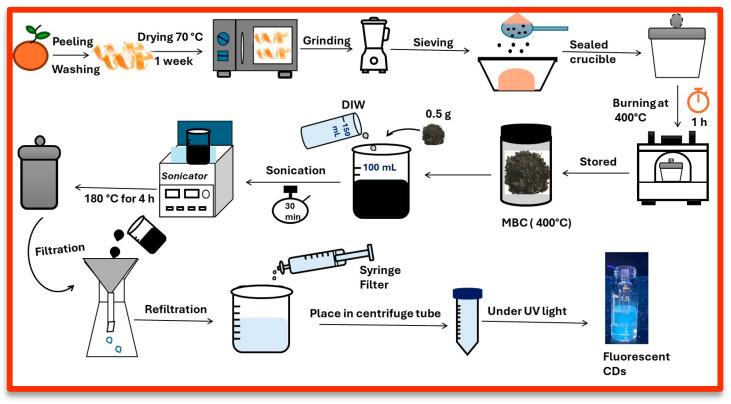
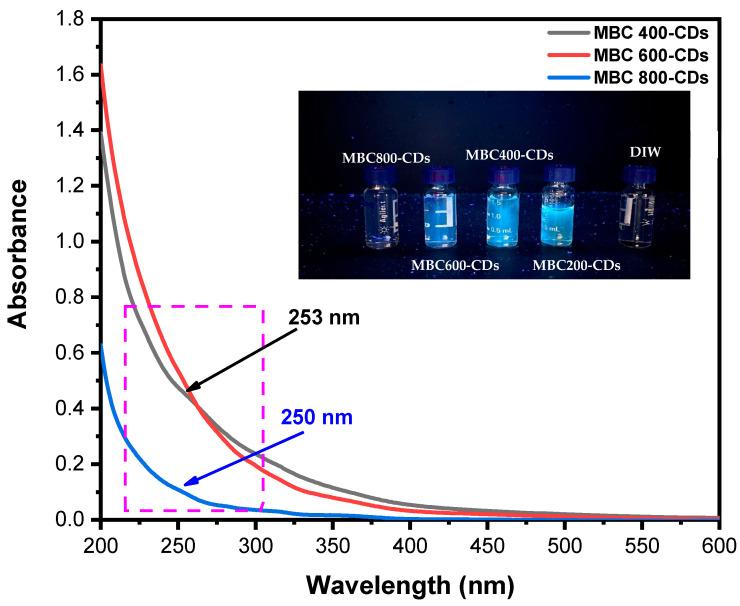
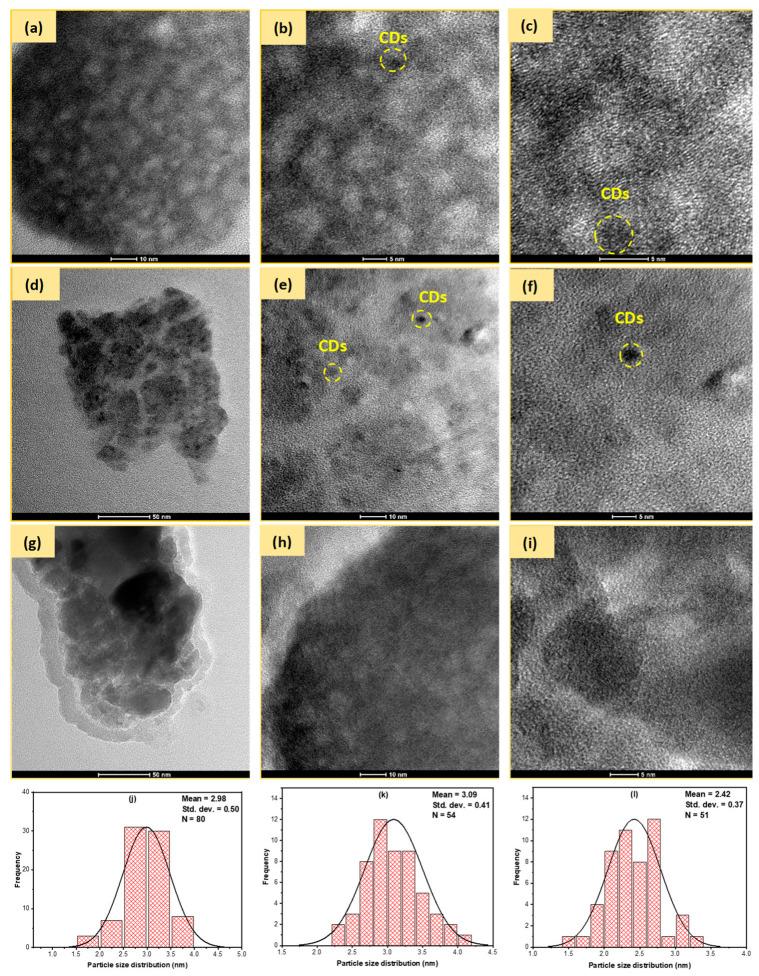
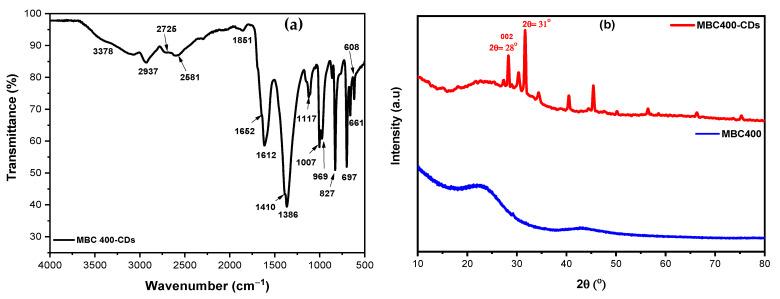
Carbon dots (CDs) derived from mandarin peel biochar (MBC) at different pyrolysis temperatures (200, 400, 600, and 800 °C) have been synthesized and characterized. This high-value transformation of waste materials into fluorescent nanoprobes for environmental monitoring represents a step forward towards a circular economy. In this itinerary, CDs produced via one-pot hydrothermal synthesis were utilized for the detection of copper (II) ions. The study looked at the spectroscopic features of biochar-derived CDs. The selectivity of CDs obtained from biochar following carbonization at 400 °C (MBC400-CDs towards various heavy metal ions resulted in considerable fluorescence quenching with copper (II) ions, showcasing their potential as selective detectors. Transmission electron microscopic (TEM) analysis validated the MBC-CDs' consistent spherical shape, with a particle size of <3 nm. The Plackett-Burman Design (PBD) was used to study three elements that influence the F/F ratio, with the best ratio obtained with a pH of 10, for 10 min, and an aqueous reaction medium. Cu (II) was detected over a dynamic range of 4.9-197.5 μM and limit of detection (LOD) of 0.01 μM. Validation testing proved the accuracy and precision for evaluating tap and mountain waters with great selectivity and no interference from coexisting metal ions.
通过在不同热解温度(200、400、600和800℃)下由柑橘皮生物炭(MBC)制备的碳点(CDs)已被合成和表征。这种将废料高价值转化为用于环境监测的荧光纳米探针是迈向循环经济的重要一步。在这个过程中,通过一锅水热合成法制备的CDs被用于检测铜(II)离子。该研究考察了生物炭衍生的CDs的光谱特征。在400℃碳化后从生物炭获得的CDs(MBC400 - CDs)对各种重金属离子的选择性导致其与铜(II)离子产生显著的荧光猝灭,这表明它们作为选择性检测器的潜力。透射电子显微镜(TEM)分析证实了MBC - CDs呈一致的球形,粒径小于3nm。采用Plackett - Burman设计(PBD)研究了影响F/F比的三个因素,在pH为10、反应10分钟和水相反应介质的条件下获得了最佳比例。在4.9 - 197.5μM的动态范围内检测到了Cu(II),检测限(LOD)为0.01μM。验证测试证明了该方法在评估自来水和山泉水时具有高选择性且不受共存金属离子干扰的准确性和精密度。




 Zotero 插件