
镧系金属会改变多巴胺能和5-羟色胺能依赖性行为。
Dopaminergic- and Serotonergic-Dependent Behaviors Are Altered by Lanthanide Series Metals in .
作者信息
Radzimirski Anthony, Croft Michael, Ireland Nicholas, Miller Lydia, Newell-Caito Jennifer, Caito Samuel
机构信息
Department of Pharmaceutical Sciences, School of Pharmacy, Husson University, Bangor, ME 04401, USA.
Department of Molecular & Biomedical Sciences, University of Maine, Orono, ME 04469, USA.
出版信息
Toxics. 2024 Oct 17;12(10):754. doi: 10.3390/toxics12100754.
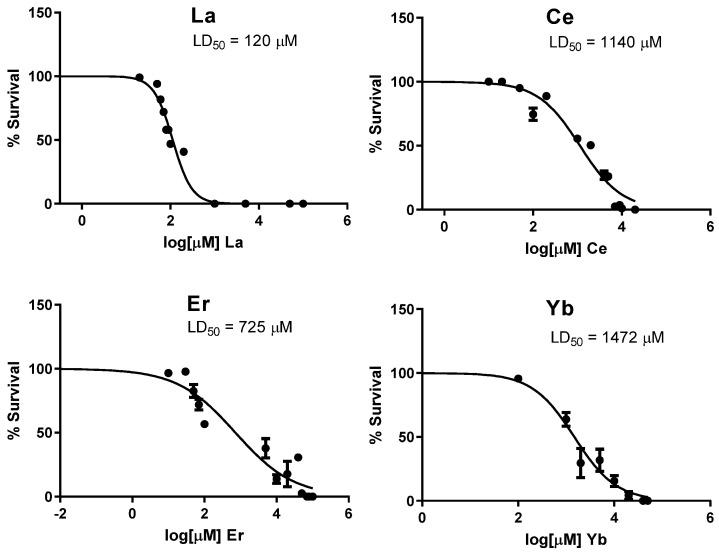
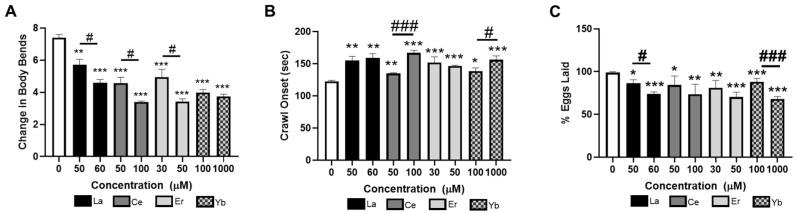
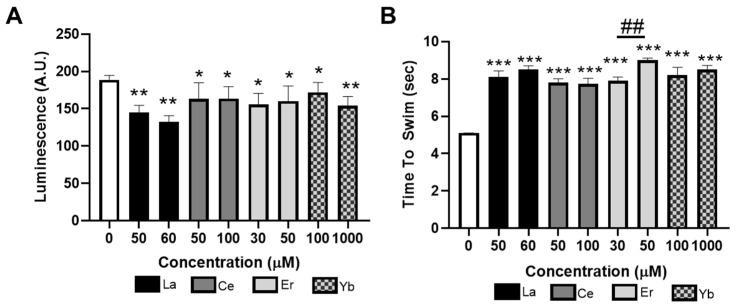
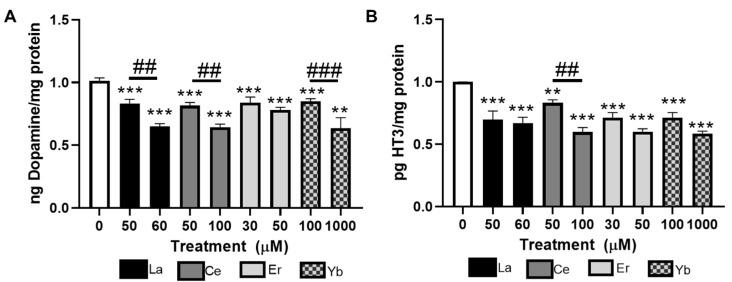
The lanthanide series elements are transition metals used as critical components of electronics, as well as rechargeable batteries, fertilizers, antimicrobials, contrast agents for medical imaging, and diesel fuel additives. With the surge in their utilization, lanthanide metals are being found more in our environment. However, little is known about the health effects associated with lanthanide exposure. Epidemiological studies as well as studies performed in rodents exposed to lanthanum (La) suggest neurological damage, learning and memory impairment, and disruption of neurotransmitter signaling, particularly in serotonin and dopamine pathways. Unfortunately, little is known about the neurological effects of heavier lanthanides. As dysfunctions of serotonergic and dopaminergic signaling are implicated in multiple neurological conditions, including Parkinson's disease, depression, generalized anxiety disorder, and post-traumatic stress disorder, it is of utmost importance to determine the effects of La and other lanthanides on these neurotransmitter systems. We therefore hypothesized that early-life exposure of light [La (III) or cerium (Ce (III))] or heavy [erbium (Er (III)) or ytterbium (Yb (III))] lanthanides in could cause dysregulation of serotonergic and dopaminergic signaling upon adulthood. Serotonergic signaling was assessed by measuring pharyngeal pump rate, crawl-to-swim transition, as well as egg-laying behaviors. Dopaminergic signaling was assessed by measuring locomotor rate and egg-laying and swim-to-crawl transition behaviors. Treatment with La (III), Ce (III), Er (III), or Yb (III) caused deficits in serotonergic or dopaminergic signaling in all assays, suggesting both the heavy and light lanthanides disrupt these neurotransmitter systems. Concomitant with dysregulation of neurotransmission, all four lanthanides increased reactive oxygen species (ROS) generation and decreased glutathione and ATP levels. This suggests increased oxidative stress, which is a known modifier of neurotransmission. Altogether, our data suggest that both heavy and light lanthanide series elements disrupt serotonergic and dopaminergic signaling and may affect the development or pharmacological management of related neurological conditions.
镧系元素是过渡金属,可用作电子产品、可充电电池、肥料、抗菌剂、医学成像造影剂和柴油燃料添加剂的关键成分。随着其使用量的激增,镧系金属在我们的环境中越来越常见。然而,人们对与镧系元素暴露相关的健康影响知之甚少。流行病学研究以及对暴露于镧(La)的啮齿动物进行的研究表明,存在神经损伤、学习和记忆障碍以及神经递质信号传导紊乱,特别是在血清素和多巴胺途径中。不幸的是,对于较重镧系元素的神经学影响了解甚少。由于血清素能和多巴胺能信号传导功能障碍与多种神经疾病有关,包括帕金森病、抑郁症、广泛性焦虑症和创伤后应激障碍,因此确定镧和其他镧系元素对这些神经递质系统的影响至关重要。因此,我们假设幼年暴露于轻镧系元素[镧(III)或铈(Ce(III))]或重镧系元素[铒(Er(III))或镱(Yb(III))]可能会导致成年后血清素能和多巴胺能信号传导失调。通过测量咽泵速率、爬行到游泳的转变以及产卵行为来评估血清素能信号传导。通过测量运动速率、产卵以及游泳到爬行的转变行为来评估多巴胺能信号传导。在所有实验中,用镧(III)、铈(III)、铒(III)或镱(III)处理均导致血清素能或多巴胺能信号传导缺陷,这表明重镧系元素和轻镧系元素都会破坏这些神经递质系统。与神经传递失调同时出现的是,所有四种镧系元素均增加了活性氧(ROS)的生成,并降低了谷胱甘肽和ATP水平。这表明氧化应激增加,而氧化应激是已知的神经传递调节剂。总之,我们的数据表明,重镧系元素和轻镧系元素都会破坏血清素能和多巴胺能信号传导,并可能影响相关神经疾病的发展或药物治疗。

 Zotero 插件