
美国成年人(50 岁以上)中可通过疫苗预防的疾病负担:一项回顾性理赔分析。
Burden of vaccine-preventable diseases in adults (50+) in the United States: a retrospective claims analysis.
机构信息
Institute for Medical Information Processing, Biometry and Epidemiology- IBE, LMU Munich, Munich, Germany.
Pettenkofer School of Public Health, Munich, Germany.
出版信息
BMC Public Health. 2024 Oct 25;24(1):2960. doi: 10.1186/s12889-024-20145-0.
BACKGROUND
In adults aged 50 + years, vaccine-preventable diseases (VPDs) pose a significant health burden and can lead to additional 'downstream effects' of infection beyond the acute phase e.g., increasing the risk for non-communicable disease and exacerbating chronic conditions. The aim was to understand and quantify the burden of VPD downstream effects in hospitalised adults in the United States.
METHODS
This retrospective observational study analysed hospitalisation claims data (2016-2019) with 1-year follow-up, in adults with a VPD diagnosis versus matched controls (using Optum's de-identified Clinformatics Data Mart Database). Outcomes included mortality; increase in Charlson Comorbidity Index (CCI) score; new diagnosis of comorbidities; and loss of independence (defined by need for home health/home care and/or move to long-term facility).
RESULTS
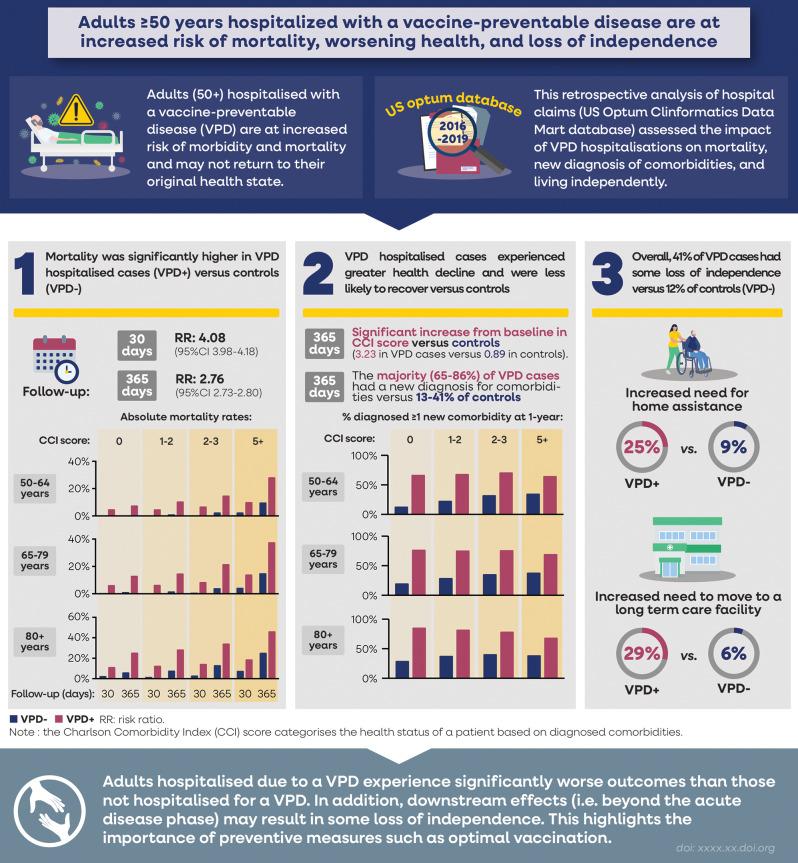
Mortality was significantly increased in VPD cases versus controls at 30-day (risk ratio [RR] of 4.08 [95% CI 3.98-4.18]) and 1-year follow-up (RR 2.76 [2.73-2.80]). Over a 1-year follow-up period, morbidity increased following VPD hospitalisation: 65-86% of VPD cases had new comorbidities diagnosed (versus 13-41% of controls); with a significantly higher mean increase in CCI score versus baseline (3.23 in VPD cases versus 0.89 in controls, p < 0.001). Adults were observed to experience a worsening of their health status and were less likely to return to their original health state. In addition, 41% of VPD cases had a loss of independence following hospitalisation versus 12% of controls; as seen by an increased need for home assistance (in 25% versus 9% of controls) and/or a move to a long-term care facility (in 29% versus 6% of controls).
CONCLUSIONS
This analysis suggests that VPD hospitalised cases suffer significantly worse clinical outcomes than controls, with downstream effects that include increased mortality and morbidity, and greater loss of independence. Evidence on potential downstream effects of infection is relatively new, and this additional burden is generally not considered in vaccine decision-making. More research is needed to disentangle the effect of VPDs on new comorbidities versus the natural course of the condition. Increasing awareness among adults, healthcare providers and decision makers could help to increase adult vaccination coverage, and reduce the clinical burden of VPDs.
背景
在 50 岁及以上的成年人中,可通过疫苗预防的疾病(VPD)对健康造成严重负担,并可能导致感染后的“下游效应”,例如增加非传染性疾病的风险,并使慢性疾病恶化。本研究旨在了解和量化美国住院成年人 VPD 下游效应的负担。
方法
本回顾性观察性研究分析了 2016 年至 2019 年有 1 年随访的 VPD 诊断患者(使用 Optum 的去识别 Clinformatics Data Mart 数据库)与匹配对照者的住院记录。结局包括死亡率、Charlson 合并症指数(CCI)评分升高、新发合并症诊断和丧失独立性(由家庭健康/家庭护理需求和/或转移至长期护理机构定义)。
结果
与对照组相比,VPD 病例在 30 天(风险比[RR]为 4.08[95%CI 3.98-4.18])和 1 年随访(RR 2.76[2.73-2.80])时死亡率显著增加。在 1 年随访期间,VPD 住院后发病率增加:65%-86%的 VPD 病例新诊断出合并症(而对照组为 13%-41%);与基线相比,CCI 评分的平均升高幅度显著更大(VPD 病例为 3.23,对照组为 0.89,p<0.001)。观察到成年人的健康状况恶化,且不太可能恢复到原来的健康状态。此外,41%的 VPD 病例住院后丧失独立性,而对照组为 12%;表现在对家庭援助的需求增加(对照组为 25%,而对照组为 9%)和/或转移至长期护理机构(对照组为 29%,而对照组为 6%)。
结论
本分析表明,VPD 住院病例的临床结局明显差于对照组,下游效应包括死亡率和发病率增加,以及更大程度的丧失独立性。感染的潜在下游效应的证据相对较新,在疫苗决策中通常不考虑这种额外负担。需要进一步研究以阐明 VPD 对新发合并症的影响与疾病自然病程的关系。提高成年人、医疗保健提供者和决策者的认识,有助于提高成人疫苗接种率,并减轻 VPD 的临床负担。


 Zotero 插件