
ATR在整个细胞周期中的非经典作用三部曲及其与癌症的关系
A TRilogy of ATR's Non-Canonical Roles Throughout the Cell Cycle and Its Relation to Cancer.
作者信息
Joo Yoon Ki, Ramirez Carlos, Kabeche Lilian
机构信息
Department of Molecular Biophysics and Biochemistry, Yale University, New Haven, CT 06511, USA.
Yale Cancer Biology Institute, Yale University, West Haven, CT 06516, USA.
出版信息
Cancers (Basel). 2024 Oct 19;16(20):3536. doi: 10.3390/cancers16203536.
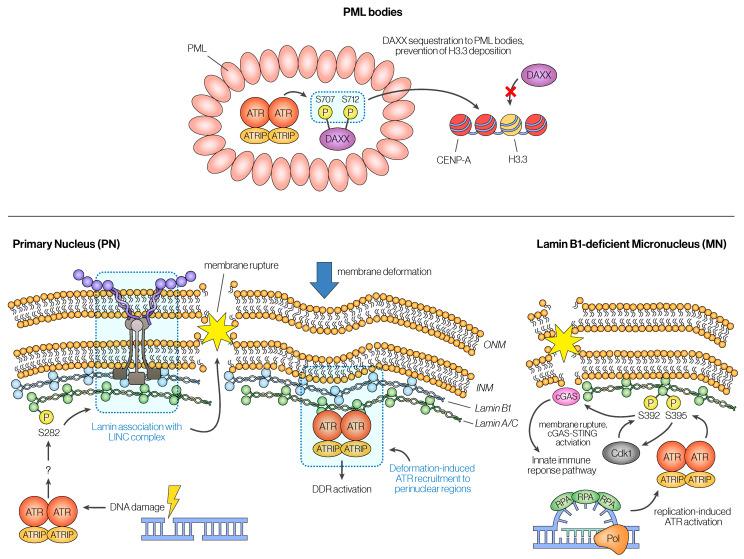
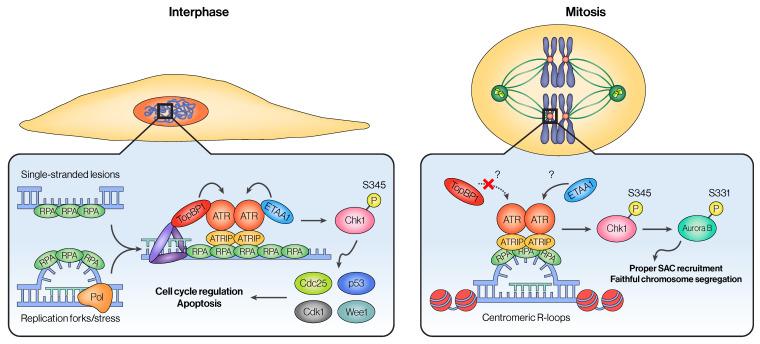
Ataxia Telangiectasia and Rad3-related protein (ATR) is an apical kinase of the DNA Damage Response (DDR) pathway responsible for detecting and resolving damaged DNA. Because cancer cells depend heavily on the DNA damage checkpoint for their unchecked proliferation and propagation, ATR has gained enormous popularity as a cancer therapy target in recent decades. Yet, ATR inhibitors have not been the silver bullets as anticipated, with clinical trials demonstrating toxicity and mixed efficacy. To investigate whether the toxicity and mixed efficacy of ATR inhibitors arise from their off-target effects related to ATR's multiple roles within and outside the DDR pathway, we have analyzed recently published studies on ATR's non-canonical roles. Recent studies have elucidated that ATR plays a wide role throughout the cell cycle that is separate from its function in the DDR. This includes maintaining nuclear membrane integrity, detecting mechanical forces, and promoting faithful chromosome segregation during mitosis. In this review, we summarize the canonical, DDR-related roles of ATR and also focus on the non-canonical, multifaceted roles of ATR throughout the cell cycle and their clinical relevance. Through this summary, we also address the need for re-assessing clinical strategies targeting ATR as a cancer therapy based on these newly discovered roles for ATR.
共济失调毛细血管扩张症和Rad3相关蛋白(ATR)是DNA损伤反应(DDR)途径的一种顶端激酶,负责检测和修复受损DNA。由于癌细胞在无节制的增殖和扩散过程中严重依赖DNA损伤检查点,近几十年来,ATR作为癌症治疗靶点受到了极大关注。然而,ATR抑制剂并非如预期那样是万灵药,临床试验显示出毒性且疗效参差不齐。为了研究ATR抑制剂的毒性和混合疗效是否源于其与ATR在DDR途径内外的多种作用相关的脱靶效应,我们分析了最近发表的关于ATR非经典作用的研究。最近的研究表明,ATR在整个细胞周期中发挥着广泛作用,这与其在DDR中的功能不同。这包括维持核膜完整性、检测机械力以及在有丝分裂期间促进准确的染色体分离。在这篇综述中,我们总结了ATR与DDR相关的经典作用,同时也关注ATR在整个细胞周期中的非经典多方面作用及其临床相关性。通过这一总结,我们还讨论了基于ATR这些新发现的作用重新评估将ATR作为癌症治疗靶点的临床策略的必要性。


 Zotero 插件