
戊型肝炎病毒感染在系统性红斑狼疮和皮肤红斑狼疮患者中。
Hepatitis E Virus Infection in Patients with Systemic and Cutaneous Lupus Erythematosus.
机构信息
Lupus Clinic, Rheumatology, Dipartimento di Scienze Cliniche, Internistiche, Anestesiologiche e Cardiovascolari, Sapienza Università di Roma, 00185 Rome, Italy.
Department of Infectious Diseases, Istituto Superiore di Sanità, 00161 Rome, Italy.
出版信息
Int J Mol Sci. 2024 Oct 17;25(20):11162. doi: 10.3390/ijms252011162.
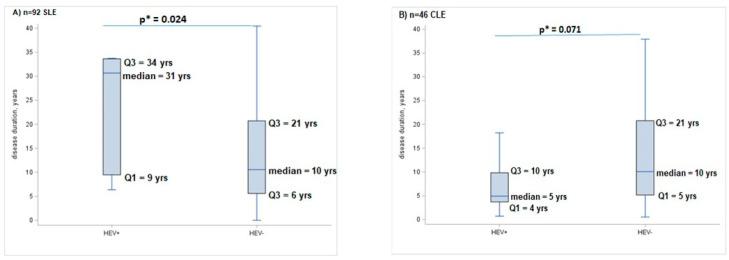
Systemic lupus erythematosus (SLE) is a chronic autoimmune disease characterized by a multifactorial etiology in which genetic and environmental factors interplay. An exclusively cutaneous condition has been described and defined as cutaneous lupus erythematosus (CLE). In Italy, a nationwide blood donor survey found an overall HEV prevalence of 8.7%, with an interregional variation from 2.2% to 22.8%. In this study, we aimed to estimate HEV seroprevalence in a cohort of patients affected by SLE and CLE attending the Lupus Clinic, Sapienza University of Rome. Serum samples were tested for anti-HEV immunoglobulin Ig G and M antibodies using commercial enzyme-linked immunosorbent assay (ELISA) kits. Statistical analysis was performed. In total, 138 patients were enrolled, 92 (67%) affected by SLE and 46 by CLE. The prevalence of HEV infection was 23.9% in the CLE group and 7.6% in the SLE group. The anti-HEV+ prevalence was significantly more frequent in CLE. Some mechanisms may be linked to increased susceptibility to HEV such as a molecular mimicry associated with the CLE condition or with the skin compartment/skin self-antigens, as well as the involvement of the genetic background. Regarding the possible risk factors, no association was found, although, of note, the odds of HEV+ relative to contact with animals and to eating raw seafood were strongly higher than the unit in the CLE group.
系统性红斑狼疮(SLE)是一种慢性自身免疫性疾病,其病因具有多因素性,遗传和环境因素相互作用。已经描述并定义了一种仅为皮肤表现的疾病,即皮肤红斑狼疮(CLE)。在意大利,一项全国性的献血者调查发现,HEV 的总体流行率为 8.7%,区域间差异为 2.2%至 22.8%。在这项研究中,我们旨在评估罗马萨皮恩扎大学狼疮诊所的 SLE 和 CLE 患者队列中 HEV 的血清流行率。使用商业酶联免疫吸附试验(ELISA)试剂盒检测血清样本中的抗 HEV 免疫球蛋白 IgG 和 M 抗体。进行了统计分析。共纳入 138 例患者,92 例(67%)患有 SLE,46 例患有 CLE。CLE 组的 HEV 感染率为 23.9%,SLE 组为 7.6%。CLE 组的抗 HEV+患病率明显更高。一些机制可能与 HEV 的易感性增加有关,例如与 CLE 状况或与皮肤部位/皮肤自身抗原相关的分子模拟,以及遗传背景的参与。关于可能的危险因素,没有发现相关性,尽管值得注意的是,与动物接触和食用生海鲜相关的 HEV+的几率在 CLE 组中明显高于单位。
 Zotero 插件