
一氧化氮和硝化修饰在玉米中的相互作用:对蚜虫取食和干旱胁迫的影响。
The Interplay of Nitric Oxide and Nitrosative Modifications in Maize: Implications for Aphid Herbivory and Drought Stress.
机构信息
Institute of Biological Sciences, Faculty of Natural Sciences, University of Siedlce, 14 Prusa St., 08-110 Siedlce, Poland.
Department of Plant Protection, Faculty of Horticulture and Landscape Architecture, University of Life Sciences in Lublin, 7 Leszczyńskiego St., 20-069 Lublin, Poland.
出版信息
Int J Mol Sci. 2024 Oct 20;25(20):11280. doi: 10.3390/ijms252011280.
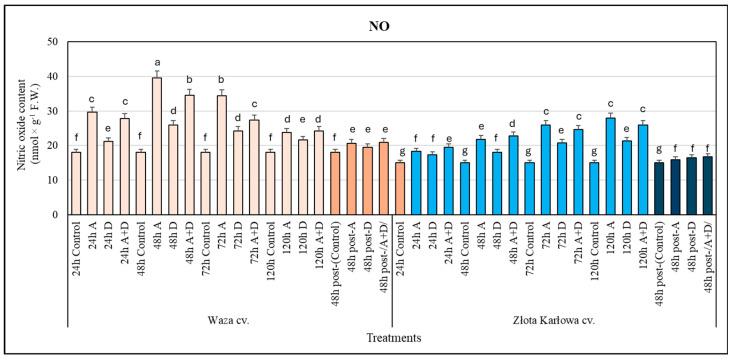
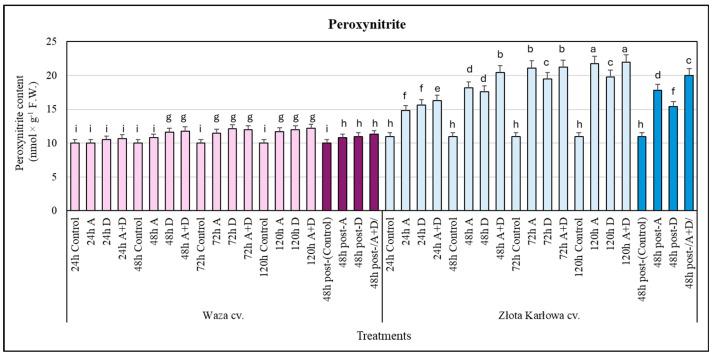
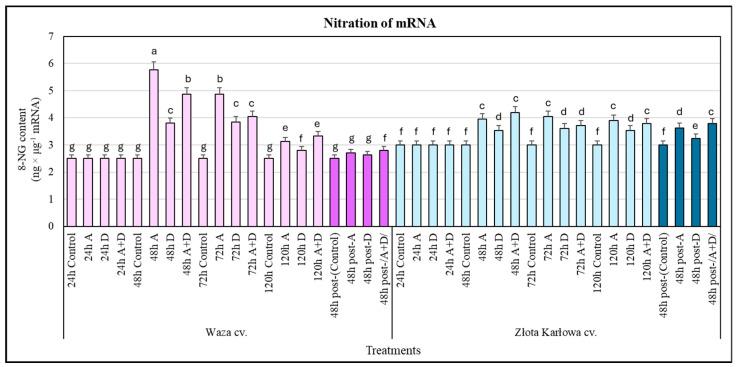
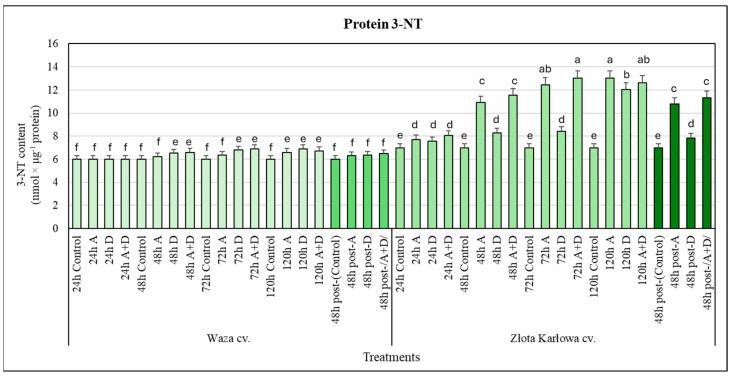
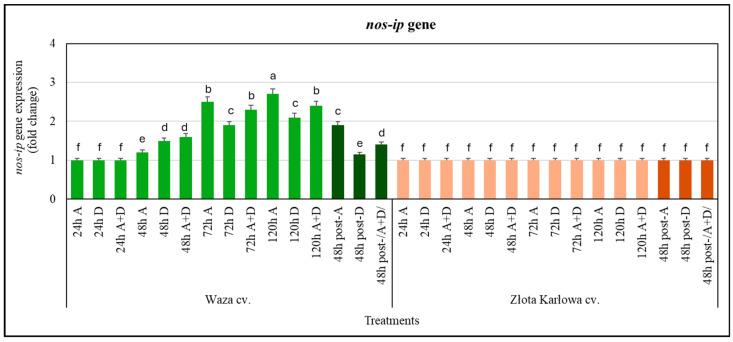
Nitric oxide (NO) and other reactive nitrogen species (RNS) are considered to be signaling molecules in higher plants involved in the regulation of growth and development processes. However, the molecular mechanisms of their formation, removal, and participation in plant responses to adverse environmental stimuli remain largely unclear. Therefore, the aim of this study was to assess the influence of selected single stresses and combined stresses (i.e., L. aphid infestation, drought, aphid infestation, and drought) and post-stress recovery on the contents of NO and peroxynitrite anion (ONOO), as well as the levels of mRNA and protein nitration (i.e., the 8-nitroguanine and protein 3-nitrotyrosine amounts, respectively), in maize seedlings ( L.). Moreover, the expression patterns of the two tested genes (, encoding nitric oxide synthase-interacting protein, and , encoding nitrate reductase 1) involved in NO metabolism in maize plants were quantified. We identified significant intervarietal, time-course, and stress-dependent differences in the levels of the quantified parameters. Under the investigated stress conditions, the aphid-resistant Waza cv. seedlings were characterized by a higher and earlier NO accumulation and mRNA nitration level and an increased expression of the two target genes ( and ), compared to the aphid-susceptible Złota Karłowa cv. seedlings. Conversely, the Złota Karłowa plants responded with a greater elevation in the content of ONOO and protein 3-nitrotyrosine than the Waza cv. plants The multifaceted role of NO and its derivatives in maize plants challenged by single and combined stresses, as well as during post-stress recovery, is discussed.
一氧化氮 (NO) 和其他活性氮物种 (RNS) 被认为是高等植物中的信号分子,参与调节生长和发育过程。然而,它们的形成、清除和参与植物对不利环境刺激的反应的分子机制在很大程度上仍不清楚。因此,本研究的目的是评估选定的单一胁迫和复合胁迫(即,蚜虫侵染、干旱、蚜虫侵染和干旱)以及胁迫后恢复对 NO 和过氧亚硝酸盐阴离子(ONOO)含量、mRNA 和蛋白质硝化水平(即,8-硝基鸟嘌呤和蛋白质 3-硝基酪氨酸的量)的影响,以及参与玉米幼苗( L.)中 NO 代谢的两个测试基因(,编码一氧化氮合酶相互作用蛋白,和 ,编码硝酸还原酶 1)的表达模式。我们确定了所研究参数的品种间、时间过程和胁迫依赖性差异。在研究的胁迫条件下,与抗蚜虫的 Waza 品系相比,易感蚜虫的 Złota Karłowa 品系幼苗的 NO 积累和 mRNA 硝化水平更高、更早,并且两个靶基因(和 )的表达增加。相反,与 Waza 品系相比,Złota Karłowa 植株对 ONOO 含量和蛋白质 3-硝基酪氨酸的升高反应更大。讨论了 NO 及其衍生物在单一和复合胁迫以及胁迫后恢复过程中对玉米植株的多方面作用。

 Zotero 插件