
免疫分析的转变引领下一代侧向流动分析及未来前景
Transitions in Immunoassay Leading to Next-Generation Lateral Flow Assays and Future Prospects.
作者信息
Fujiuchi Koyu, Aoki Noriko, Ohtake Tetsurou, Iwashita Toshihide, Kawasaki Hideya
机构信息
NanoSuit Research Laboratory, Institute of Photonics Medicine, Division of Preeminent Bioimaging Research, Hamamatsu University School of Medicine, Hamamatsu 431-3125, Japan.
Research and Development Department, TAUNS Laboratories, Inc., Izunokuni-shi 410-2325, Japan.
出版信息
Biomedicines. 2024 Oct 6;12(10):2268. doi: 10.3390/biomedicines12102268.
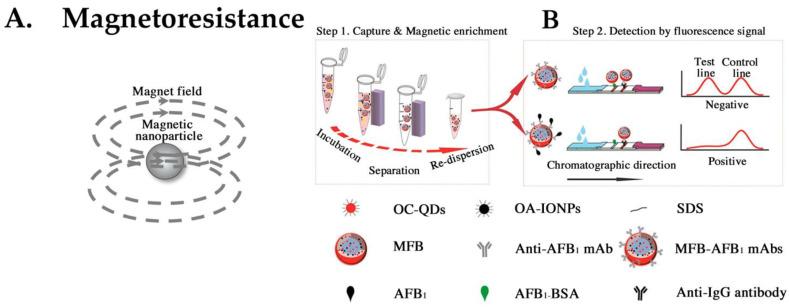
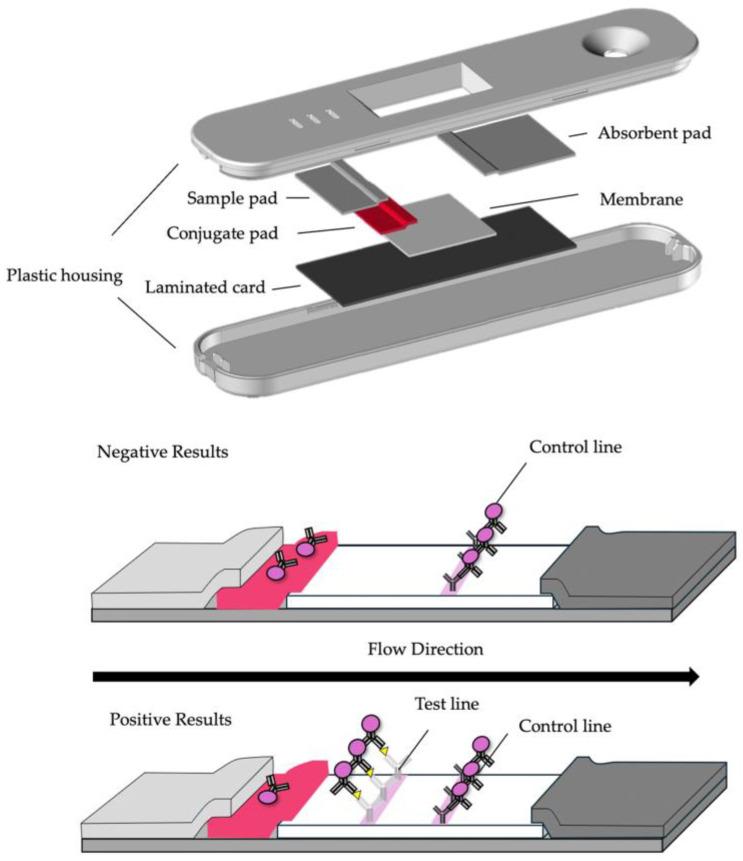
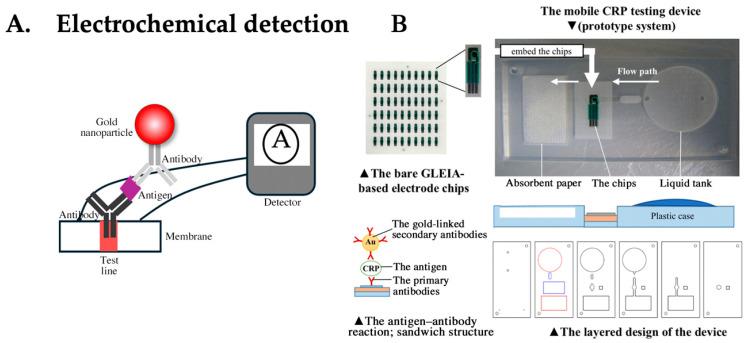
In the field of clinical testing, the traditional focus has been on the development of large-scale analysis equipment designed to process high volumes of samples with fully automatic and high-sensitivity measurements. However, there has been a growing demand in recent years for the development of analytical reagents tailored to point-of-care testing (POCT), which does not necessitate a specific location or specialized operator. This trend is epitomized using the lateral flow assay (LFA), which became a cornerstone during the 2019 pandemic due to its simplicity, speed of delivering results-within about 10 min from minimal sample concentrations-and user-friendly design. LFAs, with their paper-based construction, combine cost-effectiveness with ease of disposal, addressing both budgetary and environmental concerns comprehensively. Despite their compact size, LFAs encapsulate a wealth of technological ingenuity, embodying years of research and development. Current research is dedicated to further evolving LFA technology, paving the way for the next generation of diagnostic devices. These advancements aim to redefine accessibility, empower individuals, and enhance responsiveness to public health challenges. The future of LFAs, now unfolding, promises even greater integration into routine health management and emergency responses, underscoring their critical role in the evolution of decentralized and patient-centric healthcare solutions. In this review, the historical development of LFA and several of the latest LFA technologies using catalytic amplification, surface-enhanced Raman scattering, heat detection, electron chemical detections, magnetoresistance, and detection of reflected electrons detection are introduced to inspire readers for future research and development.
在临床检测领域,传统重点一直是开发大型分析设备,旨在通过全自动和高灵敏度测量来处理大量样本。然而,近年来对即时检测(POCT)专用分析试剂的开发需求不断增长,即时检测无需特定地点或专业操作人员。这种趋势以侧向流动分析(LFA)为例,由于其简单性、在最低样本浓度下约10分钟内即可出结果的速度以及用户友好的设计,LFA在2019年疫情期间成为了基石。LFA采用纸质结构,兼具成本效益和易于处理的特点,全面解决了预算和环境问题。尽管LFA体积小巧,但它蕴含了丰富的技术智慧,体现了多年的研发成果。当前的研究致力于进一步发展LFA技术,为下一代诊断设备铺平道路。这些进步旨在重新定义可及性、赋予个人能力并增强对公共卫生挑战的应对能力。LFA的未来正在展开,有望更多地融入日常健康管理和应急响应,凸显其在分散式和以患者为中心的医疗解决方案发展中的关键作用。在本综述中,介绍了LFA的历史发展以及几种使用催化扩增、表面增强拉曼散射、热检测、电化学检测、磁阻和反射电子检测的最新LFA技术,以激发读者对未来研发的兴趣。




 Zotero 插件