
帕里辛A通过AKT/mTOR信号通路抑制口腔鳞状细胞癌。
Parishin A Inhibits Oral Squamous Cell Carcinoma via the AKT/mTOR Signaling Pathway.
作者信息
Ma Lei, Liu Zhibin, Kim Eungyung, Huang Ke, Kim Chae Yeon, Kim Hyeonjin, Park Kanghyun, Kwon Woo-Sung, Lee Sang In, Kim Yong-Gun, Lee Youngkyun, Choi So-Young, Zhang Haibo, Kim Myoung Ok
机构信息
Department of Animal Science and Biotechnology, Research Institute for Innovative Animal Science, Kyungpook National University, Daegu 37224, Republic of Korea.
Department of Oral and Maxillofacial Surgery, School of Dentistry, University of Texas Health Science Center at San Antonio, San Antonio, TX 78229, USA.
出版信息
Pharmaceuticals (Basel). 2024 Sep 26;17(10):1277. doi: 10.3390/ph17101277.
BACKGROUND
Oral squamous cell carcinoma (OSCC) is an aggressive cancer with limited treatment options. Parishin A, a natural compound derived from , possesses multiple therapeutic properties. However, its effects on OSCC remain unexplored.
PURPOSE
This study explores the anti-cancer potential of Parishin A on OSCC and its mechanisms.
METHODS
OSCC cell lines YD-10B and Ca9-22 were treated with varying Parishin A concentrations. Cell viability was detected using the CCK-8 assay, and colony formation was evaluated in agarose gel. Migration and invasion ability were assessed through wound healing and Matrigel invasion assays. The protein expression levels involved in the PI3K/AKT/mTOR signaling pathway and epithelial-mesenchymal transition (EMT) markers were examined via Western blotting.
RESULTS
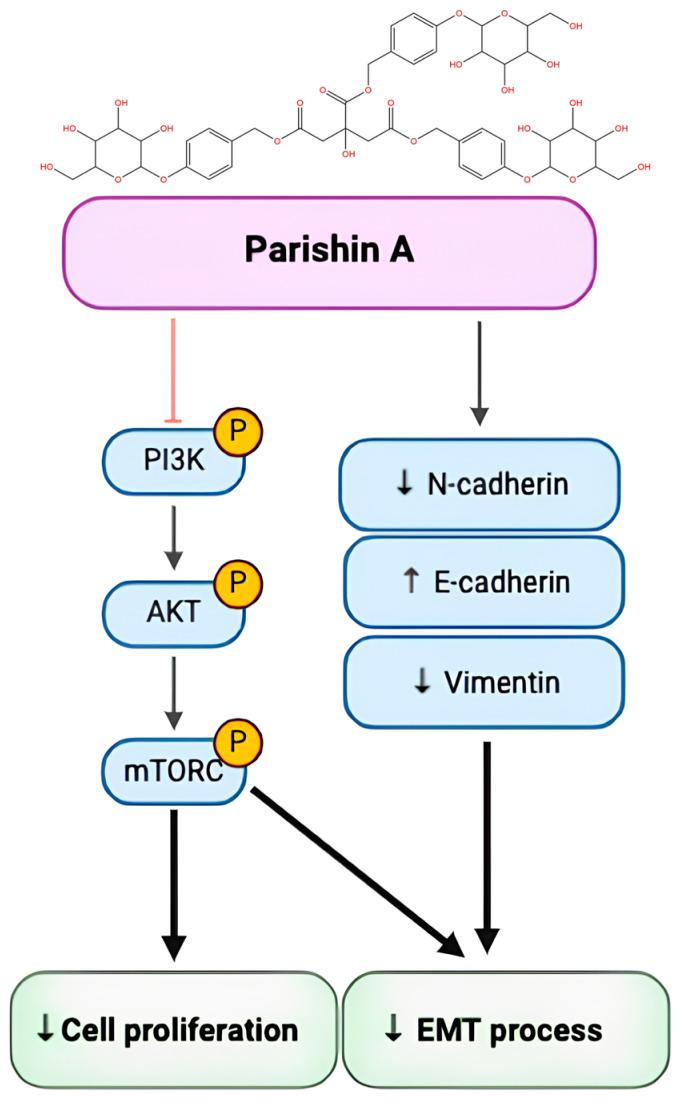
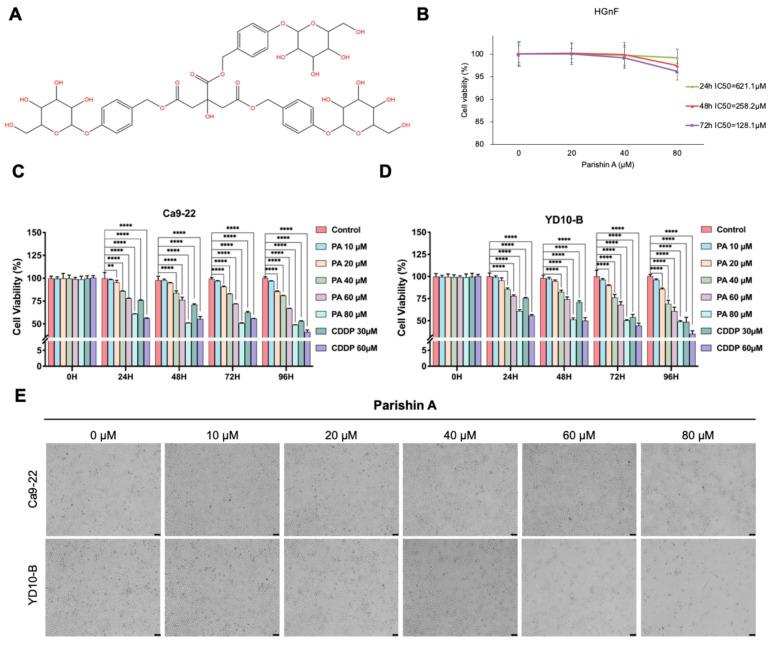
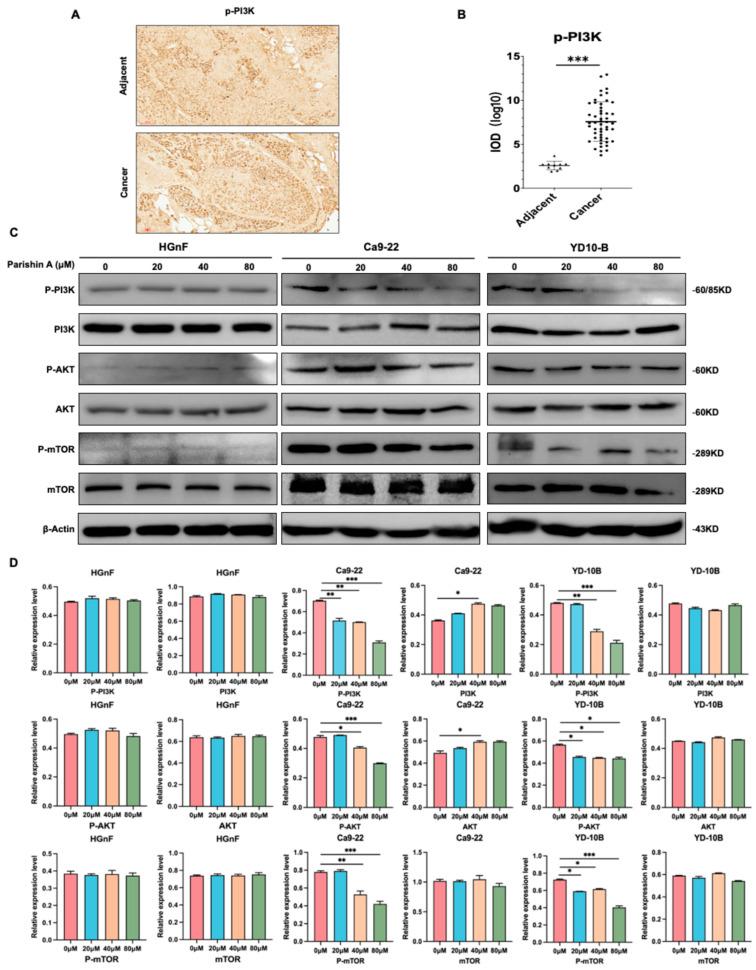
Parishin A inhibited OSCC cell viability in both dose- and time-dependent manners, with significant reductions at 20, 40, 60, and 80 μM, without affecting normal human gingival fibroblasts. Colony formation decreased substantially at ≥40 μM higher Parishin A concentrations in a dose-dependent manner. Also, migration and invasion assays showed significant suppression by Parishin A treatment concentration ≥40 μM in a dose-dependent manner, as evidenced by decreased wound closure and invasion. Western blot analyses revealed increased E-cadherin levels and decreased N-cadherin and vimentin levels, suggesting EMT inhibition. Parishin A also decreased the phosphorylation levels of PI3K, AKT, and mTOR.
CONCLUSION
Collectively, these findings support the potential of Parishin A as an anti-OSCC agent.
背景
口腔鳞状细胞癌(OSCC)是一种侵袭性癌症,治疗选择有限。Parishin A是一种从……中提取的天然化合物,具有多种治疗特性。然而,其对OSCC的影响尚未得到探索。
目的
本研究探讨Parishin A对OSCC的抗癌潜力及其机制。
方法
用不同浓度的Parishin A处理OSCC细胞系YD - 10B和Ca9 - 22。使用CCK - 8法检测细胞活力,并在琼脂糖凝胶中评估集落形成。通过伤口愈合和基质胶侵袭试验评估迁移和侵袭能力。通过蛋白质印迹法检测PI3K/AKT/mTOR信号通路和上皮 - 间质转化(EMT)标志物相关的蛋白质表达水平。
结果
Parishin A以剂量和时间依赖性方式抑制OSCC细胞活力,在20、40、60和80 μM时显著降低,且不影响正常人牙龈成纤维细胞。在Parishin A浓度≥40 μM时,集落形成以剂量依赖性方式显著减少。此外,迁移和侵袭试验表明,Parishin A处理浓度≥40 μM时以剂量依赖性方式显著抑制,伤口闭合和侵袭减少证明了这一点。蛋白质印迹分析显示E - cadherin水平升高,N - cadherin和波形蛋白水平降低,表明EMT受到抑制。Parishin A还降低了PI3K、AKT和mTOR的磷酸化水平。
结论
总体而言,这些发现支持Parishin A作为一种抗OSCC药物的潜力。


 Zotero 插件