
高原地区肺血管疾病患者的心率变异性:一项随机试验。
Heart rate variability in pulmonary vascular disease at altitude: a randomised trial.
作者信息
Herzig Joël J, Ulrich Silvia, Schneider Simon R, Müller Julian, Lichtblau Mona, Ulrich Tanja L, Bauer Meret, Furian Michael, Bloch Konrad E, Mayer Laura, Schwarz Esther I
机构信息
Department of Pulmonology, University Hospital Zurich (USZ), Zurich, Switzerland.
University of Zurich, Zurich, Switzerland.
出版信息
ERJ Open Res. 2024 Oct 28;10(5). doi: 10.1183/23120541.00235-2024. eCollection 2024 Sep.
BACKGROUND
Hypoxia is a trigger for sympathetic activation and autonomic cardiovascular dysfunction. Pulmonary vascular disease (PVD) is associated with hypoxaemia, which increases with altitude. The aim was to investigate how exposure of patients with PVD to hypobaric hypoxia at altitude affects autonomic cardiovascular regulation.
METHODS
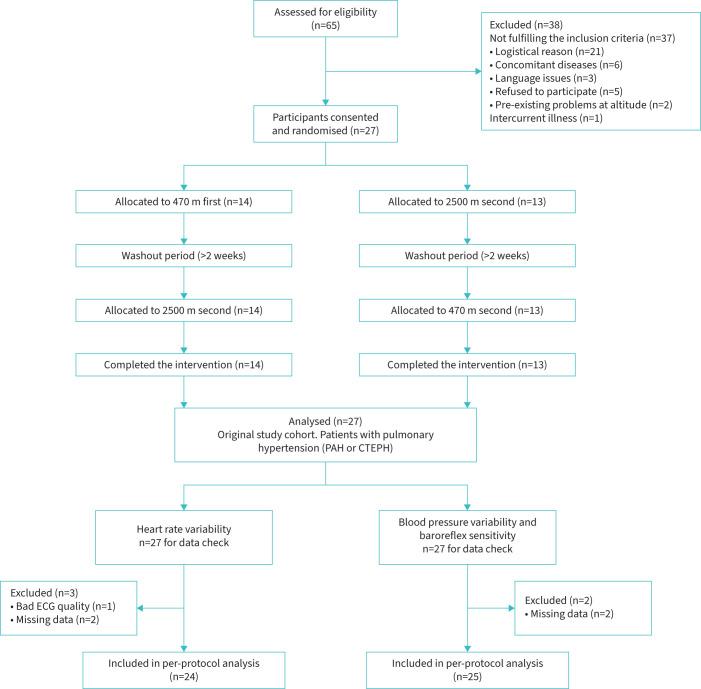
In a randomised crossover study, patients with PVD were studied for 1 day and one night at an altitude of 2500 m (hypobaric hypoxia) and low altitude at 470 m in a random order. Outcomes were heart rate variability (HRV) in the time domain and in the frequency domain (low frequency (LF)/high frequency (HF) and LF/HF) and heart rate (HR) during day and night and baroreflex sensitivity (BRS).
RESULTS
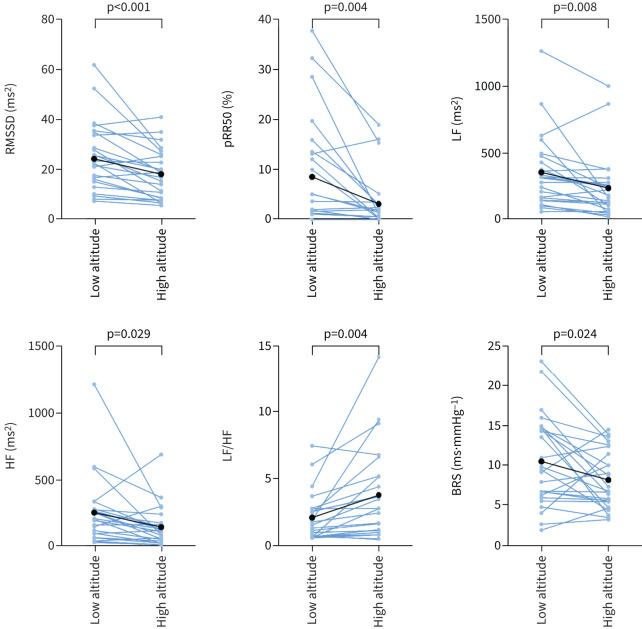
In 25 patients with PVD (72% pulmonary arterial hypertension and 28% distal chronic thromboembolic pulmonary hypertension; mean±sd age 60.7±13.6 years), exposure to altitude resulted in significant increases in awake HR by 9.4 bpm (95% confidence interval (CI) 6.3-12.4, p<0.001) and nocturnal HR by 9.0 bpm (95% CI 6.6-11.4, p<0.001) and significant changes in awake and particularly nocturnal HRV indicating decreasing parasympathetic and increasing sympathetic activity (change in daytime LF/HF 1.7 (95% CI 0.6-2.8), p=0.004; nocturnal LF/HF 1.9 (95% CI 0.3-3.4), p=0.022) and a significant decrease in BRS (-2.4·mmHg (95% CI -4.3- -0.4, p=0.024)).
CONCLUSION
Exposure of PVD patients to altitude resulted in a significant change in HRV indicating an increase in sympathetic activity and a decrease in BRS. The relative change in HRV at altitude was more pronounced during sleep.
背景
缺氧是交感神经激活和自主心血管功能障碍的触发因素。肺血管疾病(PVD)与低氧血症相关,低氧血症会随着海拔升高而增加。目的是研究海拔高度下PVD患者暴露于低压缺氧环境如何影响自主心血管调节。
方法
在一项随机交叉研究中,PVD患者以随机顺序在海拔2500米(低压缺氧)和470米的低海拔地区各研究1天1夜。观察指标包括白天和夜间的时域和频域心率变异性(HRV)(低频(LF)/高频(HF)和LF/HF)、心率(HR)以及压力反射敏感性(BRS)。
结果
25例PVD患者(72%为肺动脉高压,28%为远端慢性血栓栓塞性肺动脉高压;平均年龄±标准差60.7±13.6岁),暴露于高海拔环境导致清醒时HR显著增加9.4次/分钟(95%置信区间(CI)6.3 - 12.4,p<0.001),夜间HR增加9.0次/分钟(95%CI 6.6 - 11.4,p<0.001),清醒和尤其是夜间HRV有显著变化,表明副交感神经活动减少,交感神经活动增加(白天LF/HF变化1.7(95%CI 0.6 - 2.8),p = 0.004;夜间LF/HF 1.9(95%CI 0.3 - 3.4),p = 0.022),BRS显著降低(-2.4·mmHg(95%CI -4.3 - -0.4,p = 0.024))。
结论
PVD患者暴露于高海拔环境导致HRV显著变化,表明交感神经活动增加,BRS降低。海拔高度下HRV的相对变化在睡眠期间更为明显。

 Zotero 插件