
具有功能测定的存活脓毒症患者表现出活跃的免疫反应。
Surviving septic patients endotyped with a functional assay demonstrate active immune responses.
机构信息
Department of Surgery, University of Cincinnati College of Medicine, Cincinnati, OH, United States.
Sepsis and Critical Illness Research Center, Department of Surgery, University of Florida College of Medicine, Gainesville, FL, United States.
出版信息
Front Immunol. 2024 Oct 14;15:1418613. doi: 10.3389/fimmu.2024.1418613. eCollection 2024.
INTRODUCTION
Sepsis is a complex clinical syndrome characterized by a heterogenous host immune response. Historically, static protein and transcriptomic metrics have been employed to describe the underlying biology. Here, we tested the hypothesis that functional TNF expression as well as an immunologic endotype based on both IFNγ and TNF expression could be used to model clinical outcomes in sepsis patients.
METHODS
This prospective, observational study of patient samples collected from the SPIES consortium included patients at five health systems enrolled over 17 months, with 46 healthy control patients, 68 ICU patients without sepsis, and 107 ICU patients with sepsis. Whole blood was collected on day 1, 4, and 7 of ICU admission. Outcomes included in-hospital and 180-day mortality and non-favorable discharge disposition defined by skilled nursing facility, long-term acute care facility, or hospice. Whole blood ELISpot assays were conducted to quantify TNF expression [stimulated by lipopolysaccharide (LPS)] and IFNγ expression (stimulated by anti-CD3/CD28 mAb), which were then used for assignment to one of four subgroups including an 'immunocompetent', 'immunosuppressed endotype', and two 'mixed' endotypes.
RESULTS
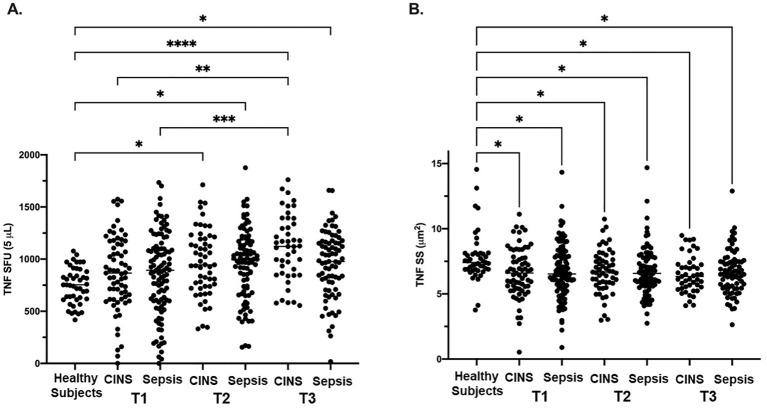
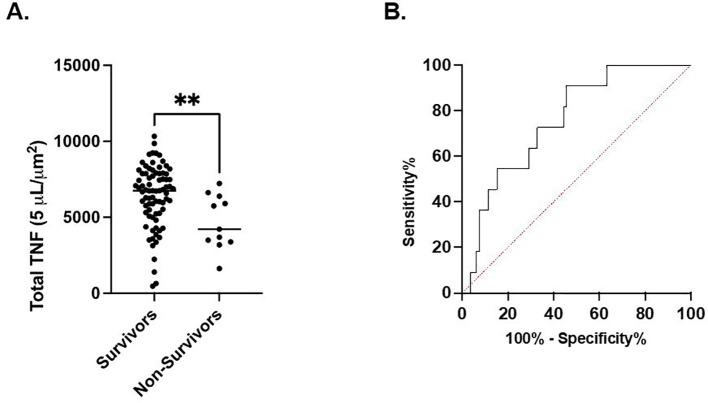
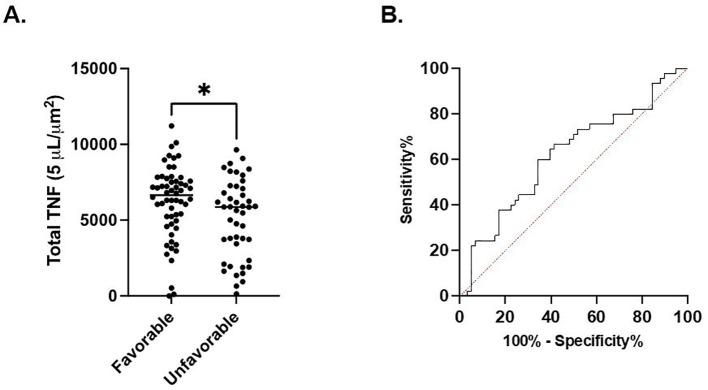
Whole blood TNF spot-forming units were significantly increased in septic and CINS patients on days 4 and 7 compared to healthy subjects. In contrast, TNF expression per cell on days 1, 4, and 7 was significantly lower in both septic and critically ill non-septic (CINS) patients compared to healthy subjects. Early increases in total TNF expression were associated with favorable discharge disposition and lower in-hospital mortality. 'Immunocompetent' endotype patients on day 1 had a higher proportion of favorable to non-favorable discharges compared to the 'immunosuppressed' endotype. Similarly, 'immunocompetent' endotype patients on day 4 had a higher in-hospital survival compared to the 'immunosuppressed' endotype patients. Finally, among septic patients, decreased total TNF and IFNγ expression were associated with 180-day mortality.
CONCLUSIONS
Increased whole blood TNF expression is associated with improved clinical outcomes. Further, the early 'immunocompetent' endotype is associated with favorable discharge and improved in-hospital and 180-day survival. The ability to functionally stratify septic patients based on blood cell function may allow for identification of future immune modulating therapies.
简介
败血症是一种复杂的临床综合征,其特征为宿主免疫反应的异质性。在历史上,静态蛋白质和转录组学指标一直被用于描述潜在生物学。在这里,我们测试了以下假设:功能性 TNF 表达以及基于 IFNγ 和 TNF 表达的免疫表型可以用于模拟败血症患者的临床结局。
方法
这项前瞻性、观察性研究纳入了 SPIES 联盟收集的患者样本,这些患者来自五个医疗系统,在 17 个月内入组,包括 46 名健康对照患者、68 名无败血症的 ICU 患者和 107 名败血症的 ICU 患者。在 ICU 入院第 1、4 和 7 天采集全血。结局包括院内和 180 天死亡率以及通过熟练护理设施、长期急性护理设施或临终关怀定义的非有利出院处置。进行全血 ELISpot 检测以量化 TNF 表达(由脂多糖(LPS)刺激)和 IFNγ 表达(由抗 CD3/CD28 mAb 刺激),然后根据其中之一将其分配到四个亚组之一,包括“免疫功能正常”、“免疫抑制表型”和两个“混合”表型。
结果
与健康受试者相比,在败血症和 CINS 患者中,第 4 天和第 7 天的全血 TNF 斑点形成单位明显增加。相比之下,在败血症和危重症非败血症(CINS)患者中,第 1、4 和 7 天的 TNF 表达细胞数均显著低于健康受试者。早期总 TNF 表达的增加与有利的出院处置相关,并且院内死亡率较低。与“免疫抑制”表型相比,第 1 天“免疫功能正常”表型患者的有利到非有利出院比例更高。同样,与“免疫抑制”表型患者相比,第 4 天“免疫功能正常”表型患者的院内生存率更高。最后,在败血症患者中,总 TNF 和 IFNγ 表达减少与 180 天死亡率相关。
结论
全血 TNF 表达增加与改善的临床结局相关。此外,早期的“免疫功能正常”表型与有利的出院和改善的院内和 180 天生存率相关。基于血细胞功能对败血症患者进行功能分层的能力可能有助于确定未来的免疫调节治疗方法。

 Zotero 插件