
炎症负担指数是接受根治性治疗的食管癌患者的独立预后因素。
Inflammatory Burden Index Is an Independent Prognostic Factor for Esophageal Cancer Patients Who Receive Curative Treatment.
机构信息
Department of Surgery, Yokohama City University, Yokohama, Japan
Department of Surgery, Yokohama City University, Yokohama, Japan.
出版信息
In Vivo. 2024 Nov-Dec;38(6):2928-2934. doi: 10.21873/invivo.13775.
BACKGROUND/AIM: We hypothesized that the inflammatory burden index (IBI) is a promising biomarker for esophageal cancer (EC) treatment and management. To confirm our hypothesis, we evaluated the prognostic impact of IBI in patients with EC who received curative treatment.
PATIENTS AND METHODS
We conducted a retrospective review of medical records and collected data from consecutive patients with EC who underwent curative resection at Yokohama City University between 2005 and 2020. The IBI score was calculated as the C-reactive protein level multiplied by the neutrophil-to-lymphocyte ratio.
RESULTS
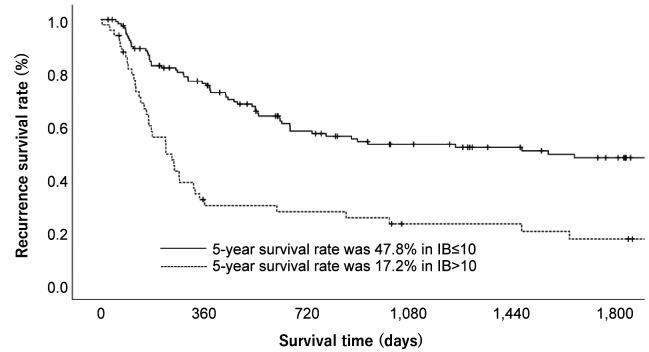
In total, 180 patients with EC were included in this study. The 3- and 5-year overall survival (OS) rates were 72.9% and 63.4%, respectively, in the IBI-low group, and 38.2% and 32.5% in the IBI-high group (p<0.001). In the multivariate analysis, IBI was identified as a significant prognostic factor for OS [hazard ratio (HR)=2.372; 95% confidence interval CI=1.478-3.806, p<0.001]. In addition, the 3- and 5-year recurrence-free survival (RFS) rates were 52.9% and 47.8%, respectively, in the IBI-low group, and 22.9% and 17.2% in the IBI-high group (p<0.001). In the multivariate analysis, IBI was identified as a significant prognostic factor for RFS (HR=2.484; 95%CI=1.373-4.494, p<0.001). When comparing the recurrence patterns between the IBI-high and IBI-low groups, there were significant differences in lymph node recurrence (46.0% vs. 26.2%, p=0.010) and hematological recurrence (52.0% vs. 18.5%, p<0.001).
CONCLUSION
IBI affects both the short- and long-term oncological outcomes. Thus, IBI may be a promising prognostic factor for the treatment and management of EC.
背景/目的:我们假设炎症负担指数(IBI)是一种有前途的食管癌(EC)治疗和管理的生物标志物。为了证实我们的假设,我们评估了接受根治性治疗的 EC 患者的 IBI 的预后影响。
患者和方法
我们对病历进行了回顾性审查,并从 2005 年至 2020 年在横滨市立大学接受根治性切除术的连续 EC 患者中收集数据。IBI 评分的计算方法是将 C 反应蛋白水平乘以中性粒细胞与淋巴细胞比值。
结果
总共纳入了 180 名 EC 患者。IBI 低组的 3 年和 5 年总生存率(OS)分别为 72.9%和 63.4%,而 IBI 高组分别为 38.2%和 32.5%(p<0.001)。在多变量分析中,IBI 被确定为 OS 的显著预后因素[风险比(HR)=2.372;95%置信区间(CI)=1.478-3.806,p<0.001]。此外,IBI 低组的 3 年和 5 年无复发生存率(RFS)分别为 52.9%和 47.8%,而 IBI 高组分别为 22.9%和 17.2%(p<0.001)。在多变量分析中,IBI 被确定为 RFS 的显著预后因素(HR=2.484;95%CI=1.373-4.494,p<0.001)。比较 IBI 高组和 IBI 低组的复发模式时,淋巴结复发(46.0% vs. 26.2%,p=0.010)和血液学复发(52.0% vs. 18.5%,p<0.001)有显著差异。
结论
IBI 影响 EC 的短期和长期肿瘤学结局。因此,IBI 可能是 EC 治疗和管理的有前途的预后因素。

 Zotero 插件