
髓鞘形成中的分子马达及其在疾病中的调控异常
Molecular Motors in Myelination and Their Misregulation in Disease.
作者信息
Barbosa Daniel José, Carvalho Cátia, Costa Inês, Silva Renata
机构信息
i3S - Instituto de Investigação e Inovação em Saúde, Universidade do Porto, 4200-135, Porto, Portugal.
Associate Laboratory i4HB - Institute for Health and Bioeconomy, University Institute of Health Sciences - CESPU, 4585-116, Gandra, Portugal.
出版信息
Mol Neurobiol. 2025 Apr;62(4):4705-4723. doi: 10.1007/s12035-024-04576-9. Epub 2024 Oct 31.
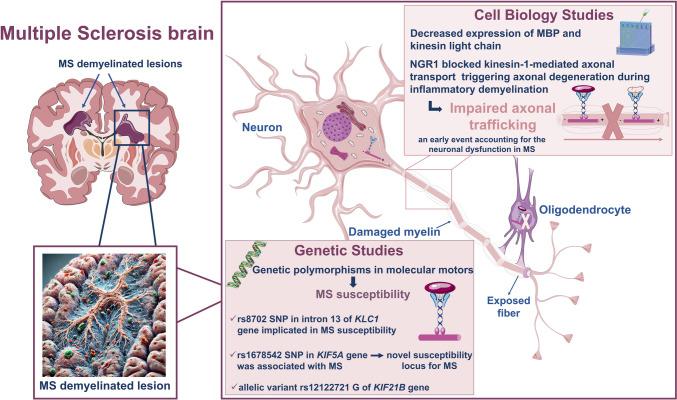
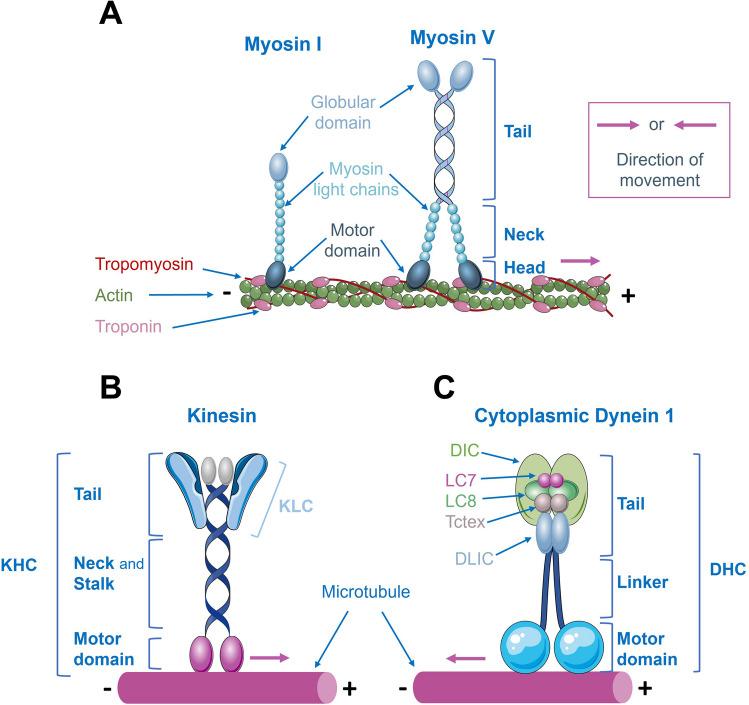
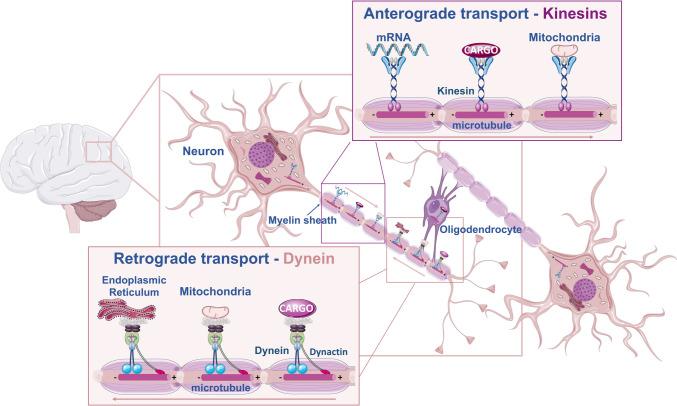
Molecular motors are cellular components involved in the intracellular transport of organelles and materials to ensure cell homeostasis. This is particularly relevant in neurons, where the synaptic components synthesized in the soma need to travel over long distances to their destination. They can walk on microtubules (kinesins and dyneins) or actin filaments (myosins), the major components of cell cytoskeleton. While kinesins mostly perform the anterograde transport of intracellular components toward the plus ends of microtubules located distally in cell processes, cytoplasmic dyneins allow the retrograde flux of intracellular cargo toward the minus ends of microtubules located at the cell soma. Axon myelination represents a major aspect of neuronal maturation and is essential for neuronal function, as it speeds up the transmission of electrical signals. Increasing evidence supports a role for molecular motors in the homeostatic control of myelination. This role includes the trafficking of myelin components along the processes of myelinating cells and local regulation of pathways that ensure axon wrapping. Dysfunctional control of the intracellular transport machinery has therefore been linked to several brain pathologies, including demyelinating diseases. These disorders include a broad spectrum of conditions characterized by pathological demyelination of axons within the nervous system, ultimately leading to axonal degeneration and neuronal death, with multiple sclerosis representing the most prevalent and studied condition. This review highlights the involvement of molecular motors in the homeostatic control of myelination. It also discusses studies that have yielded insights into the dysfunctional activity of molecular motors in the pathophysiology of multiple sclerosis.
分子马达是参与细胞器和物质细胞内运输以确保细胞内稳态的细胞成分。这在神经元中尤为重要,因为在胞体中合成的突触成分需要长距离运输到其目的地。它们可以在微管(驱动蛋白和动力蛋白)或肌动蛋白丝(肌球蛋白)上行走,而微管和肌动蛋白丝是细胞骨架的主要成分。驱动蛋白大多将细胞内成分向位于细胞突起远端的微管正端进行顺行运输,而胞质动力蛋白则使细胞内货物向位于细胞胞体的微管负端逆行运输。轴突髓鞘形成是神经元成熟的一个主要方面,对神经元功能至关重要,因为它能加速电信号的传递。越来越多的证据支持分子马达在髓鞘形成的稳态控制中发挥作用。这一作用包括髓鞘成分沿髓鞘形成细胞的突起运输以及确保轴突包裹的信号通路的局部调节。因此,细胞内运输机制的功能失调与包括脱髓鞘疾病在内的几种脑部疾病有关。这些疾病包括一系列以神经系统内轴突病理性脱髓鞘为特征的病症,最终导致轴突退化和神经元死亡,其中多发性硬化是最常见且研究最多的病症。本综述强调了分子马达在髓鞘形成稳态控制中的作用。它还讨论了一些对分子马达在多发性硬化病理生理学中功能失调活动有深入了解的研究。
 Zotero 插件