
现代磁共振成像时代,局限期小细胞肺癌的预防性颅脑照射或可省略:一项倾向评分匹配分析
Prophylactic cranial irradiation for limited-stage small-cell lung cancer in the modern magnetic resonance imaging era may be omitted: a propensity score-matched analysis.
作者信息
Ito Kei, Nakajima Yujiro, Minakami Shota, Machitori Yumiko, Hosomi Yukio, Hashimoto Kana, Saito Makoto, Murofushi Keiko Nemoto
机构信息
Division of Radiation Oncology, Department of Radiology, Tokyo Metropolitan Cancer and Infectious Diseases Center, Komagome Hospital, 3-18-22 Honkomagome, Bunkyo-ku, Tokyo 113-8677, Japan.
Department of Radiological Sciences, Komazawa University, 1-23-1 Komazawa, Setagaya-ku, Tokyo 154-8525, Japan.
出版信息
J Radiat Res. 2024 Dec 3;65(6):805-812. doi: 10.1093/jrr/rrae087.
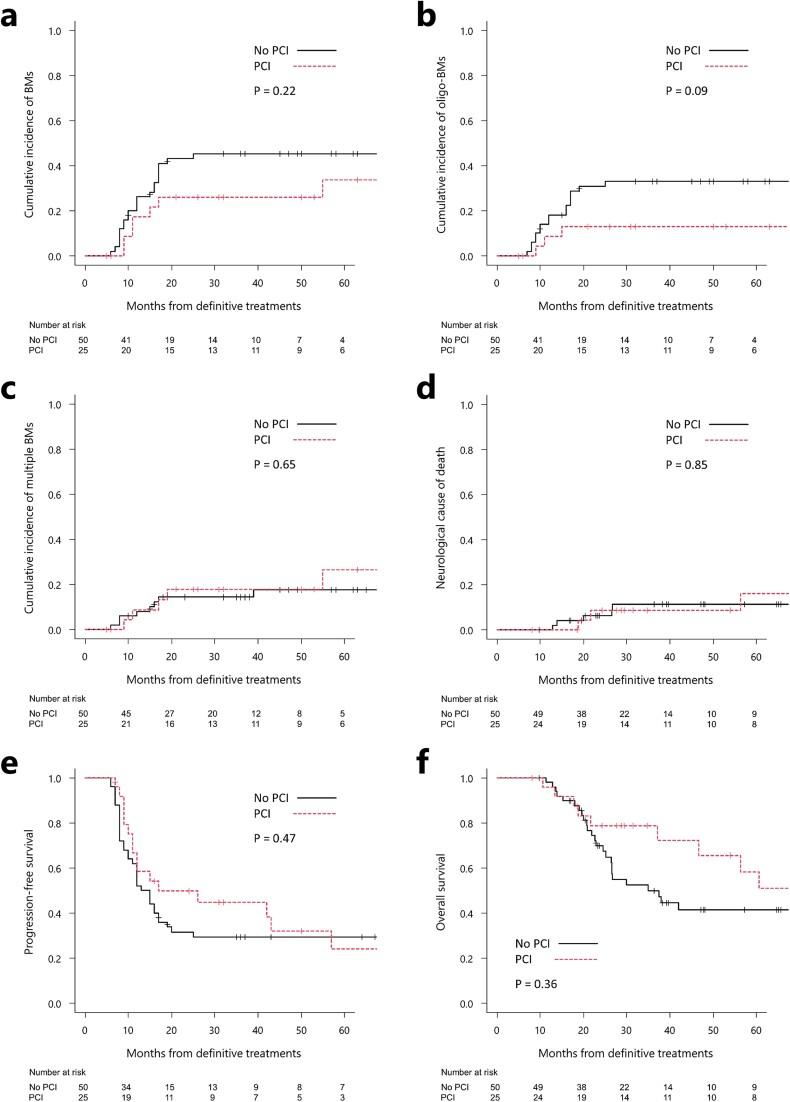
We aimed to clarify whether prophylactic cranial irradiation (PCI) is associated with improved outcomes in limited-stage small-cell lung cancer (LS-SCLC) in the current era of magnetic resonance imaging (MRI). Data from patients with LS-SCLC who achieved a complete response to definitive chemoradiotherapy (CRT) at two medical centers were retrospectively reviewed. Propensity score-matching was performed in a 2:1 ratio to balance the baseline characteristics of the no-PCI and PCI groups. The endpoints were the incidence of brain metastasis (BM), neurological causes of death and overall survival (OS). Overall, 80% patients underwent head MRI during the initial staging and 75 patients (no-PCI, n = 50; PCI, n = 25) were matched. Their baseline characteristics were generally well-balanced except for age; patients in the no-PCI group tended to be older. The median follow-up period was 29 months. Although the incidence of BMs tended to be higher in the no-PCI group (1-year BM occurrence: 26% vs 17%, P = 0.22), the incidence of multiple BMs (defined as >4 metastases) was similar between groups (1-year multiple BMs occurrence: 8% vs 9%, P = 0.65). The 2-year neurological causes of death and OS rate did not significantly differ between the groups (6% and 9%; P = 0.85; and 70% and 79%; P = 0.36, respectively). The 1-year occurrence of multiple BMs did not increase, even without PCI, when modern imaging modalities were integrated into the initial diagnosis, suggesting that PCI could be omitted after CRT, if MRI was incorporated into the initial diagnosis and follow-up.
我们旨在明确在当前磁共振成像(MRI)时代,预防性颅脑照射(PCI)是否与局限期小细胞肺癌(LS-SCLC)患者预后改善相关。对两家医疗中心接受根治性放化疗(CRT)后达到完全缓解的LS-SCLC患者的数据进行回顾性分析。按2:1的比例进行倾向评分匹配,以平衡未接受PCI组和PCI组的基线特征。终点指标为脑转移(BM)发生率、神经原因导致的死亡以及总生存期(OS)。总体而言,80%的患者在初始分期时接受了头部MRI检查,共匹配了75例患者(未接受PCI组,n = 50;PCI组,n = 25)。除年龄外,两组的基线特征总体平衡;未接受PCI组的患者年龄偏大。中位随访期为29个月。虽然未接受PCI组的BM发生率有更高的趋势(1年BM发生率:26% 对17%,P = 0.22),但两组间多发BM(定义为转移灶>4个)的发生率相似(1年多发BM发生率:8% 对9%,P = 0.65)。两组间2年神经原因导致的死亡率和OS率无显著差异(分别为6%和9%;P = 0.85;以及70%和79%;P = 0.36)。当将现代成像方式纳入初始诊断时,即使不进行PCI,1年多发BM的发生率也未增加,这表明如果在初始诊断和随访中纳入MRI,CRT后可省略PCI。
 Zotero 插件