
由生物衍生热塑性聚氨酯和聚乳酸制成的机械坚固且可生物降解的电纺膜。
Mechanically Robust and Biodegradable Electrospun Membranes Made from Bioderived Thermoplastic Polyurethane and Polylactic Acid.
作者信息
Chambers Robert J, Rajput Bhausaheb S, Scofield Gordon B, Reindel Jaysen, O'Shea Katherine, Li Richey Jiang, Simkovsky Ryan, Mayfield Stephen P, Burkart Michael D, Cai Shengqiang
机构信息
Material Science and Engineering Department, University of California, San Diego, La Jolla, California 92093, United States.
Department of Chemistry and Biochemistry, University of California, San Diego, La Jolla, California 92093, United States.
出版信息
ACS Appl Polym Mater. 2024 Oct 16;6(20):12528-12537. doi: 10.1021/acsapm.4c01974. eCollection 2024 Oct 25.
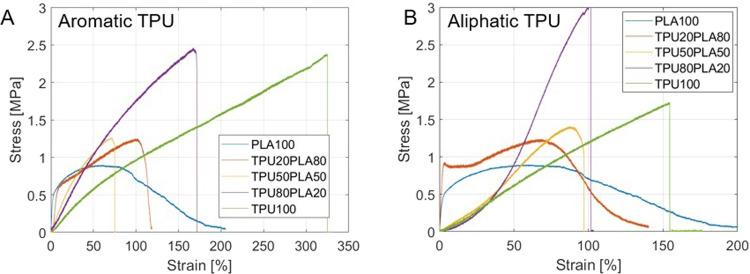
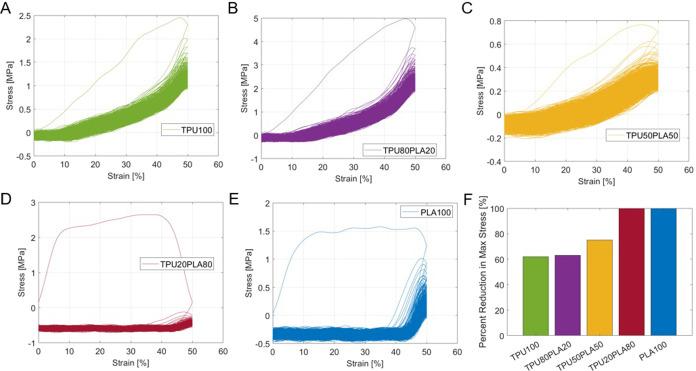
Petroleum-based plastic waste plagues the natural environment, but plastics solve many high-performance solutions across industries. For example, porous polymer membranes are used for air filtration, advanced textiles, energy, and biomedical applications. Sustainable and biodegradable Bioplastic membranes can compete with nonrenewable materials in strength, durability, and functionality but biodegrade under select conditions after disposal. Membranes electrospun using a blend of bioderived thermoplastic polyurethane (TPU) and polylactic acid (PLA) perform effectively under tensile and cyclic loading, act adequately as an air filter media, and biodegrade in a home-compost environment, with the aliphatic formulation of TPU showing greater biodegradability compared to the formulation containing aromatic moieties. Blending TPU with PLA dramatically increases the strain at break of the PLA membrane, while the addition of PLA in TPU stiffens the material considerably. Measurements of the pressure drop and filtration efficiency deem this electrospun membrane an effective air filter. This membrane provides a solution to the need for quality air filtration while decreasing the dependence on petroleum feedstocks and addressing the issue of plastic disposal through biodegradation.
石油基塑料垃圾给自然环境带来了困扰,但塑料在各个行业中解决了许多高性能问题。例如,多孔聚合物膜用于空气过滤、先进纺织品、能源和生物医学应用。可持续且可生物降解的生物塑料膜在强度、耐用性和功能性方面可与不可再生材料相媲美,但在处置后会在特定条件下生物降解。使用生物衍生的热塑性聚氨酯(TPU)和聚乳酸(PLA)的混合物进行电纺丝制成的膜在拉伸和循环加载下能有效发挥作用,可充分用作空气过滤介质,并在家庭堆肥环境中生物降解,与含有芳香族部分的配方相比,TPU的脂肪族配方显示出更高的生物降解性。将TPU与PLA混合可显著提高PLA膜的断裂应变,而在TPU中添加PLA会使材料显著变硬。对压降和过滤效率的测量表明这种电纺膜是一种有效的空气过滤器。这种膜在满足优质空气过滤需求的同时,减少了对石油原料的依赖,并通过生物降解解决了塑料处置问题。




 Zotero 插件