
在接受异基因造血干细胞移植前,将博纳吐单抗作为最后巩固治疗的B细胞急性淋巴细胞白血病儿童和青年患者的治疗结果。
Outcomes of children and young adults with B-cell acute lymphoblastic leukemia given blinatumomab as last consolidation treatment before allogeneic hematopoietic stem cell transplantation.
作者信息
Algeri Mattia, Massa Michele, Pagliara Daria, Bertaina Valentina, Galaverna Federica, Pili Ilaria, Li Pira Giuseppina, Carta Roberto, Quagliarella Francesco, Pinto Rita M, Rosignoli Chiara, Lucarelli Barbarella, Cefalo Maria G, Boccieri Emilia, Benini Francesca, Del Bufalo Francesca, Becilli Marco, Merli Pietro, Zugmaier Gerhard, Locatelli Franco
机构信息
Department of Pediatric Hematology/Oncology and Cell and Gene Therapy, IRCCS Bambino Gesu Children's Hospital; Department of Health Sciences, Magna Graecia University, Catanzaro.
Department of Pediatric Hematology/Oncology and Cell and Gene Therapy, IRCCS Bambino Gesu Children's Hospital; Department of Maternal and Child Health, Sapienza University of Rome.
出版信息
Haematologica. 2025 Mar 1;110(3):596-607. doi: 10.3324/haematol.2024.286350.
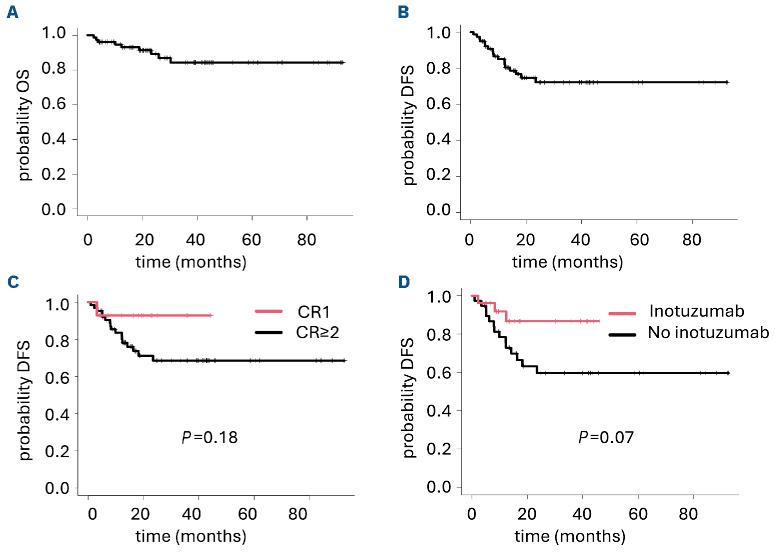
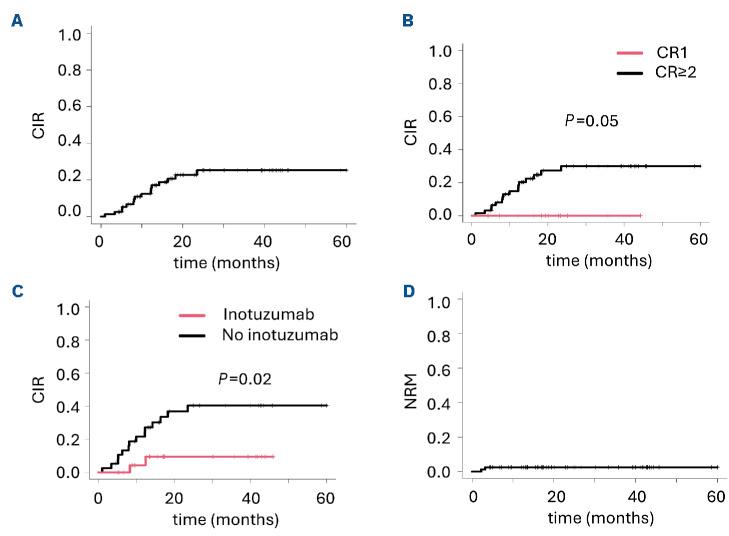
Blinatumomab has remarkable efficacy in patients with relapsed/refractory (r/r) or measurable residual disease (MRD)-positive B-cell acute lymphoblastic leukemia (B-ALL). In many patients, blinatumomab treatment is followed by allogeneic hematopoietic stem cell transplantation (HSCT). However, the influence of blinatumomab on HSCT outcomes in children and young adults (YA) remains to be fully elucidated. We conducted a single-center, retrospective analysis of patients given blinatumomab as last treatment before HSCT. Seventy-eight pediatric and YA patients were evaluated. With a median follow- up of 23.23 months, the 2-year disease-free (DFS) and overall survival (OS) probability were 72.2% and 89.2%, respectively, with a 2-year cumulative incidence of non-relapse mortality (NRM) of 2.6%. A trend toward improved 2-year DFS, but not OS, was noted in patients transplanted in first complete remission (CR1) (92.9%) compared to those in second or greater remission (CR2/3) (68.5%; P=0.18) due to a lower cumulative incidence of relapse (0% vs. 29.9%; P=0.05). Among CR2/3 patients, those receiving the sequential combination of inotuzumab and blinatumomab had a significantly lower cumulative incidence of relapse as compared to those who did not receive inotuzumab (9.5% vs. 40.4%; P=0.023). Relapse after HSCT occurred in 16 patients, all exhibiting CD19-positive blasts; ten of them received anti-CD19 chimeric antigen receptor T-cell (CAR T) therapy and two inotuzumab as salvage therapy, leading to a 2-year post-relapse OS of 52.7%. Our results indicate that HSCT following blinatumomab in children and YA with B-ALL is highly effective, being associated with low NRM and not affecting the efficacy of subsequent salvage immunotherapies, including CAR T cells.
博纳吐单抗在复发/难治性(r/r)或微小残留病(MRD)阳性的B细胞急性淋巴细胞白血病(B-ALL)患者中具有显著疗效。在许多患者中,博纳吐单抗治疗后会进行异基因造血干细胞移植(HSCT)。然而,博纳吐单抗对儿童和青年成人(YA)HSCT结果的影响仍有待充分阐明。我们对HSCT前接受博纳吐单抗作为最后治疗的患者进行了单中心回顾性分析。评估了78例儿科和YA患者。中位随访23.23个月,2年无病生存率(DFS)和总生存率(OS)分别为72.2%和89.2%,2年非复发死亡率(NRM)累积发生率为2.6%。与第二次或更高缓解期(CR2/3)(68.5%;P=0.18)的患者相比,首次完全缓解期(CR1)(92.9%)接受移植的患者2年DFS有改善趋势,但OS无改善趋势,这是由于复发累积发生率较低(0%对29.9%;P=0.05)。在CR2/3患者中,接受因诺妥珠单抗和博纳吐单抗序贯联合治疗的患者与未接受因诺妥珠单抗治疗的患者相比,复发累积发生率显著更低(9.5%对40.4%;P=0.023)。16例患者在HSCT后复发,均表现为CD19阳性原始细胞;其中10例接受抗CD19嵌合抗原受体T细胞(CAR T)治疗,2例接受因诺妥珠单抗作为挽救治疗,导致复发后2年OS为52.7%。我们的结果表明,儿童和YA的B-ALL患者在接受博纳吐单抗治疗后进行HSCT非常有效,NRM较低,且不影响包括CAR T细胞在内的后续挽救性免疫治疗的疗效。
 Zotero 插件