
颞叶癫痫中的嗅觉功能障碍和边缘系统活动低下。
Olfactory Dysfunction and Limbic Hypoactivation in Temporal Lobe Epilepsy.
机构信息
Department of Neuroradiology, University Hospital Bonn, Bonn, Germany.
Department of Epileptology, University Hospital Bonn, Bonn, Germany.
出版信息
Hum Brain Mapp. 2024 Nov;45(16):e70061. doi: 10.1002/hbm.70061.
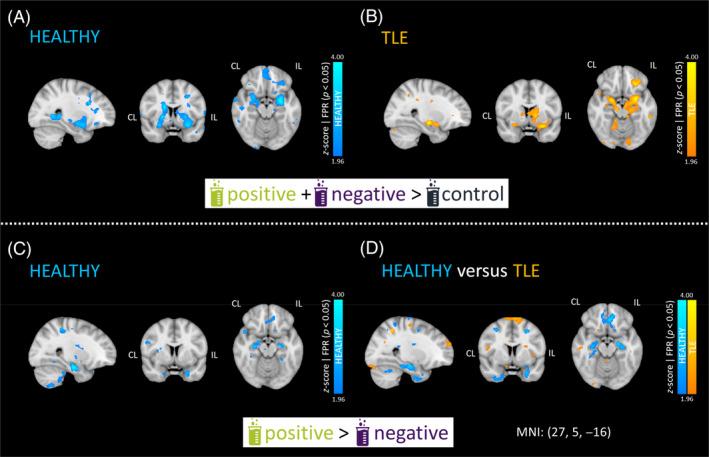
The epileptogenic network in temporal lobe epilepsy (TLE) contains structures of the primary and secondary olfactory cortex such as the piriform and entorhinal cortex, the amygdala, and the hippocampus. Olfactory auras and olfactory dysfunction are relevant symptoms of TLE. This study aims to characterize olfactory function in TLE using olfactory testing and olfactory functional magnetic resonance imaging (fMRI). We prospectively enrolled 20 individuals with unilateral TLE (age 45 ± 20 years [mean ± SD], 65% female, 90% right-handed) and 20 healthy individuals (age 33 ± 15 years [mean ± SD], 35% female, 90% right-handed). In the TLE group, the presumed seizure onset zone was left-sided in 75%; in 45% of the individuals with TLE limbic encephalitis was the presumed etiology; and 15% of the individuals with TLE reported olfactory auras. Olfactory function was assessed with a Screening Sniffin' Sticks Test (Burkhart, Wedel, Germany) during a pre-assessment. During a pre-testing, all individuals were asked to rate the intensity, valence, familiarity, and associated memory of five different odors (eugenol, vanillin, phenethyl alcohol, decanoic acid, valeric acid) and a control solution. During the fMRI experiment, all individuals repeatedly smelled eugenol (positively valenced odor), valeric acid (negatively valenced odor), and the control solution and were asked to rate odor intensity on a five-point Likert scale. We acquired functional EPI sequences and structural images (T1, T2, FLAIR). Compared to healthy individuals, individuals with TLE rated the presented odors as more neutral (two-sided Mann-Whitney U tests, FDR-p < 0.05) and less familiar (two-sided Mann-Whitney U tests, FDR-p < 0.05). fMRI data analysis revealed a reduced response contrast in secondary olfactory areas (e.g., hippocampus) connected to the limbic system when comparing eugenol and valeric acid in individuals with TLE when compared with healthy individuals. However, no lateralization effect was obtained when calculating a lateralization index by the number of activated voxels in the olfactory system (two-sided Mann-Whitney U test; U = 176.0; p = 0.525). TLE is characterized by olfactory dysfunction and associated with hypoactivation of secondary olfactory structures connected to the limbic system. These findings contribute to our understanding of the pathophysiology of TLE. This study was preregistered on OSF Registries (www.osf.io).
颞叶癫痫(TLE)的致痫网络包含初级和次级嗅觉皮层的结构,如梨状皮层和内嗅皮层、杏仁核和海马体。嗅觉先兆和嗅觉障碍是 TLE 的相关症状。本研究旨在使用嗅觉测试和嗅觉功能磁共振成像(fMRI)来描述 TLE 中的嗅觉功能。我们前瞻性地招募了 20 名单侧 TLE 患者(年龄 45±20 岁[平均值±标准差],65%为女性,90%为右利手)和 20 名健康个体(年龄 33±15 岁[平均值±标准差],35%为女性,90%为右利手)。在 TLE 组中,假定的发作起始区位于左侧的占 75%;在 TLE 伴边缘性脑炎的个体中,假定的病因是边缘性脑炎;15%的 TLE 个体报告有嗅觉先兆。在预评估期间使用 Screening Sniffin' Sticks 测试(Burkhart,Wedel,德国)评估嗅觉功能。在预测试期间,所有个体都被要求对五种不同气味(丁香酚、香草醛、苯乙醇、癸酸、缬草酸)和一种对照溶液的强度、效价、熟悉度和相关记忆进行评分。在 fMRI 实验期间,所有个体反复闻到丁香酚(正效价气味)、缬草酸(负效价气味)和对照溶液,并要求他们在五点李克特量表上对气味强度进行评分。我们获得了功能 EPI 序列和结构图像(T1、T2、FLAIR)。与健康个体相比,TLE 个体对呈现的气味的评价更为中性(双侧曼-惠特尼 U 检验,FDR-p<0.05),熟悉度更低(双侧曼-惠特尼 U 检验,FDR-p<0.05)。当比较 TLE 个体与健康个体时,fMRI 数据分析显示,当比较丁香酚和缬草酸时,与边缘系统相连的次级嗅觉区域(如海马体)的反应对比减弱。然而,当通过嗅觉系统中激活体素的数量计算侧化指数时,未获得侧化效应(双侧曼-惠特尼 U 检验;U=176.0;p=0.525)。TLE 的特征是嗅觉功能障碍,并与边缘系统相连的次级嗅觉结构的低激活相关。这些发现有助于我们理解 TLE 的病理生理学。本研究已在 OSF 注册处(www.osf.io)预先注册。

 Zotero 插件