
配对的正常和肿瘤乳腺组织的基因组与表观基因组揭示了不同的进化轨迹和肿瘤-宿主相互作用。
Genomes and epigenomes of matched normal and tumor breast tissue reveal diverse evolutionary trajectories and tumor-host interactions.
作者信息
Zhu Bin, Tapinos Avraam, Koka Hela, Yi Lee Priscilla Ming, Zhang Tongwu, Zhu Wei, Wang Xiaoyu, Klein Alyssa, Lee DongHyuk, Tse Gary M, Tsang Koon-Ho, Wu Cherry, Hua Min, Highfill Chad A, Lenz Petra, Zhou Weiyin, Wang Difei, Luo Wen, Jones Kristine, Hutchinson Amy, Hicks Belynda, Garcia-Closas Montserrat, Chanock Stephen, Tse Lap Ah, Wedge David C, Yang Xiaohong R
机构信息
Division of Cancer Epidemiology and Genetics, National Cancer Institute, National Institutes of Health, Rockville, MD, USA.
Manchester Cancer Research Centre, The University of Manchester, Manchester, UK.
出版信息
Am J Hum Genet. 2024 Dec 5;111(12):2773-2788. doi: 10.1016/j.ajhg.2024.10.005. Epub 2024 Nov 3.
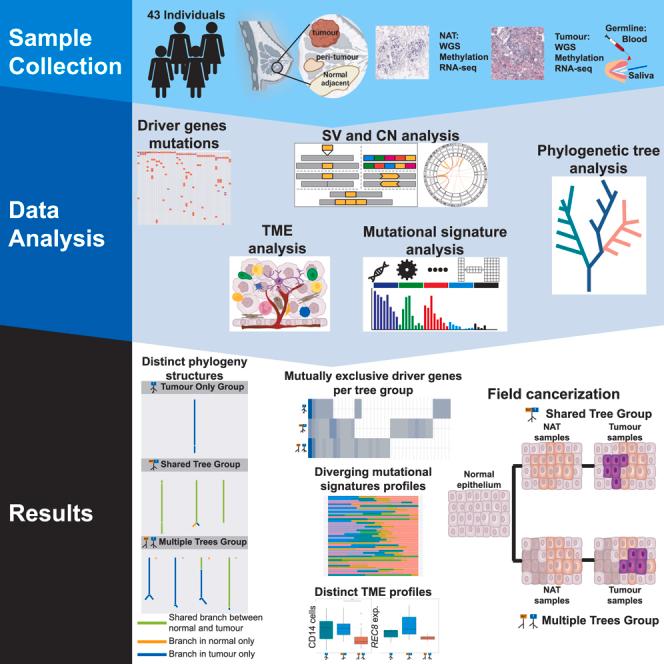
Normal tissues adjacent to the tumor (NATs) may harbor early breast carcinogenesis events driven by field cancerization. Although previous studies have characterized copy-number (CN) and transcriptomic alterations, the evolutionary history of NATs in breast cancer (BC) remains poorly characterized. Utilizing whole-genome sequencing (WGS), methylation profiling, and RNA sequencing (RNA-seq), we analyzed paired germline, NATs, and tumor samples from 43 individuals with BC in Hong Kong (HK). We found that single-nucleotide variants (SNVs) were common in NATs, with one-third of NAT samples exhibiting SNVs in driver genes, many of which were present in paired tumor samples. The most frequently mutated genes in both tumor and NAT samples were PIK3CA, TP53, GATA3, and AKT1. In contrast, large-scale aberrations such as somatic CN alterations (SCNAs) and structural variants (SVs) were rarely detected in NAT samples. We generated phylogenetic trees to investigate the evolutionary history of paired NAT and tumor samples. They could be categorized into tumor only, shared, and multiple-tree groups, the last of which is concordant with non-genetic field cancerization. These groups exhibited distinct genomic and epigenomic characteristics in both NAT and tumor samples. Specifically, NAT samples in the shared-tree group showed higher number of mutations, while NAT samples belonging to the multiple-tree group showed a less inflammatory tumor microenvironment (TME), characterized by a higher proportion of regulatory T cells (Tregs) and lower presence of CD14 cell populations. In summary, our findings highlight the diverse evolutionary history in BC NAT/tumor pairs and the impact of field cancerization and TME in shaping the genomic evolutionary history of tumors.
肿瘤邻近的正常组织(NATs)可能存在由场癌化驱动的早期乳腺癌发生事件。尽管先前的研究已经对拷贝数(CN)和转录组改变进行了表征,但乳腺癌(BC)中NATs的进化历史仍未得到充分表征。利用全基因组测序(WGS)、甲基化分析和RNA测序(RNA-seq),我们分析了来自中国香港(HK)43例BC患者的配对种系、NATs和肿瘤样本。我们发现单核苷酸变异(SNVs)在NATs中很常见,三分之一的NAT样本在驱动基因中表现出SNVs,其中许多也存在于配对的肿瘤样本中。肿瘤和NAT样本中最常突变的基因是PIK3CA、TP53、GATA3和AKT1。相比之下,在NAT样本中很少检测到大规模畸变,如体细胞CN改变(SCNAs)和结构变异(SVs)。我们构建了系统发育树来研究配对的NAT和肿瘤样本的进化历史。它们可分为仅肿瘤、共享和多树组,最后一组与非遗传场癌化一致。这些组在NAT和肿瘤样本中均表现出不同的基因组和表观基因组特征。具体而言,共享树组中的NAT样本显示出更多的突变,而属于多树组的NAT样本显示出炎症性较低的肿瘤微环境(TME),其特征是调节性T细胞(Tregs)比例较高,CD14细胞群体较少。总之,我们的研究结果突出了BC中NAT/肿瘤对的多样进化历史,以及场癌化和TME对塑造肿瘤基因组进化历史的影响。
 Zotero 插件